
Will the Housing Market Crash in 2027? An Honest Ventura County Forecast
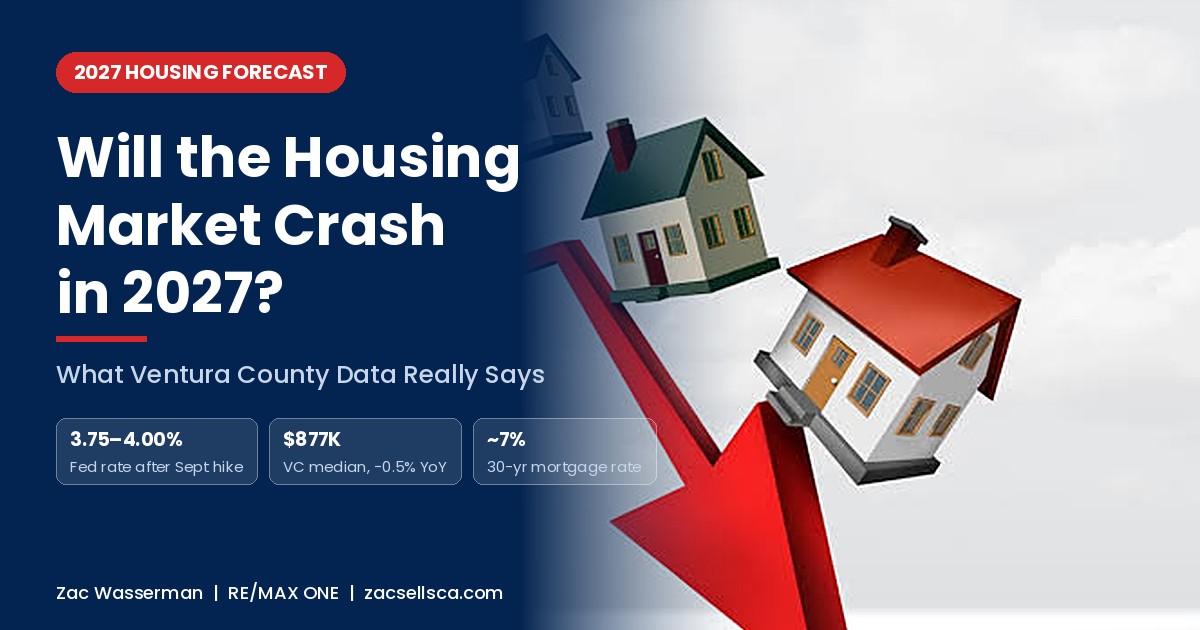
The Federal Reserve just raised interest rates for the first time in more than three years, mortgage rates are hovering around 7%, and the headlines are getting louder. As a result, the question I hear most from Ventura County homeowners and buyers right now is simple: will the housing market crash in 2027? I'm Zac Wasserman, a licensed REALTOR® with RE/MAX ONE, and in this guide I'll walk you through what the national data, the Fed, and our local Ventura County numbers actually say — without the hype in either direction.
Will the Housing Market Crash in 2027? The Short Answer
No, a housing market crash in 2027 is unlikely, both nationally and in Ventura County. However, "no crash" does not mean "no change." The most likely path for 2027 is a flat to slightly rising market, with higher rates keeping price growth in check and tight inventory keeping prices from falling sharply.
In other words, expect a slow, negotiable market rather than a collapse. That distinction matters, because the right move for a buyer or seller in a flat market looks very different from the right move in a crash.
What a Real Housing Crash Looks Like (and Why 2008 Was Different)
First, it helps to define the word. A true crash means sharp, fast, widespread price declines — typically double digits — driven by a flood of homes for sale and a collapse in buyer demand at the same time. For example, during the Great Recession, U.S. home prices fell roughly 26% between 2007 and 2012.
That crash had specific causes. Lenders were approving loans borrowers could not repay, adjustable-rate mortgages reset to payments people could not afford, and millions of forced sales hit the market at once. Consequently, prices spiraled down as foreclosures fed more foreclosures.
Today's market looks fundamentally different. Lending standards have been far stricter since 2010, most homeowners hold fixed-rate mortgages, and many locked in rates well below today's levels. Therefore, the "forced seller" engine that drove 2008 simply isn't running at anything close to that scale.
The Fed's September 2026 Rate Hike: What Changed
On September 16, 2026, the Federal Reserve voted 12–0 to raise its benchmark rate by a quarter point, to a target range of 3.75% to 4.00%. That was the Fed's first increase since July 2023. Additionally, the Fed's updated projections point to one more hike before the end of 2026, and Chair Kevin Warsh made it clear that inflation remains the priority.
Mortgage rates had already moved before the announcement. For instance, the 30-year fixed climbed to about 7.19% on one daily index in the weeks leading up to the meeting, and the 10-year Treasury briefly touched roughly 5%, its highest level since 2007. Meanwhile, Freddie Mac's weekly survey showed the 30-year averaging 6.76% as of September 10, compared with 6.35% a year earlier.
What does that mean for 2027? Higher-for-longer rates reduce buying power, which slows demand and caps price growth. However, higher rates alone rarely cause a crash. Instead, they tend to freeze the market — fewer sales, longer days on market, and more negotiation. Looking ahead, the next Fed meeting on October 27–28 is the one to watch.
Where Ventura County Home Prices Stand Right Now
Next, let's look at our own backyard. According to Redfin's Ventura County housing market data, the county's median sale price was about $877,000 over the three months ending July 2026, down just 0.52% from the same period a year earlier. In addition, homes sold in an average of 45 days, faster than 56 days a year ago, and 593 homes sold in July versus 564 the prior July.
That is not a crashing market. It's a flat market with steady sales. Similarly, my own MLS reviews earlier this year showed the same stability: Q1 2026 closed with a countywide median of $880,000 and a 98.8% sale-to-list ratio, while May 2026 posted a $920,000 median across 545 sales. You can see the most recent monthly numbers in my Ventura County real estate market update for August 2026.
Statewide, the picture is similar. California's median price was about $904,640 in June 2026, up 0.4% year over year, while only about 18% of households could afford a median-priced home. As a result, affordability — not a looming collapse — is the defining challenge heading into 2027. If you want the deeper price breakdown, read my guide on whether home prices are dropping in Ventura County.
5 Reasons a 2027 Housing Market Crash Is Unlikely in Ventura County
So why am I confident a crash isn't coming? Here are the five factors that matter most locally.
1. Supply is structurally limited. Ventura County is boxed in by mountains, the ocean, and farmland, and the voter-approved SOAR ordinances restrict how much open space and agricultural land can be converted for development. Consequently, we cannot build our way into an oversupply problem the way some Sun Belt metros can.
2. Homeowners have deep equity. Many Ventura County owners bought years ago or refinanced into low rates. Therefore, even a homeowner facing hardship can usually sell for a profit rather than lose the home to foreclosure.
3. The rate lock-in effect keeps listings low. Owners with 3% mortgages are reluctant to trade them for 7%. While that frustrates buyers, it also prevents the wave of listings that would be needed to push prices down sharply.
4. Foreclosures are rising, but from a very low base. ATTOM's August 2026 foreclosure report showed U.S. foreclosure filings up 13% year over year and completed foreclosures up 42%. However, total volumes remain well below historical norms — nationally, about one in every 3,569 housing units had a filing. I track local distress closely in my guide to Ventura County foreclosures, and we are nowhere near 2009 levels.
5. Demand from Los Angeles hasn't gone away. Ventura County continues to draw buyers from L.A. who want more space, better value, and a slower pace of life. Additionally, that steady move-in demand supports prices even when local sales slow.
The Real Risks to Watch Heading Into 2027
That said, an honest forecast includes the downside. These are the factors that could push Ventura County from "flat" to "softening."
First, rates could keep climbing. If the Fed hikes again and the 10-year Treasury stays near 5%, 30-year mortgage rates could settle above 7% for most of 2027. In that case, buyer demand would thin further, especially in the $1 million-plus tier.
Second, a recession with real job losses would change the math. Rising unemployment is what turns a slow market into forced selling. So far, that isn't happening at scale, but it's the single biggest variable to monitor.
Third, insurance costs are a genuine local pressure point. The California FAIR Plan rate increase raises carrying costs for many homeowners in fire-prone areas, and that can soften demand for specific neighborhoods even when the broader county holds steady.
Finally, some pricier segments are more rate-sensitive than others. Luxury homes and properties that need significant work tend to feel slowdowns first, while well-priced, move-in-ready homes under the conforming loan limit continue to sell.
Three Realistic Scenarios for Ventura County in 2027
Because no one can predict the future with certainty, I find it more useful to think in scenarios. Here is my read on how 2027 could play out in Ventura County.
Base case — flat to modest growth (most likely). Rates stay in the high-6% to 7% range, inventory stays tight, and prices finish 2027 roughly flat to up about 2%. This lines up with national forecasts; for example, J.P. Morgan Global Research projects home prices flat in 2026 and up about 3% in 2027.
Downside case — a soft correction, not a crash. Rates rise above 7.5% and the economy weakens. In that scenario, prices could slip a few percent, with the luxury tier and homes needing work taking the biggest hits. Even so, a mid-single-digit decline is a correction, not a 2008-style crash.
Upside case — a spring 2027 rebound. Inflation cools, the Fed pauses or reverses course, and rates drift toward 6%. As a result, sidelined buyers return at once, and prices could rise faster than expected because inventory is still thin.
Notably, the California Association of REALTORS® typically releases its annual statewide forecast in the fall. When its 2027 numbers are published, I'll update this post so you have the latest projection.
What Buyers Should Do Now
If you're waiting for a crash before you buy, you may be waiting for something that doesn't arrive. Instead, focus on what you can control:
- Negotiate hard. In a flat market with longer days on market, sellers are more open to price reductions, closing cost credits, and rate buydowns.
- Shop your lender. With rates near 7%, comparing several quotes can save you real money every month.
- Buy the payment, not the headline. Run your numbers at today's rate and treat any future refinance as a bonus, not a plan.
For a deeper look at timing, read my guide on whether you should wait to buy a house. You'll also find why waiting for lower prices can backfire if rates fall and competition returns.
Buying in 2027? Get your real monthly payment before you start touring.
Talk to Zac About Buying Get a Free Home ValuationWhat Sellers Should Do Now
For sellers, the message is equally clear: the market isn't crashing, but it's no longer forgiving. Consequently, pricing correctly from day one matters more than ever. Homes priced off 2022 comps tend to sit, collect price reductions, and ultimately sell for less.
Additionally, preparation pays. Clean, well-presented, move-in-ready homes are still attracting strong offers, while homes with deferred maintenance are where buyers push back hardest. If you're weighing a 2027 sale, start with an accurate number — get a free home valuation based on current Ventura County comps, not last year's.
Selling in 2027? Find out what your home is worth in today's market.
Get a Free Home Valuation Contact ZacWill the Housing Market Crash in 2027? FAQs
Is a housing market crash coming in 2027?
A crash is unlikely. Most major forecasts call for flat to low single-digit price growth in 2027, supported by tight inventory, strict lending standards, and high homeowner equity.
Will home prices go down in Ventura County in 2027?
Prices could dip slightly in some segments, especially luxury homes and homes needing work, but a broad, sharp decline is not expected. Ventura County prices were essentially flat year over year as of mid-2026.
Will mortgage rates go down in 2027?
It depends on inflation. The Fed raised rates in September 2026 and signaled another possible hike, so rates may stay elevated near term. If inflation cools, rates could ease later in 2027.
Should I wait for a crash to buy a home in Ventura County?
Waiting for a crash is risky because one may not come. A better strategy is to buy when the monthly payment fits your budget and use today's slower market to negotiate credits or a rate buydown.
Is now a bad time to sell my house in Ventura County?
Not necessarily. Homes are still selling, but buyers are more selective. Sellers who price accurately and prepare their homes well continue to get solid results.
How is 2027 different from the 2008 housing crash?
In 2008, risky loans and forced sales flooded the market. Today, most owners have fixed-rate loans, significant equity, and stronger lending standards, which makes a similar collapse far less likely.
The Bottom Line on a 2027 Crash
So, is a crash coming next year? Based on the data available today, my honest answer is no — but 2027 is likely to reward buyers and sellers who make decisions based on local numbers rather than national headlines. If you want to see how the 2026 predictions held up, you can revisit last year's housing market crash forecast for 2026.
Ready to make a plan for 2027? Contact Zac Wasserman at RE/MAX ONE — your local Ventura County expert — at 805.212.9147 or ZacSellsCA@gmail.com, or reach out here. Whether you're buying, selling, or simply want to know what your home is worth today, I'll give you straight answers backed by real local data.
Zac Wasserman is a licensed REALTOR® (CA DRE# 02210760) with RE/MAX ONE, serving Ventura County and the San Fernando Valley from 30699 Russell Ranch Rd #100, Westlake Village, CA 91362.
- All Posts
- Buyer Guides
- California Home Insurance & Wildfire Risk
- Home Financing (Mortgage & Loan Guides)
- Market Updates & Forecasts
- Seller Guides
- Back
- Ventura County Real Estate Market Updates
- San Fernando Valley Real Estate Market Updates (Monthly): Prices, Inventory & Trends

Encino Real Estate in 2026: Homes, Prices & Neighborhood Guide Encino Real Estate in 2026: Homes, Prices & Neighborhood Guide...

Sherman Oaks Real Estate in 2026: Homes, Prices & What Buyers Should Know Sherman Oaks Real Estate in 2026: Homes,...
Will the housing market crash in 2027? After the Fed's September hike, see what Ventura County prices, inventory and foreclosures...

Ventura County & Los Angeles Real Estate What the September 2026 Fed Rate Hike Means for Ventura County & LA...

East Los Angeles Real Estate Guide • 2026 Boyle Heights Real Estate Guide 2026: Homes, Prices & What Buyers Should...
Koreatown Real Estate in 2026: Homes, Condos & What Buyers Should Know 2026 Los Angeles Buyer Guide Koreatown Real Estate...