
September 16, 2026/
Explore Port Hueneme investment properties in 2026, from multifamily and NNN opportunities to owner-financed and commercial real estate near the...

2026 loan limits are set, and buyers across the San Fernando Valley, the Westside / LA County, and Ventura County are recalculating what’s “conforming,” what’s “jumbo,” and what’s realistic at today’s payments. This guide breaks down the exact caps (FHA + conforming), how high-cost/high-balance works, and how limits translate into purchase-price ranges—using clear charts and simplified examples. For broader context, see the 2026 Southern California housing market forecast.
“Conforming” means the loan amount is within the maximum that Fannie Mae and Freddie Mac can purchase. Those limits are set annually by the Federal Housing Finance Agency (FHFA). If your loan amount is above the conforming limit for the county, it’s commonly referred to as a jumbo loan. If you’re deciding between lanes, it helps to frame the decision alongside your broader plan and timeline (see: Buyer Resources and the Mortgage Pre-Approval Guide 2026).
With 2026 limits established, many buyers are re-running budgets to see whether they can stay under conforming/high-balance caps (often more widely available) versus crossing into jumbo, where guidelines and pricing can vary more by lender and borrower profile. This interacts with market conditions too—so if you’re also watching demand and seasonality, keep the 2026 Southern California housing market forecast handy.
For a 1-unit property in most counties, the 2026 baseline conforming loan limit is $832,750. Multi-unit properties have higher limits (see the 1–4 unit table below). If you’re a first-time buyer, pairing the limit with down payment options matters just as much as the limit itself—start with: First-Time Homebuyer Guide 2026 and the Closing Costs 2026 guide.
In higher-priced counties, FHFA allows higher conforming caps based on local home values—up to a maximum “ceiling.” In everyday conversation, you’ll hear this called high-balance conforming or high-cost conforming. It’s still conforming—just with a higher maximum loan amount for eligible areas. For local context on where “high-balance” tends to show up in actual home searches, see the Los Angeles County real estate hub, the San Fernando Valley hub, and the Ventura County hub.
For 2026, the maximum high-cost ceiling for most high-cost areas (contiguous U.S.) is: $1,249,125 (1-unit).
| Area / Reference | 2026 1-Unit Limit | What this represents |
|---|---|---|
| FHFA baseline (most U.S. counties) | $832,750 | Standard conforming cap outside designated high-cost areas. |
| Ventura County, CA | $1,035,000 | High-cost conforming cap (below the ceiling) for Ventura County. |
| Los Angeles County, CA | $1,249,125 | High-cost conforming cap at the 2026 ceiling for LA County. |
Note: The “high-cost ceiling” is the maximum allowed for most high-cost areas; individual counties can be below the ceiling. Always confirm the county limit for the subject property address. If you’re mapping a strategy, combine this with: pre-approval planning and a realistic view of closing costs.
| Units | Baseline (most counties) | Max high-cost ceiling (most high-cost areas) |
|---|---|---|
| 1-unit | $832,750 | $1,249,125 |
| 2-unit | $1,066,250 | $1,599,375 |
| 3-unit | $1,288,800 | $1,933,200 |
| 4-unit | $1,601,750 | $2,402,625 |
Multi-unit caps are higher because the economics and underwriting of 2–4 unit properties are different—income potential is different, operating expenses vary, and lenders typically apply different assumptions for multi-unit homes. For owner-occupants, 2–4 units can be a powerful strategy, but it also adds complexity (appraisal, rental income calculations, and reserves). If you’re considering a multi-unit purchase, build the plan from the ground up using: Buyer Resources, the Mortgage Pre-Approval Guide 2026, and the Closing Costs 2026 guide.
FHA loans are insured by the Federal Housing Administration (a HUD program) and are designed for owner-occupied properties. FHA is often associated with lower down payments and more flexible credit standards, but FHA also includes mortgage insurance and specific property/condition requirements. If you want the FHA details by county in one place, start with: FHA loan limits 2026 (Los Angeles County) and FHA loan limits 2026 (Ventura County).
FHA loan limits cap the base loan amount that FHA can insure. The limit does not guarantee approval, and it does not automatically translate into affordability—your DTI, income, credit profile, down payment, and the property itself still drive underwriting. If you’re comparing programs, cross-reference FHA with: VA loans (2026 guide), your pre-approval approach, and a realistic view of closing costs.
| County | 1-unit | 2-unit | 3-unit | 4-unit |
|---|---|---|---|---|
| Los Angeles County, CA | $1,249,125 | $1,599,375 | $1,933,200 | $2,402,625 |
| Ventura County, CA | $1,035,000 | $1,325,000 | $1,601,600 | $1,990,450 |
Tip: FHA and conforming limits can sometimes appear similar in high-cost regions, but they’re governed by different rules and different agencies. Always confirm the program’s limit (FHA vs GSE) for the property address, the unit count, and the year you close. If you’re a first-time buyer, pair this with the First-Time Homebuyer Guide and the Mortgage Pre-Approval Guide.
The key nuance: loan limits are county-based, not neighborhood-based. So the San Fernando Valley and the Westside share LA County’s cap. But buyers experience the “limit” differently because the search process isn’t just a number—it’s inventory choice, competition dynamics, and how quickly a buyer hits the payment wall. If you want a real-world snapshot of the most recent trend framing, review the SFV market update (January 2026) alongside the 2026 forecast.
Even with the same LA County loan cap, the path to winning a home can feel very different depending on where you’re shopping. In practice, buyers are responding to three forces at once: inventory (how many viable options are available at any given time), price pressure (how often homes list at a certain level versus where offers land), and competition (how many buyers are chasing the same segment). When inventory is tight in the exact price band you need, buyers often stretch in one of two ways: they increase down payment to keep the loan amount under the conforming cap, or they consider crossing into jumbo if the home they want sits just beyond the high-balance boundary. This is where having a clean plan matters—see Mortgage Pre-Approval Guide 2026 and the checklist inside Buyer Resources.
In the San Fernando Valley, buyers frequently compare multiple neighborhoods and property types (SFR versus condos/townhomes), which can create “micro-markets” where similar homes behave very differently week to week. On the Westside / LA County side, buyers may run into higher typical price points and fewer homes that comfortably fit under a chosen payment cap—especially once taxes, insurance, and HOA dues are modeled realistically. The outcome is that two buyers with the same approval amount can experience very different buying power depending on which segment is moving fast that month. If you want the most current SFV framing, start with the SFV market update (January 2026), then zoom out to the 2026 market forecast for broader direction.
Ventura County tends to play differently for many LA buyers because the conforming cap is lower than LA County’s, but the overall home-search experience can offer a different mix of inventory and price bands depending on the city and neighborhood. The smartest way to compare is to run the same assumptions across both counties: (1) target monthly payment, (2) down payment amount, and (3) preferred property type, then see which areas remain conforming versus which push you into jumbo. Use the Ventura County hub for local navigation and pair it with Closing Costs 2026 so your “max price” math doesn’t ignore cash-to-close.
Ask your lender for two pre-approval scenarios using the same purchase price: one structured to stay under the LA County conforming cap (high-balance) and one assuming jumbo. Then compare them against your target payment and your timeline (start here: Pre-Approval Guide 2026).
Loan limits cap the loan amount, not the purchase price. To translate a loan limit into a rough purchase-price ceiling, you can use this simplified formula:
Max Purchase Price = Loan Limit ÷ (1 − Down Payment %)
Example: $1,035,000 loan limit with 10% down → $1,035,000 ÷ 0.90 ≈ $1.15M purchase price (before closing costs and payment qualification).
For a better real-world view of cash-to-close, see Closing Costs 2026 (Ventura vs LA).
| Down Payment % | LA County (limit: $1,249,125) | Ventura County (limit: $1,035,000) |
|---|---|---|
| 3% down | ~$1,288,000 | ~$1,067,000 |
| 3.5% down (common FHA reference) | ~$1,294,000 | ~$1,073,000 |
| 5% down | ~$1,315,000 | ~$1,089,000 |
| 10% down | ~$1,388,000 | ~$1,150,000 |
| 20% down | ~$1,561,000 | ~$1,294,000 |
These are simplified examples for understanding “loan limit math.” Real-world buying power depends on rate, taxes, insurance, HOA, mortgage insurance (if any), DTI, lender overlays, reserves, and the specific property. Start your planning here: Buyer Resources and Mortgage Pre-Approval Guide 2026.
A buyer prioritizes entry price + payment manageability and considers FHA for lower down payment. In LA County, FHA’s 1-unit limit is high, but payment qualification is often the gating factor. In Ventura County, FHA can still reach into higher price bands—but the loan limit is lower than LA County. If you want FHA-specific numbers and FAQs by county, see: FHA LA County and FHA Ventura County.
A buyer sells (or plans to sell) and wants flexibility on timing, and may prefer conventional for options and resale appeal. In LA County, high-balance conforming can keep the loan “conforming” at higher amounts. In Ventura County, the conforming cap arrives earlier—so purchase price and down payment strategy can determine whether the buyer stays conforming. If you’re balancing a buy/sell, the “cash-to-close” details matter: see Closing Costs 2026 and Seller Resources.
The buyer targets areas where purchase prices can quickly push the loan amount above conforming caps. If the loan amount stays at or under the county conforming limit, the borrower may remain in a high-balance conforming lane. If the loan amount exceeds the limit, the borrower shifts to jumbo. This is also where program comparisons can matter (e.g., FHA vs conventional vs VA eligibility). If VA is relevant, read the VA loans 2026 guide.
Buyers sometimes assume “my county limit is $1,249,125, so I’m approved up to that.” In reality, the limit simply defines the maximum loan size within that program lane. Your pre-approval is driven by underwriting fundamentals. If you want a clean framework, start with the Mortgage Pre-Approval Guide 2026, then use Buyer Resources to build a purchase plan and offer strategy.
Your lender is looking at monthly obligations relative to income—especially when rates are elevated and taxes/insurance are meaningful. Many buyers are “limit-qualified” but not “payment-qualified,” meaning the loan limit isn’t the barrier—the payment is. For a practical setup, run pre-approval scenarios that include realistic totals (taxes + insurance + HOA + mortgage insurance if applicable) and use the Closing Costs 2026 guide so cash-to-close isn’t an afterthought.
Two buyers can shop the same price point and land in different loan categories depending on down payment. A larger down payment can keep the loan amount under the conforming cap, even if purchase prices are high. This is one reason buyers in SFV and the Westside revisit “5% vs 10% vs 20%” when 2026 limits reset. If you’re a first-time buyer, start with the First-Time Homebuyer Guide.
FHA and conventional mortgage insurance behave differently, and the cost/structure matters over time. The “right” option depends on the buyer’s plan (hold duration, refinance likelihood, and tolerance for underwriting requirements). If FHA is on the table, read the county pages: FHA LA County and FHA Ventura County. If VA is relevant, see the VA loans guide.
The property itself can be the swing factor: condition, repair items, appraisal support, and (for condos/townhomes) HOA financial health can all matter. Another factor buyers increasingly account for is the full insurance picture for the property and area. For a practical overview, review the insurance guides: Ventura County wildfire & insurance guide and Los Angeles County wildfire & insurance guide.
Higher loan amounts can come with stricter reserve or documentation expectations (often more so in jumbo). Clean documentation and predictable funds sourcing can reduce friction—particularly when buyers are stretching into higher price bands. The best place to start is still the basics: pre-approval planning and a clear to-do list from Buyer Resources.
Loan limits set the lane; underwriting determines the car you can drive in that lane. If you want clarity, ask your lender for two side-by-side pre-approval scenarios: one that keeps the loan amount under the conforming cap and one that assumes jumbo—using the same purchase price and down payment. Use the Mortgage Pre-Approval Guide 2026 as your checklist.
| Category | Conforming (baseline) | High-balance conforming (high-cost) | Jumbo (above conforming caps) |
|---|---|---|---|
| Loan amount | Up to baseline cap (e.g., $832,750 for 1-unit) | Up to county high-cost cap (e.g., $1,249,125 in LA County) | Above county conforming cap |
| Availability | Broad lender availability | Broad, but may vary by lender appetite and overlays | Varies more by lender and borrower profile |
| Underwriting sensitivity | Standard conventional guidelines | Similar framework, sometimes tighter overlays | Can be more document/reserve sensitive |
| Rate/points variability | Market-driven; generally consistent across lenders | Market-driven; can vary more than baseline products | Can vary meaningfully by lender and scenario; compare quotes carefully |
| Appraisal / property factors | Standard appraisal requirements | Standard to slightly more conservative depending on lender | Can be more conservative in some scenarios; depends on lender |
| Timeline / process | Typically predictable | Typically predictable | Can be predictable, but varies more by lender and complexity |
This table is educational and generalized. Specific guidelines vary by lender and borrower profile; confirm details with a licensed mortgage professional. For next steps, see Buyer Resources and the Pre-Approval Guide.
The limit is a maximum loan size—not a promise of approval, and not a guarantee the payment will fit. Avoid this by anchoring on your target monthly payment first and using loan limits as guardrails. The planning sequence that works best is: pre-approval → buyer plan → realistic cash-to-close via closing costs.
In LA County and Ventura County, taxes and insurance can materially impact the monthly payment. For condos/townhomes, HOA dues can shift the entire pre-approval conversation. Always model the full monthly housing cost, not just principal and interest—then sanity-check cash-to-close using the Closing Costs 2026 guide. For insurance context, review the LA County insurance guide and the Ventura County insurance guide.
Buyers sometimes do “max price” math using only down payment and loan amount—then get surprised by the extra cash needed at closing. Closing costs vary by scenario, but they can be meaningful enough to change whether a buyer can keep the loan amount in the conforming lane. Build your purchase plan with the Closing Costs 2026 guide and keep your plan organized using Buyer Resources.
“High-balance conforming” is a category, but lender overlays can differ—documentation expectations, reserve requirements, and DTI tolerances may not be identical. The fix is simple: compare offers using the same assumptions and ask the lender to confirm which lane you’re in (conforming vs jumbo). Use the Mortgage Pre-Approval Guide 2026 as your questions checklist.
Buyers sometimes treat FHA as a default “low down payment” option without comparing the full payment picture and long-term plan. If FHA is on the table, read: FHA LA County and FHA Ventura County. If VA may apply, review the VA loans 2026 guide.
If your search range sits near the line, it’s worth comparing lanes early. That way, if price negotiations or appraisal outcomes shift your loan amount, you already understand your alternatives. Use Buyer Resources and the Pre-Approval Guide to set this up before you write offers.
Some deals don’t fall apart because of the buyer—they fall apart because the property can’t meet program rules or the total monthly cost becomes too high once HOA or insurance is fully modeled. This is why it’s helpful to understand the insurance context early: LA County wildfire & insurance guide and Ventura County wildfire & insurance guide.
Call/text 805.212.9147. Tell me (1) your estimated down payment and (2) the monthly payment you want to stay near, and I’ll map 2–3 example ranges for SFV, the Westside, and Ventura County.
No. “Conforming” refers to conventional loans eligible for purchase by Fannie Mae and Freddie Mac under FHFA-set limits. FHA loans are insured by FHA (a HUD program) and have their own rules, mortgage insurance structure, and property requirements. If FHA is the focus, see FHA LA County and FHA Ventura County.
“High-balance” is a common term for conforming loans in designated high-cost counties where FHFA allows higher caps based on local home values. It’s still conforming conventional financing—just at a higher maximum loan amount due to local home values. For local navigation, use the LA County hub, the SFV hub, and the Ventura County hub.
Not necessarily. Limits cap the loan amount, but affordability is determined by income, DTI, rate, taxes, insurance, HOA, and other obligations. Many buyers are “limit-qualified” but not “payment-qualified.” A solid start is to run scenarios through the Pre-Approval Guide 2026 and then map your budget using Buyer Resources.
Jumbo loans typically have more lender-to-lender variation in guidelines and pricing. Documentation, reserves, DTI tolerance, and appraisal considerations can differ. The best approach is to compare quotes and requirements side-by-side with the same assumptions. Use the Mortgage Pre-Approval Guide as your question checklist and factor in the full cash-to-close via Closing Costs 2026.
Conforming limits are set annually by FHFA and generally apply to loans delivered to Fannie Mae/Freddie Mac during that calendar year. FHA limits are announced annually under HUD/FHA rules and vary by county and property type. For broader context on the year, keep the 2026 forecast nearby.
The loan limit is based on county and unit count, not whether the property is a condo or detached home. However, condos can introduce HOA and project eligibility considerations that may affect approval in practice. If you’re planning ahead, use Buyer Resources and the Pre-Approval Guide.
FHA limits in LA County for 2026 reach the high-cost ceiling for 1-unit properties. Whether FHA is the right fit depends on payment qualification, mortgage insurance, and property requirements—confirm program fit with a licensed lender. For county details, see FHA LA County and compare to FHA Ventura County if you’re shopping both counties.
2–4 unit properties have higher limits than 1-unit homes. Both conforming and FHA publish multi-unit caps by county. Multi-unit purchases also add underwriting complexity (rent calculations, condition, and reserves), so get the unit count and program confirmed early. Start with pre-approval and your planning checklist in Buyer Resources.
FHFA publishes county-by-county conforming limits, and HUD provides an official FHA mortgage limits lookup tool. Links are in the Resources section below. For local navigation and related guides, use the blog hub plus the LA County and Ventura County hubs.
If you’re serious about buying in 2026, the goal is to turn “loan limits” into a simple, repeatable plan you can execute quickly when the right home appears. Use the steps below to tighten your numbers, avoid cash-to-close surprises, and keep your approval aligned with the homes you’re actually touring.
Start with the Mortgage Pre-Approval Guide 2026. Ask your lender to confirm whether you’re being approved as FHA, conforming/high-balance, or jumbo—and request two scenarios if you’re near the line.
Build cash-to-close using Closing Costs 2026, then organize your plan with Buyer Resources. If you’re tracking conditions, pair with SFV market update and the 2026 forecast.
Local navigation: LA County hub • Ventura County hub
Related guides: FHA LA • FHA Ventura • VA 2026

Zac Wasserman (CA DRE# 02210760) – RE/MAX ONE
Straight-talk guidance for Ventura County and Los Angeles County buyers and sellers.
Phone/Text: 805.212.9147
Website: zacwasserman.goldnationsocal.com
Email: ZacSellsCA@gmail.com
Connect: Facebook • LinkedIn • YouTube • Instagram
Looking for more local analysis? Blog hub • Ventura County hub • LA County hub • SFV hub • 2026 forecast

Explore Port Hueneme investment properties in 2026, from multifamily and NNN opportunities to owner-financed and commercial real estate near the...
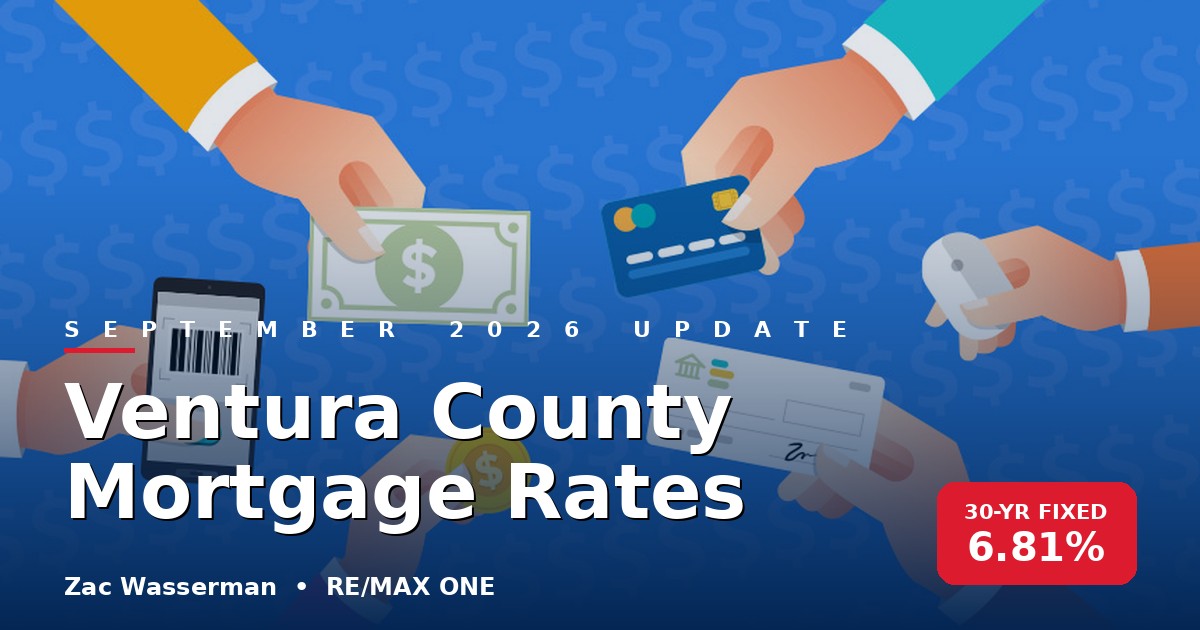
Ventura County Mortgage Rates: September 2026 Update September 2026 Mortgage Update Ventura County Mortgage Rates: September 2026 Update Rates have...

Can You Sell an ADU Separately in California? Your 2026 AB 1033 Guide for LA & Ventura County Sell an...
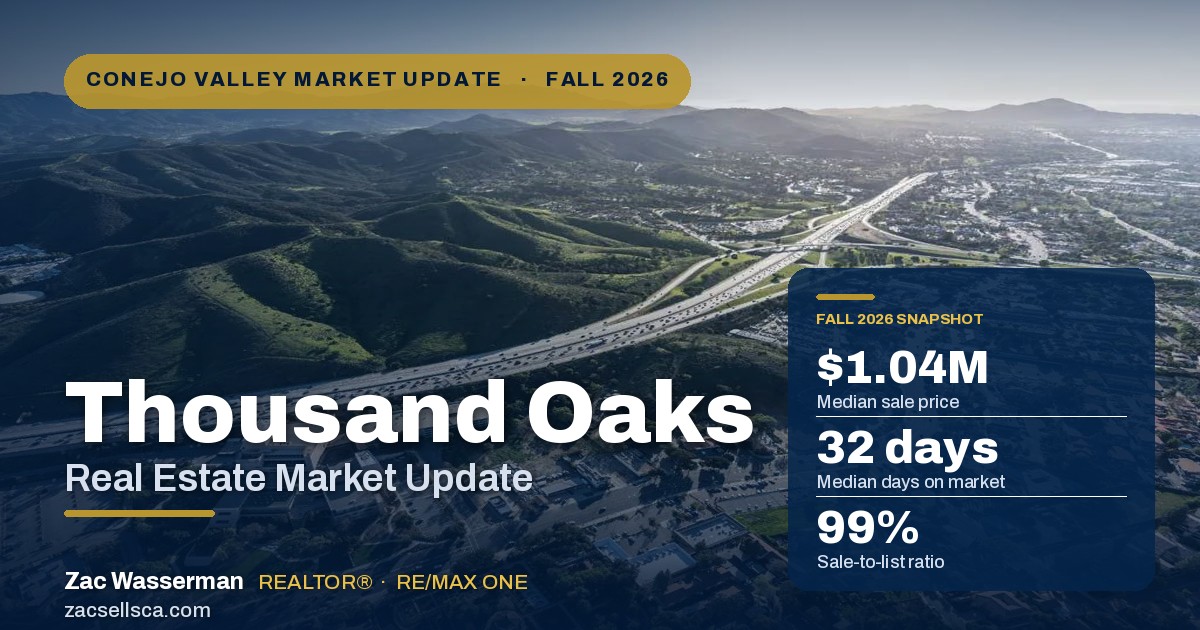
Conejo Valley Market Update · Fall 2026 Thousand Oaks Real Estate Market Update: Fall 2026 Prices remain firm, inventory is...
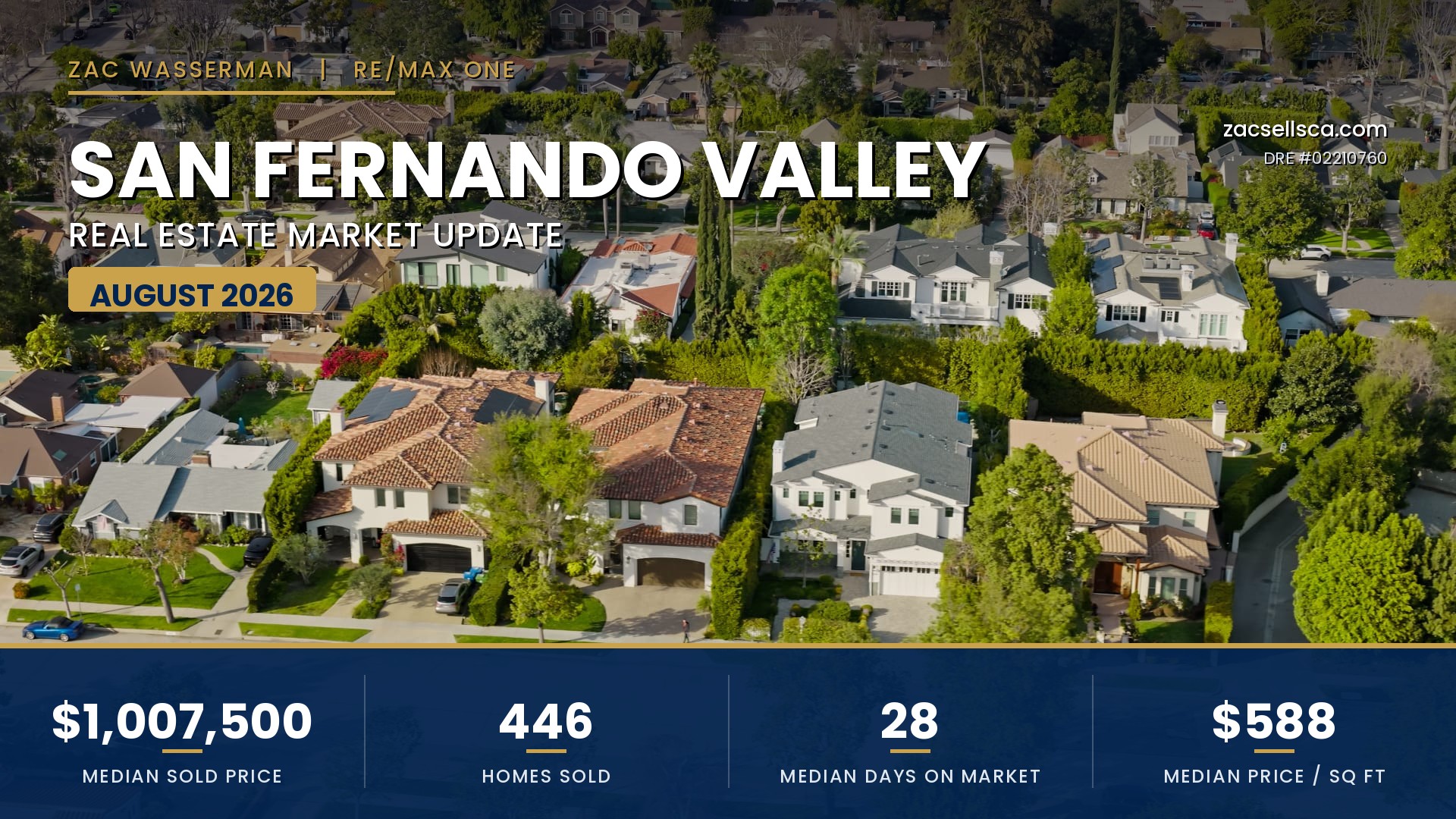
August 2026 • Local Market Report San Fernando Valley Housing Market Update: August 2026 Prices, Trends & City-by-City Data By...
Ventura County Real Estate Market Update: August 2026 Ventura County Market Update — August 2026 Ventura County Real Estate Market...