

New California Real Estate Laws for 2027: What Buyers, Sellers & Homeowners Need to Know
A practical timeline for homeowners, buyers, and sellers covering ADUs, HOA rules, insurance, and wildfire protections.
Get My Free Home Valuation →If you own, buy, or sell a home in Ventura County, the new California real estate laws 2027 will change a few things you probably don't think about every day: how many backyard units you can build, what your HOA can block, and how much warning your insurer must give before dropping you. Governor Newsom signed the final bills of the 2026 session between September 27 and September 30, and most of them take effect on January 1. However, not every change starts in 2027, so this guide separates what arrives soon from what arrives later. I'm Zac Wasserman, a REALTOR® with RE/MAX ONE, and here is what actually matters for local buyers, sellers, and homeowners.
What the New California Real Estate Laws 2027 Change, and What Waits Until 2028
Under California's usual calendar, laws without an urgency clause take effect on January 1 after they are signed. As a result, many of the housing and HOA bills below start on January 1, 2027. Several of the biggest insurance protections, on the other hand, start later. In short, here is the timeline:
- January 1, 2027: Two detached ADUs per single-family lot (AB 956), HOA limits on window and cooling-system restrictions (SB 908 and AB 1684), and the first phase of the new insurance claims law (SB 876).
- January 1, 2028: The longer insurance nonrenewal notice (SB 1301), plus the mandatory 50% extended replacement cost offer, which is reported to start on that date.
- January 1, 2032: HOA reserve funding mandates (AB 2050).
- January 1, 2027, an ending: The temporary ban on unsolicited offers in wildfire-affected ZIP codes is scheduled to expire unless lawmakers extend it (AB 851).
Therefore, if you are planning a purchase or sale this winter, treat 2027 as a phase-in year rather than a single switch.
ADU and Housing Laws: Two Backyard Units Per Lot
For homeowners with a yard, AB 956 is the headline of the housing package the governor announced on September 29. Starting January 1, 2027, cities and counties must approve two detached, newly built ADUs on a lot with a single-family home, up from one. Additionally, they cannot require side and rear setbacks larger than four feet, although they can still cap each unit at 800 square feet and apply height limits. In exchange, a city no longer has to approve a junior ADU on a lot where the owner builds two detached units.
Meanwhile, SB 1117 targets the cost side. According to summaries of the bill, ADUs of 750 square feet or less stay exempt from impact fees, and larger units are charged only on the square footage above that line instead of on the whole unit. Consequently, a 900-square-foot cottage could be assessed on 150 square feet rather than 900.
For Ventura County sellers, this matters because buildable space can change how a buyer values a lot. If you are curious about the resale side, read my guide on selling an ADU separately in California, since ownership and financing rules are a separate question from permitting.
Other signed bills are aimed at builders and small-lot buyers, but they are worth knowing about:
- SB 1116 rewrites small-lot subdivision rules for applications filed on or after January 1, 2027.
- AB 1751 creates a streamlined approval pathway for qualifying townhome developments.
- AB 1738 requires local governments to let homeowners in single- and two-family homes request remote building inspections for certain structural components.
New California Real Estate Laws 2027 for HOA Homeowners
If you live in a planned development or condo community, several 2027 changes limit what an association can say no to.
AB 956 and ADUs. The law extends existing protections against HOA restrictions on ADUs and junior ADUs to lots in any zone that allows single-family homes. However, it applies to planned developments, not condominium projects. One open question is whether an HOA can still limit an owner to one detached unit now that cities must approve two, so check your CC&Rs.
SB 908 and windows. HOAs generally cannot block energy-code-compliant window replacements. They may impose reasonable installation rules only if those rules do not raise the project cost or cut energy efficiency by more than 10%. Furthermore, if your HOA requires approval, an application not decided within 45 days is deemed approved.
AB 1684 and air conditioning. HOAs cannot restrict code-compliant cooling systems, which matters a great deal in Simi Valley, Moorpark, and the inland parts of the Conejo Valley, where summer heat is a real cost-of-living issue.
AB 739 and resale document fees. This bill regulates what HOA managing agents can charge, including fees tied to the documents sellers must provide at closing. As a result, sellers in HOA communities should ask for an itemized fee quote early.
AB 2050 and reserves. Finally, a longer-range change: starting in 2032, HOAs must update reserve studies every year and fund reserves at no less than a stated minimum. If a study projects reserves running out within 30 years, the HOA must put at least 15% of its gross annual budget into reserves and may need to levy a special assessment. Therefore, buyers should read reserve studies closely today, because underfunded reserves become a bigger deal over time.
Home Insurance Changes: What Starts in 2027 and What Starts in 2028
Insurance is where most Ventura County buyers feel the squeeze, so the new laws deserve a careful read.
SB 876 (claims reform). Signed September 27, this law is described by the California Department of Insurance as the most comprehensive update to claims-handling rules in more than 30 years. It phases in beginning January 1, 2027, with more provisions following in 2028 and 2029. It doubles penalties for claims-law violations during a declared emergency, lets the Insurance Commissioner order restitution paid directly to policyholders, and requires a status report within 15 days when a new adjuster takes over a claim. It also requires insurers to offer extended replacement cost coverage of at least 50% and to give updated replacement cost estimates at new policies and renewals. According to a brokerage summary of the chaptered text, that offer requirement becomes operative January 1, 2028.
SB 1301 (nonrenewals). Insurers must give 90 days' notice before nonrenewal, up from 75, and 120 days if the problem is something you can fix. They must also explain the reason in plain language and provide inspection findings on request. Additionally, an insurer cannot refuse to renew based solely on roof age if the owner pays for an independent inspection showing at least five years of useful roof life. Nearly all of this starts on January 1, 2028, so nothing changes for a policy renewing before then.
FAIR Plan bills. Newsom also signed three bills about the California FAIR Plan, including AB 1680, which strengthens the Insurance Commissioner's oversight and enforcement powers. For context on where rates stand today, read my breakdown of the California FAIR Plan rate increase and what State Farm's new California policies mean for local homeowners.
Notably, the governor vetoed SB 877 and SB 878, two bills backed by wildfire survivors that would have expanded claim-estimate disclosures and added interest on certain delayed payments. In other words, this is a meaningful step, but it is not the full package advocates wanted. You can read the official summary on the California Department of Insurance website.
Fire-Zone Unsolicited Offer Ban Ends January 1, 2027
If you own property affected by the January 2025 fires or know someone who does, AB 851 is the one to watch. The law bars buyers from making unsolicited offers on residential property in 15 specified ZIP codes across Los Angeles and Ventura counties, and it requires a written statement that a purchase did not come from a banned unsolicited offer. Violators can face civil penalties of up to $25,000 per violation, and licensees can face license discipline.
However, the law is written to repeal on January 1, 2027, unless it is extended. I did not find a signed extension as of October 14, 2026. Therefore, if you are a fire-area owner who is not ready to sell, expect investor outreach to resume after that date, and know your rights before you respond. For local context, my Mountain Fire rebuild update covers what Ventura County owners are facing.
What These Laws Mean for Buyers
First, ask about insurance before you fall in love with a house. Because nonrenewal protections do not start until 2028, a home's roof age, claims history, and wildfire exposure still shape your options today. Next, request the HOA's reserve study and fee schedule, since 2027 and later laws change both costs and rules. Finally, look at the lot. A property with room for two detached ADUs may be worth more to the right buyer, even if you never build.
Rates still drive affordability, too, so pair these law changes with my latest look at Ventura County mortgage rates in October 2026.
What These Laws Mean for Sellers
If you are selling, the new laws cut both ways. On one hand, ADU potential and HOA-friendly rules can strengthen your listing story. On the other hand, buyers are more insurance-aware than ever, so a fresh roof inspection and a clear insurance history can remove objections early. In addition, if you live in an HOA, order your resale documents early and review the fee itemization.
Timing matters as well. If you are weighing a listing this winter against waiting for spring, my guide on whether to sell now or wait until spring walks through the tradeoffs. Meanwhile, the broader outlook is in my 2027 Ventura County housing market forecast.
Frequently Asked Questions About the New California Real Estate Laws 2027
Q: When do the new California real estate laws take effect?
A: Most housing and HOA bills signed in September 2026 take effect on January 1, 2027. However, several insurance protections start January 1, 2028, and the HOA reserve funding mandate does not start until January 1, 2032.
Q: Can I build two ADUs on my Ventura County lot in 2027?
A: Under AB 956, cities and counties must approve two detached, newly built ADUs on a lot with a single-family home starting January 1, 2027, subject to the statute's requirements. Local rules on size, height, and permits still apply, so check with your city planning department first.
Q: Will the new laws stop my insurance company from dropping me?
A: Not entirely. SB 1301 requires longer notice, a clear explanation, and a chance to fix problems, but nearly all of it starts January 1, 2028. Insurers can still nonrenew in many cases.
Q: Can my HOA still block air conditioning or window replacements?
A: Starting January 1, 2027, HOAs generally cannot block code-compliant cooling systems or energy-code-compliant window replacements, although reasonable limits may still apply.
Q: What happens to the ban on unsolicited offers in fire zones?
A: AB 851 is scheduled to repeal on January 1, 2027, unless it is extended. Check for updates before assuming the protection continues.
Talk to a Local Expert Before You Make a Move
These laws can change what your home is worth, what you can build, and what you will pay to insure it. Ready to see how they affect your property? Get your free home valuation from Zac Wasserman at RE/MAX ONE, your Ventura County and San Fernando Valley expert, or contact Zac to talk through your buying or selling plan.
Get Your FREE Home Valuation → Talk With Zac →- All Posts
- Buyer Guides
- California Home Insurance & Wildfire Risk
- Home Financing (Mortgage & Loan Guides)
- Market Updates & Forecasts
- Seller Guides
- Back
- Ventura County Real Estate Market Updates
- San Fernando Valley Real Estate Market Updates (Monthly): Prices, Inventory & Trends
New California real estate laws 2027 change what you can build, what your HOA can block, and how much notice...

Ventura County Mortgage Rates October 2026 October 2026 Mortgage Market Update Ventura County Mortgage Rates October 2026: 7.4% and What...

Ventura County Home Seller Guide | Fall / Winter 2026 Should You Sell Now or Wait Until Spring? Ventura County...

SEPTEMBER 2026 · MARKET UPDATE San Fernando Valley Housing Market Update: September 2026 Prices, Trends & City-by-City Data The median...
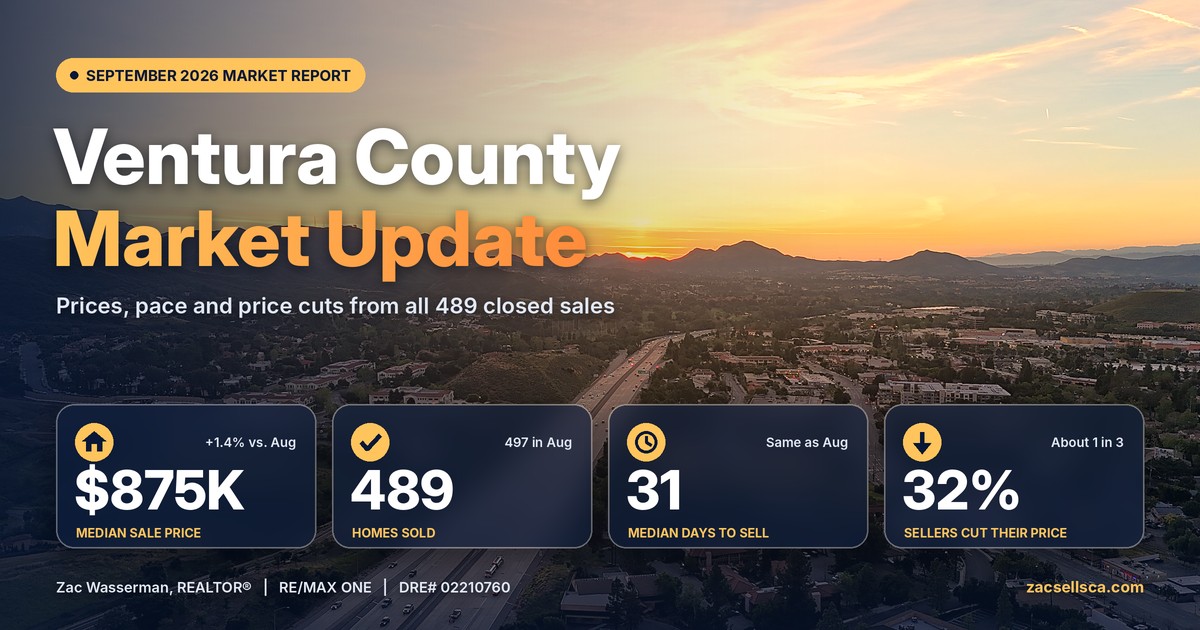
Ventura County’s September 2026 housing market: $875K median price, 489 closed sales, 31 days on market, and city-by-city data for...

State Farm filed to start writing new California home policies again, but only for homes with an IBHS Wildfire Prepared...