
What Are Closing Costs for Sellers in Ventura County?
Seller Closing Costs in Ventura County: What You'll Actually Pay in 2026
Thinking about selling your Ventura County home? Before you list, it is critical to understand what comes out of your proceeds at closing — including commission, title, escrow, transfer taxes, and possible buyer credits.
Quick Estimate
Most Ventura County sellers should budget roughly 6% to 9% of the sale price for total closing costs.
On a $750,000 sale, that can mean approximately $45,000 to $67,500 before your mortgage payoff.
What Are Closing Costs for Sellers in Ventura County?
If you're thinking about selling your home in Ventura County, one of the most important numbers to understand upfront is how much it's going to cost you to close the deal. Seller closing costs in Ventura County typically range from 6% to 9% of the sale price — and on a $750,000 home, that's anywhere from $45,000 to $67,500 coming out of your proceeds before you see a dime.
That number surprises a lot of sellers. Therefore, understanding exactly where that money goes — and how to reduce it — is essential before you decide to list. In this guide, I'll walk you through every major seller closing cost in Ventura County for 2026, what's negotiable, and how to calculate your real net proceeds.
Want your real number?
A seller net sheet gives you a much clearer estimate than a generic closing cost calculator.
I can help you estimate your sale price, closing costs, mortgage payoff, concessions, and projected walk-away proceeds before you list.
Start With a Free Home ValuationWhat Are Closing Costs for Sellers?
Closing costs are fees and expenses paid at the time of closing — the final step in a real estate transaction where ownership officially transfers from seller to buyer. As a seller, your closing costs typically include real estate commissions, title insurance, escrow fees, transfer taxes, and any credits you agree to give the buyer.
Unlike buyers — who bring cash to closing — sellers typically have their closing costs deducted directly from the sale proceeds. That means you don't write a check the day of closing; instead, your net proceeds arrive after all fees have been subtracted. However, knowing those costs in advance is critical for accurate financial planning.
It's also worth noting that seller closing costs in California differ somewhat from the national average, because California has specific transfer tax structures and title/escrow norms that vary by county. Ventura County has its own fee schedule, which I'll break down below.
How Much Do Sellers Pay at Closing in Ventura County?
Here's a realistic breakdown for a $750,000 home sale in Ventura County in 2026:
| Cost Item | Estimated Range | On a $750K Sale |
|---|---|---|
| Real estate commission | Listing agent + buyer's agent compensation | $30,000–$45,000 |
| Owner's title insurance policy | 0.5%–0.7% | $3,750–$5,250 |
| Escrow fees, seller's share | $1,500–$2,500 | ~$2,000 |
| County documentary transfer tax | $0.55 per $500 | ~$825 |
| City transfer tax, if applicable | Varies by city | $0–$1,500+ |
| Home warranty, if offered | $400–$700 | ~$500 |
| Prorated property taxes | Varies | Varies |
| HOA transfer/document fees | $200–$600 | Varies |
| Total estimate | 6%–9% | $45,000–$67,500 before mortgage payoff |
Additionally, if you've agreed to pay buyer concessions, credits toward repairs, or closing cost credits, those are deducted from proceeds as well. As a result, some sellers end up closer to 8%–10% total when credits are factored in.
For a personalized estimate, a free home valuation combined with a net sheet from your agent gives you the most accurate picture.
Real Estate Commission: The Biggest Seller Closing Cost
By far the largest line item for most Ventura County sellers is real estate commission. Traditionally, sellers paid 5%–6% total commission, split between the listing agent and the buyer's agent. However, following the 2024 NAR settlement, commission structures have changed — and are now more openly negotiated.
In practice across Ventura County in 2026, many transactions still involve a buyer's agent compensation offer, but the amount is set through negotiation rather than a fixed standard. Many sellers are paying 2%–2.5% to the buyer's agent and a separate negotiated rate to their listing agent.
Commission examples at common price points
| Sale Price | Example Total Commission | Dollar Amount |
|---|---|---|
| $600,000 | 5% | $30,000 |
| $750,000 | 5% | $37,500 |
| $950,000 | 5% | $47,500 |
Therefore, your commission cost scales significantly with your sale price. It's the line item with the most room for negotiation — but be cautious about cutting too deep on listing agent compensation, as experience and marketing quality directly impact your final sale price and speed to close.
Understanding the home selling mistakes Ventura County sellers make — including undervaluing the listing agent relationship — can help you make a more informed decision here.
Title Insurance and Escrow Fees: What Sellers Owe
In Ventura County, it is customary for the seller to pay for the buyer's owner's title insurance policy. This is a one-time premium that protects the buyer against any title defects, liens, or ownership disputes that arose before the sale. The cost is based on the purchase price and typically runs 0.5%–0.7% of the sale price.
On a $750,000 sale, that's approximately $3,750–$5,250.
Escrow fees are split between buyer and seller in Ventura County. Your share as the seller is typically $1,500–$2,500 depending on the transaction complexity and which escrow company is used. Some sellers negotiate for the buyer to cover a larger share of escrow, particularly in strong seller's markets.
Both title and escrow fees are paid at closing and deducted from proceeds, so you won't pay out of pocket ahead of time — but they will reduce your net.
Transfer Taxes and County Documentary Fees
California charges a documentary transfer tax on all real property sales. The state/county rate is $0.55 per $500 of sale price, or $1.10 per $1,000. On a $750,000 sale, that's $825.
Additionally, certain cities within Ventura County charge their own city transfer taxes on top of the county tax. The good news is that most Ventura County cities — including Thousand Oaks, Camarillo, Simi Valley, and Oxnard — do not impose an additional city transfer tax, keeping your tax exposure relatively modest compared to some LA County cities.
However, always confirm the specific city rules with your escrow officer, as tax ordinances can change. Your net sheet will itemize this clearly before closing. For official transfer tax rates, you can reference the Ventura County Assessor's Office directly, or review commission and transaction guidance from the California Association of REALTORS®.
Seller Concessions and Credits: What to Budget For
In today's Ventura County market, buyers frequently request concessions — particularly first-time buyers using FHA or VA financing. A concession is a credit from the seller that the buyer uses to cover a portion of their own closing costs or reduce their rate through discount points.
According to the Ventura County housing market Q1 2026 data, the market has softened modestly compared to the peak, which means sellers are more frequently agreeing to concessions to get deals closed. Typical concession amounts in 2026 range from $5,000 to $15,000, depending on price point and negotiation.
Additionally, if your pre-sale inspection reveals deferred maintenance, buyers may request repair credits rather than requiring you to fix items before close. Therefore, budgeting an additional 1%–2% for concessions and credits is a prudent planning assumption.
How to Calculate Your Seller Closing Costs and Net Proceeds
Your net proceeds = Sale Price − Mortgage Payoff − Total Closing Costs − Concessions
Here's a simple example:
| Item | Amount |
|---|---|
| Sale price | $800,000 |
| Mortgage payoff | −$420,000 |
| Commission, 5% | −$40,000 |
| Title insurance | −$5,000 |
| Escrow, seller share | −$2,000 |
| Transfer taxes | −$880 |
| Seller concessions | −$8,000 |
| Estimated net proceeds | ~$324,120 |
This is a simplified estimate — your actual number will depend on your specific mortgage balance, HOA fees, prorated property taxes, and any repairs completed before listing. Your escrow officer and listing agent will provide a formal net sheet once you're in contract.
Before you list, I strongly recommend getting a free home valuation to understand your current equity position and run an accurate net proceeds calculation together.
For context on what the closing costs 2026 Ventura County look like from the buyer's side, that post covers the full picture of what your buyer is bringing to the table — which can inform your concession strategy.
How to Reduce Your Seller Closing Costs in Ventura County
There are several strategies sellers can use to reduce their total closing cost burden without sacrificing their net proceeds:
1. Negotiate commission strategically
Now that commission rates are more openly discussed, you have real room to negotiate — particularly if you're selling in a price range where competition among agents is high. However, focus on value per dollar, not simply the lowest rate.
2. Choose your escrow provider
In California, sellers have the right to choose the escrow company, which gives you the ability to shop rates. Some sellers save $300–$800 simply by selecting a competitive provider.
3. Limit concessions proactively
Price your home correctly from day one. Homes that sit on the market accumulate days on market, and additionally tend to attract buyers with more aggressive concession requests. A well-priced home listed in clean condition gives you more leverage to push back.
4. Review the preliminary title report early
Any title issues — old liens, easement disputes, judgment clouds — discovered after opening escrow create delays and sometimes additional costs. Getting your title report reviewed before listing eliminates surprises.
Understanding how long it takes to sell a home in Ventura County also helps you plan your listing timeline and avoid the cost-creep that comes with extended market time.
Seller planning step
Before you decide to sell, know your likely walk-away number.
The sale price is only one part of the equation. Your real decision should be based on estimated market value, mortgage payoff, closing costs, concessions, and your next move.
Contact Zac for a Seller Net SheetFrequently Asked Questions About Seller Closing Costs in Ventura County
How much does it cost to sell a house in Ventura County?
Most sellers in Ventura County pay between 6% and 9% of the sale price in total closing costs, including commission, title, escrow, transfer taxes, and any concessions. On a $750,000 home, that typically means $45,000–$67,500 in total costs before your mortgage payoff.
Do sellers pay closing costs in California?
Yes. In California, sellers customarily pay for the buyer's owner's title insurance policy, their share of escrow fees, the county documentary transfer tax, and real estate commissions. Buyers cover their own lender fees and a portion of escrow. Total seller costs vary by county and city.
Can a seller negotiate closing costs with the buyer?
Yes. Sellers can negotiate which party pays specific fees, and can offer buyer concessions in exchange for a higher sale price or cleaner terms. However, in competitive markets, sellers generally have more leverage to limit concessions.
Is the real estate commission negotiable in Ventura County?
Yes. Following the 2024 NAR settlement, commission rates are now openly negotiated on every transaction. There is no longer a fixed standard rate. Most sellers are currently negotiating total commissions in the 4.5%–5.5% range, depending on price point and agent.
What is the documentary transfer tax in Ventura County?
The county documentary transfer tax in California is $0.55 per $500 of the sale price, or $1.10 per $1,000. On a $750,000 sale, that's $825. Most Ventura County cities do not impose an additional city transfer tax, though you should confirm with your escrow officer.
When are seller closing costs paid?
Seller closing costs are deducted from your sale proceeds at closing — you don't pay them out of pocket in advance. Your escrow officer will provide a final settlement statement showing every deduction before you sign.
Ready to Know Your Real Numbers?
Selling in Ventura County is a major financial move. Your net proceeds should never be a guess.
Knowing your net proceeds before you list gives you the confidence to price, negotiate, and plan effectively. As a licensed REALTOR® with RE/MAX ONE serving Ventura County and the San Fernando Valley, I build detailed net sheets for every client so there are zero surprises at closing.
Zac Wasserman | RE/MAX ONE | CA DRE# 02210760 | 805.212.9147 | zacsellsca.com
- All Posts
- Buyer Guides
- California Home Insurance & Wildfire Risk
- Home Financing (Mortgage & Loan Guides)
- Market Updates & Forecasts
- Seller Guides
- Back
- Ventura County Real Estate Market Updates
- San Fernando Valley Real Estate Market Updates (Monthly): Prices, Inventory & Trends
Ventura County Mortgage Rates October 2026 October 2026 Mortgage Market Update Ventura County Mortgage Rates October 2026: 7.4% and What...
Ventura County Home Seller Guide | Fall / Winter 2026 Should You Sell Now or Wait Until Spring? Ventura County...
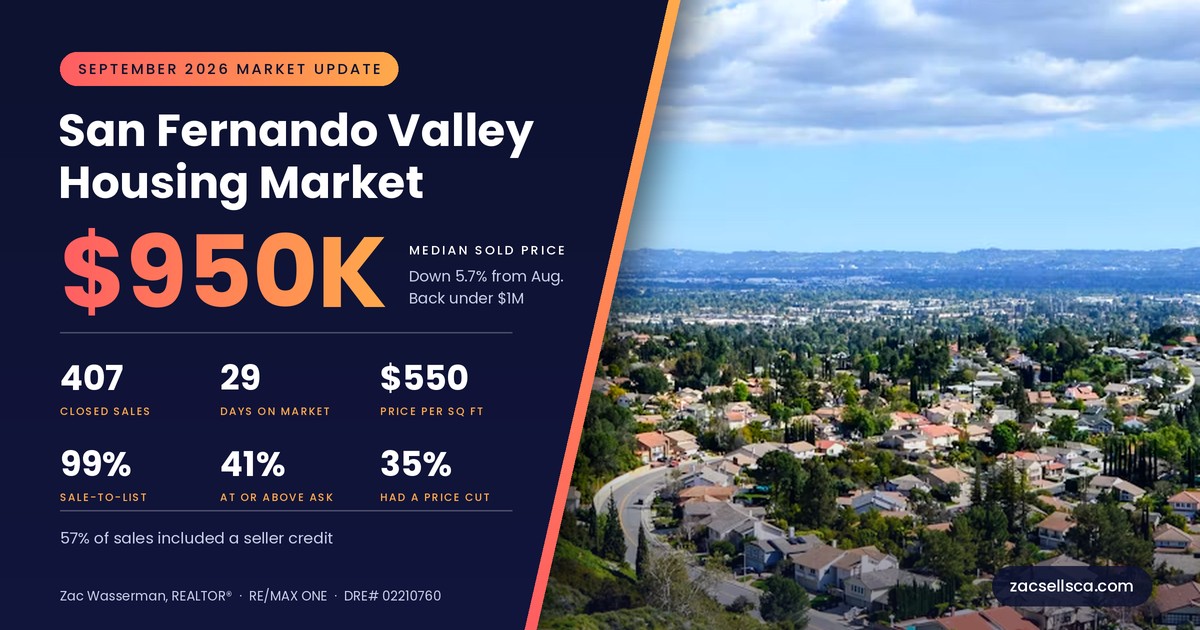
SEPTEMBER 2026 · MARKET UPDATE San Fernando Valley Housing Market Update: September 2026 Prices, Trends & City-by-City Data The median...
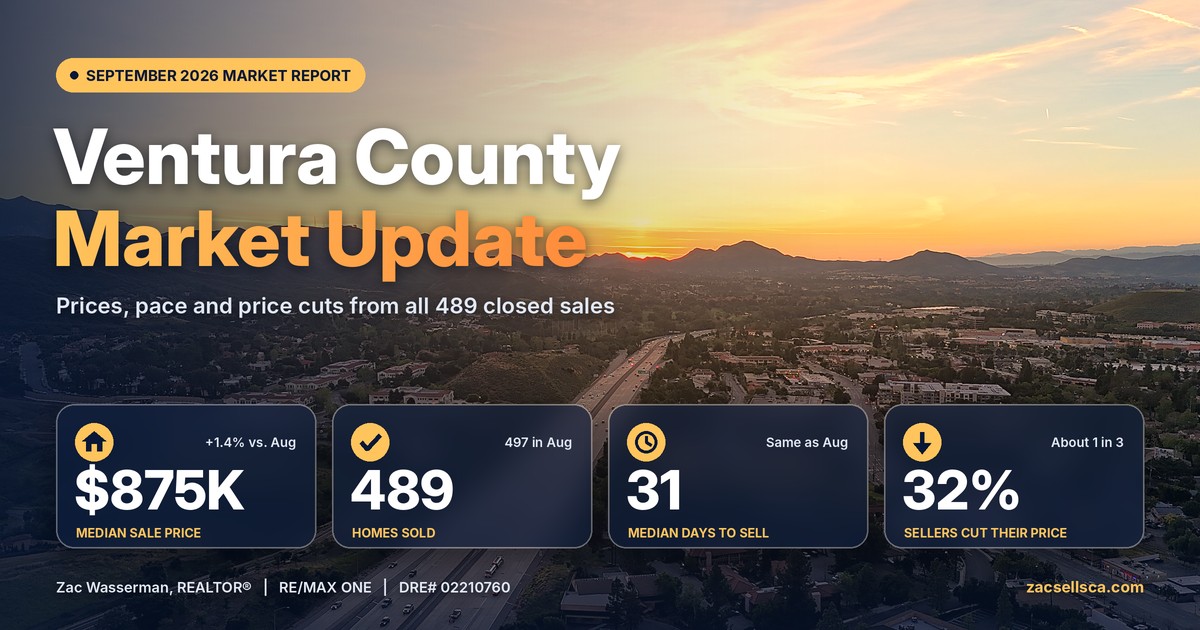
Ventura County’s September 2026 housing market: $875K median price, 489 closed sales, 31 days on market, and city-by-city data for...

State Farm filed to start writing new California home policies again, but only for homes with an IBHS Wildfire Prepared...

Encino real estate in 2026: see median home and condo prices, 494 closed sales, 91436 vs. 91316 trends, neighborhood insights,...