

Is Ventura County a Buyer's Market in 2026?
Inventory is rising, homes are sitting longer, and buyers finally have room to negotiate. Here’s what the Ventura County housing market 2026 data is really telling buyers and sellers right now.
Ventura County is not a full buyer’s market in 2026, but it is clearly more balanced than it has been in years. Buyers have more leverage, more time, and more negotiating room than they did in 2021–2023. Sellers can still succeed — but only with accurate pricing, strong presentation, and a realistic plan.
If you've been watching Ventura County real estate lately, something has quietly shifted. Homes are sitting on the market longer. Price reductions are appearing more frequently. And buyers — for the first time in years — are finding room to negotiate. So the question on everyone's mind right now is: is Ventura County a buyer's market in 2026?
The honest answer is nuanced. However, the data points clearly in one direction — and understanding that direction could save you tens of thousands of dollars whether you're buying or selling. In this post, I'll break down exactly what the current numbers show, which cities are seeing the biggest shifts, and what it all means for your strategy this spring.
- A clear answer on whether Ventura County is behaving more like a buyer’s market vs seller’s market
- Median price, inventory, and days on market trends across key Ventura County cities
- Practical guidance for buyers looking to negotiate and sellers trying to price right
What Defines a Buyer's Market in Real Estate?
Before diving into the Ventura County data, it helps to define what we're actually measuring. A buyer's market exists when housing supply outpaces demand — meaning more homes are available than there are buyers competing for them. As a result, sellers are forced to compete for buyers rather than the reverse.
Real estate professionals typically look at three core indicators to make this determination:
Measures how long it would take to sell all active listings at the current pace of sales. A balanced market generally sits at 4–6 months. Below that range, sellers hold leverage. Above it, buyers do.
Reflects how long homes sit before going under contract. Rising DOM is often the first visible signal that the market is cooling. Additionally, it's the metric buyers should watch most closely — because a home that's been sitting for 30+ days often comes with negotiating room.
Tracks how often sellers cut their asking price after listing. When reductions become routine rather than rare, it signals that buyers have meaningful leverage.
Furthermore, it's important to understand that most real markets aren't purely one or the other. Most markets fall somewhere on a spectrum — and Ventura County in spring 2026 is a textbook example of a market in transition.
Is Ventura County a Buyer's Market Right Now? (The Short Answer)
As of spring 2026, Ventura County is not a full buyer's market — but it is meaningfully more balanced than at any point since 2019. In other words, buyers have more leverage today than they've had in years, even though sellers in well-priced, high-demand areas still hold some of the cards.
Several key indicators have shifted since late 2024. Active inventory has risen. Days on market have increased across most cities. Price reductions — once a rarity — are now a regular feature of active listings. However, none of these trends have reached the severity that would tip Ventura County into true buyer's market territory across the board.
For a full picture of current conditions, my breakdown of the Ventura County housing market Q1 2026 covers the first quarter in detail and provides context for what's been driving the shift.
The bottom line: if you're a buyer, you have more power than you've had in years. If you're a seller, the market still works — but it requires a smarter approach than it did in 2021 or 2022.
If you're trying to decide whether to buy, sell, or wait, this is the type of market where the right strategy matters more than the headline. Timing helps — but pricing, negotiation, and execution matter more.
Schedule a Local Market ConversationVentura County Median Home Prices in 2026
Median home price is the number most buyers and sellers want to know first — and in Ventura County, it tells an interesting story.
As of early 2026, the median home price in Ventura County sits in the $775,000–$825,000 range, depending on the data source and the specific month. That figure remains significantly elevated compared to pre-pandemic levels. However, it also reflects a modest cooling from the peak values seen in 2022.
Here's how the city-level picture looks:
For deeper analysis of whether median prices are trending up or down, I covered this specifically in my post on whether home prices are dropping in Ventura County. You can also compare local pricing movement against recent market data for additional context.
Inventory Trends: How Supply Has Shifted in Ventura County
Inventory is the single most important variable in determining market balance. Therefore, it's where I always start when assessing whether a market is shifting.
The trajectory in Ventura County has been clear: active inventory has been rising since late 2024 after years of historically tight supply. Here's how the trend has developed:
Inventory in most Ventura County cities was extremely tight — well below 2 months of supply in many areas. Sellers had overwhelming leverage.
Supply began loosening as higher mortgage rates kept buyers on the sidelines while some sellers chose to list anyway.
Inventory continued building. Several Ventura County cities are now approaching or crossing the 3–4 month supply range, which represents a meaningful shift toward balance.
For buyers, rising inventory means more options and far less pressure. Bidding wars still happen on exceptional homes, but they're no longer the default experience across all price points. Additionally, buyers now have time to complete proper due diligence — inspections, walk-throughs, financing reviews — without being forced to act in hours.
For sellers, however, this shift demands a recalibration. Similarly priced homes are now competing directly against each other, and standing out on price, condition, and marketing matters more than it did during the frenzy years. For broader CAR market data, the statewide trendline supports the same larger shift toward a more balanced environment.
Days on Market in Ventura County: What the Data Shows
Days on market has risen noticeably across Ventura County in 2026 compared to the 2021–2022 peak. This is one of the clearest signals that the market has become more balanced.
In 2022, many Ventura County homes were going under contract in under 7 days — sometimes within hours of listing. Furthermore, multiple offers and waived contingencies were the norm across most price ranges. That dynamic has changed considerably.
As of spring 2026, median DOM across Ventura County sits in the 25–45 day range depending on city and price point. Consequently, sellers can no longer assume a fast, frictionless sale is automatic. Homes that are overpriced, poorly presented, or located in less desirable pockets are sitting — sometimes for 60 days or more.
For buyers, this shift creates real opportunity. A home that's been on the market for 30+ days often indicates a motivated seller, which creates room to negotiate on price, seller credits, or closing timeline. However, always understand why a home has been sitting before making an offer — some homes linger because of genuine issues rather than simply price.
In today’s market, 30+ days on market matters. It often means you can negotiate price, request credits, or structure cleaner terms than buyers could just a few years ago.
Price Reductions: A Buyer's Market Signal?
Price reductions are one of the clearest lagging indicators of a shifting market — and they've become significantly more common in Ventura County in 2026.
In the peak seller's market years, price reductions were rare enough to be newsworthy. A home that cut its price was assumed to have something wrong with it. However, in today's market, reductions have become routine for listings that opened too high relative to current buyer demand.
Currently, a meaningful share of active Ventura County listings have had at least one price reduction before going under contract. For buyers, this creates an interesting opportunity: in some cases, it can be smarter to target a home with a recent reduction than to be the first offer on a freshly listed property, because the seller has already shown a willingness to negotiate.
I covered the full mechanics of this in my post on price reductions in Ventura County — including what they signal for both buyers and sellers in the current environment.
Which Ventura County Cities Are Shifting Most in 2026?
Ventura County is not a single market. Therefore, the buyer's market question has meaningfully different answers depending on where you're looking:
Have seen the most noticeable softening in the county. Inventory is up, DOM has risen, and price reductions are common. Buyers targeting this price range have real negotiating leverage right now.
Have become more balanced. Supply has increased from historically tight levels, and there's more inventory to choose from. However, demand remains solid from LA County commuters, which prevents these markets from tipping fully toward buyers.
Are more stable in the upper-mid range. Well-priced homes still attract strong interest. However, overpriced listings are sitting meaningfully longer than they were 18–24 months ago — and buyers should not hesitate to come in below asking on stale inventory.
Has seen demand hold up well due to its popularity with LA commuters. Inventory has risen, but buyer interest has kept pace, making this one of the more balanced and competitive submarkets in the county.
Have softened modestly. Lifestyle buyers remain active, though the urgency and competition of 2021-era conditions is largely absent.
What This Means If You're Buying in Ventura County
If you're a buyer wondering whether Ventura County is a buyer's market in 2026, the current environment should encourage you — even if it hasn't fully crossed that threshold. Here's what the data means for your strategy:
In most price ranges, you no longer need to waive inspections or write offers sight-unseen. Additionally, you have space to evaluate the home, the neighborhood, the comps, and the true cost of ownership before committing.
In particular, homes that have been on the market for 3+ weeks are often flexible on price, seller credits toward closing costs, or repairs. A reasonable offer below asking — something that would have been insulting in 2021 — is now a legitimate opening move.
Rising inventory means more options. Consequently, if a home doesn't feel right, there's likely another one coming. You don't need to "settle" the way buyers did during the supply crunch.
Even in a shifting market, your mortgage rate is your biggest monthly lever. Therefore, get pre-approved early, know your numbers, and be ready to move quickly when the right home appears.
For a detailed breakdown of the rate vs. timing question, my post on whether you should wait to buy a house in 2026 walks through the scenarios in depth.
What This Means If You're Selling in Ventura County
For sellers, a more balanced market requires a strategy recalibration. However, it doesn't mean it's a bad time to sell — it means it's time to sell smartly.
In a more balanced market, pricing right from day one is everything. Overpricing creates extra days on market, weaker negotiating position, and often a lower final sale price.
Pricing right from day one is non-negotiable. In a more balanced market, overpricing kills deals. Homes that open too high accumulate days on market, signal weakness, and ultimately sell for less than they would have with correct initial pricing. Similarly, a well-priced home still moves quickly and can generate multiple offers.
Condition matters again. When buyers have choices, they gravitate toward the best-presented homes. Furthermore, deferred maintenance and cosmetic issues that buyers overlooked in 2021 are now legitimate negotiating points or deal-breakers for many.
Be realistic about timelines. A 30–45 day sale is the current norm in many Ventura County submarkets — sometimes longer. Build that into your planning, especially if you're coordinating a simultaneous purchase or relocation.
Know your true market value. Before deciding whether or when to list, get a realistic sense of what your home is worth in today's market — not what your neighbor got in 2022. I offer free home valuations based on current sales data and local market conditions.
If you want to know what your home could realistically sell for in today’s Ventura County market, I’ll help you look at current comps, timing, and likely buyer demand.
Frequently Asked Questions
If you're trying to decide whether to buy, sell, or wait in Ventura County, these are the most common questions I’m hearing right now. The answers below can help you read the market more clearly and make a smarter move.
Q: Is Ventura County officially a buyer's market in 2026?
A: Not officially by the traditional definition, but the market has shifted meaningfully toward balance. Inventory is up, days on market have risen, and price reductions are more common than they've been in years. Buyers have more leverage today than at any point since 2019 — but well-priced homes in desirable areas still attract strong competition.
Q: What is the median home price in Ventura County in 2026?
A: As of early 2026, the median home price in Ventura County sits in the $775,000–$825,000 range, depending on the city and the specific month. City-level medians vary significantly — from around $650,000–$725,000 in Oxnard to $950,000–$1.05M in Thousand Oaks.
Q: Are home prices dropping in Ventura County?
A: Prices aren't in freefall, but appreciation has slowed dramatically and some price softening has occurred from 2022 peak values. The key distinction is between a price correction (which is happening modestly) and a crash (which is not). For a detailed look, see my post on are home prices dropping in Ventura County.
Q: Which Ventura County cities are most favorable for buyers right now?
A: Oxnard and Port Hueneme have shown the most softening and offer the most negotiating room. Camarillo and Simi Valley are balanced but competitive due to commuter demand. Thousand Oaks and Moorpark remain more supply-constrained, though overpriced listings are seeing longer market times.
Q: Should I wait to buy in Ventura County or act now?
A: There's no universal answer — it depends on your financial situation, the specific city you're targeting, and your long-term goals. However, waiting for a dramatic price crash carries real risk: if rates drop, demand surges and prices follow. A more nuanced breakdown is in my post on whether you should wait to buy a house in 2026.
Q: How can I tell if a specific home has negotiating room?
A: Look at days on market, price history, and how the listing is priced relative to recent comparable sales. A home that's been sitting for 30+ days with a price reduction history is a strong signal that the seller has flexibility. Working with a local REALTOR® who knows the submarket gives you a significant advantage in reading these signals accurately.
Get real guidance for today’s Ventura County market
Ready to buy or sell in today's Ventura County market? Whether you're trying to time your purchase or get the most from your sale, I'm here to help you navigate it with real data — not guesswork. Contact Zac Wasserman at RE/MAX ONE at zacsellsca.com or call 805.212.9147 to talk through your situation.
- All Posts
- Buyer Guides
- California Home Insurance & Wildfire Risk
- Home Financing (Mortgage & Loan Guides)
- Market Updates & Forecasts
- Seller Guides
- Back
- Ventura County Real Estate Market Updates
- San Fernando Valley Real Estate Market Updates (Monthly): Prices, Inventory & Trends
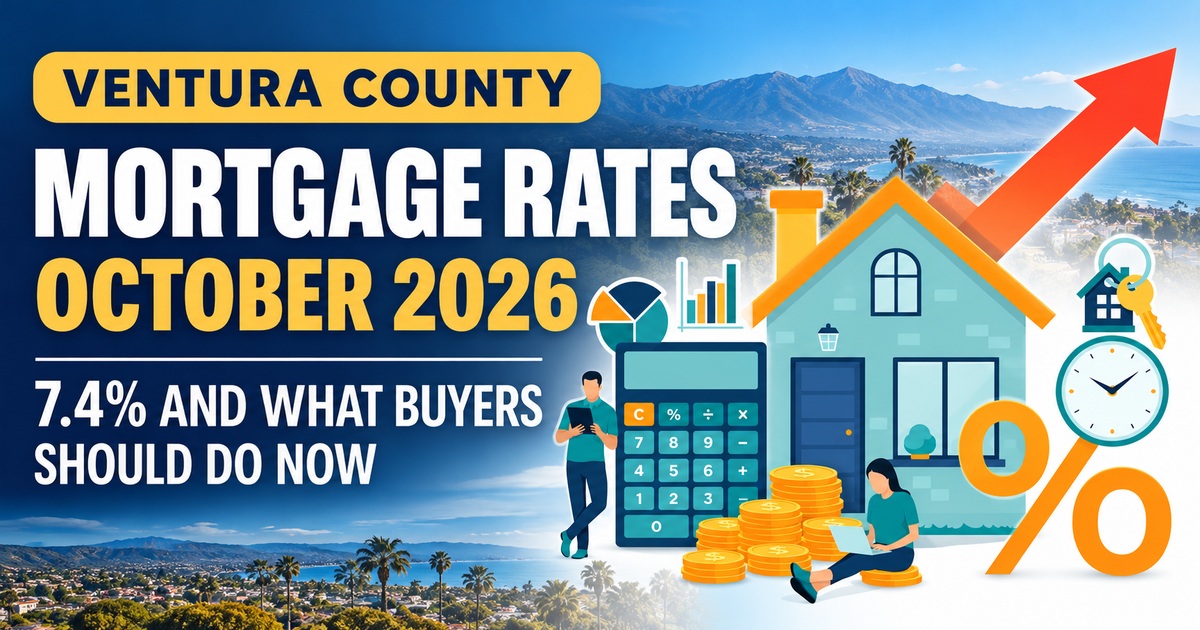
Ventura County Mortgage Rates October 2026 October 2026 Mortgage Market Update Ventura County Mortgage Rates October 2026: 7.4% and What...
Ventura County Home Seller Guide | Fall / Winter 2026 Should You Sell Now or Wait Until Spring? Ventura County...
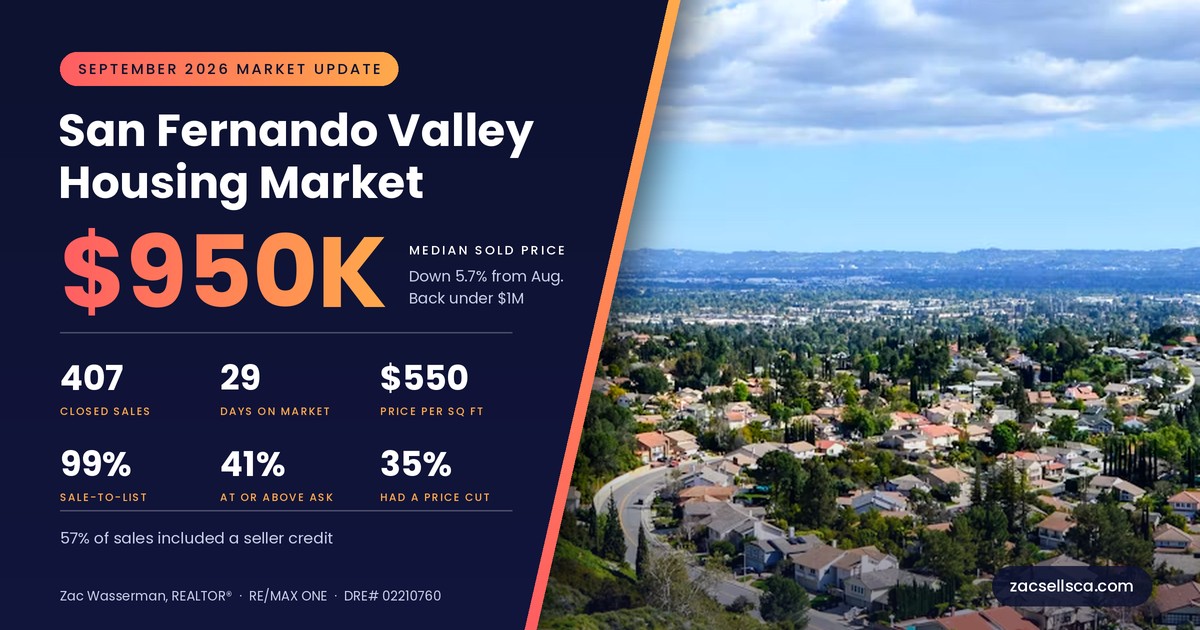
SEPTEMBER 2026 · MARKET UPDATE San Fernando Valley Housing Market Update: September 2026 Prices, Trends & City-by-City Data The median...
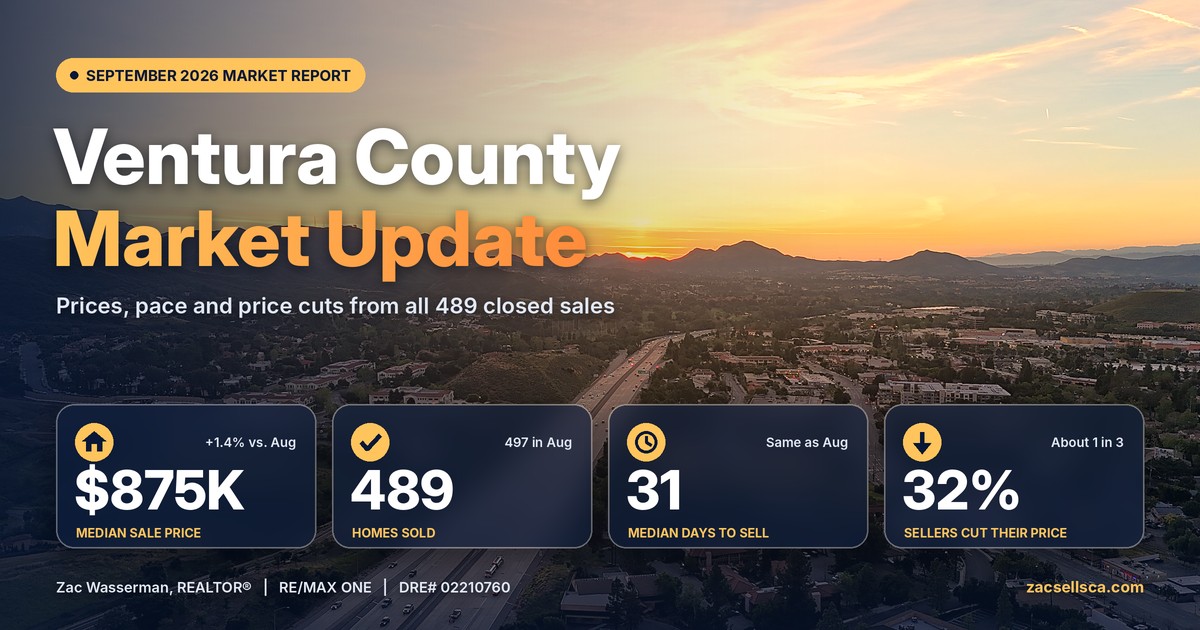
Ventura County’s September 2026 housing market: $875K median price, 489 closed sales, 31 days on market, and city-by-city data for...

State Farm filed to start writing new California home policies again, but only for homes with an IBHS Wildfire Prepared...

Encino real estate in 2026: see median home and condo prices, 494 closed sales, 91436 vs. 91316 trends, neighborhood insights,...