

How Pricing Impacts Home Sales in Ventura County
Your list price is the first signal buyers see — and in many cases, the biggest factor in how fast you sell, how much leverage you keep, and whether your home attracts strong offers right away.
If you're thinking about selling your home in Ventura County, one decision will define everything else: what price you list at.
Your list price isn't just a number. It's a signal to every buyer in the market, and it determines how fast you sell, how many offers you get, and ultimately how much money ends up in your pocket at close of escrow. A well-executed home pricing strategy in Ventura County can be the difference between a bidding war and a listing that sits for months.
Why Your List Price Is the Most Powerful Tool You Have
When your home hits the MLS, buyers aren't evaluating it in isolation. They're comparing it to every other active listing in your price range, in your neighborhood, in your city. Your list price determines which pool of buyers even sees your home.
Think about it this way: a buyer searching for homes between $750,000 and $850,000 will never see your home if you price it at $865,000 — even if you're willing to negotiate down. You've already been filtered out. That's why strategic pricing isn't about what you think your home is worth. It's about where your home needs to live in the market to attract the right buyers at the right moment.
Additionally, the first two weeks on market are by far the most critical. Buyer activity is highest when a listing is new. After that initial window, interest drops significantly — and price reductions rarely recover that lost momentum fully.
Your asking price controls two things immediately: who sees your home and how your home is perceived. Strong pricing creates urgency. Weak pricing creates hesitation.
What Happens When You Overprice a Home in Ventura County
Overpricing is the single most common mistake Ventura County sellers make, and it's also one of the most costly. Here's what typically unfolds:
Taken together, these four outcomes form a compounding cycle. Furthermore, each one reinforces the next — fewer showings lead to longer days on market, which leads to price reductions, which attract lower offers. As a result, the best protection against this cycle is simply not entering it in the first place.
The Danger Zone: How Overpricing Leads to Price Reductions
There's a pattern I see repeatedly with sellers in Ventura County. A homeowner gets an emotional attachment to a number — often based on what a neighbor sold for two years ago, or what they feel they deserve after years of improvements — and they list too high. Then the silence sets in.
After two or three weeks with no offers, the pressure builds. A price reduction follows — typically 3% to 5%. Then another. By the time the home sells, it's often at or below what a correct initial price would have generated, plus the seller has paid additional carrying costs (mortgage, taxes, HOA) for the extra months on market.
As I noted in my post on price reductions in Ventura County (https://zacsellsca.com/price-reductions-ventura-county-2026/), reductions that happen after prolonged market exposure almost always result in a lower final sale price than a well-priced original listing would have achieved.
Furthermore, in today's market — where buyers have more options and are watching interest rates carefully — the tolerance for overpriced listings is particularly low. Buyers are doing their homework, and they know when something is priced above market.
Home Pricing Strategy in Ventura County: What the Data Shows
So what does good pricing actually look like in Ventura County right now?
According to the Ventura County housing market Q1 2026 data (https://zacsellsca.com/ventura-county-housing-market-q1-2026/), median home prices across the county have remained relatively stable, with inventory ticking up in several cities. That shift in inventory is critical for sellers to understand: when there are more homes competing for buyer attention, pricing precision matters even more.
In seller's market conditions, a strategic slight underpricing can actually generate more money — by creating competition among buyers and driving offers above the asking price. However, that strategy requires careful market analysis and timing, which is where working with an experienced local agent becomes essential.
How to Price Your Home to Sell Fast — Without Leaving Money on the Table
The goal of any strong home pricing strategy in Ventura County is to maximize your net proceeds while minimizing your time on market. Here's how that works in practice:
Additionally, none of these steps need to be complicated. In fact, most sellers who work through this process with a local agent find that the right price range becomes clear fairly quickly. Therefore, the goal isn't to find a perfect number — it's to find a defensible one that the market will respond to.
Want to know the price range your home could realistically command right now?
I offer a free, no-pressure home valuation built around local comps, active competition, and what buyers are responding to in your specific neighborhood.
What a Comparative Market Analysis (CMA) Actually Tells You
A CMA is the foundation of any sound home pricing strategy in Ventura County. However, it's worth understanding what a CMA actually measures — and what it doesn't.
- Closed sales from the past 90–120 days (the most relevant data points)
- Active listings — your current competition
- Pending sales — where the market is heading right now
- Expired listings — homes that didn't sell, which often reveal overpricing patterns in your area
What a CMA doesn't do is account for emotional value, renovation costs you may not recoup, or what you paid for the home. Additionally, automated online estimates (Zestimates, etc.) are not CMAs — they're algorithm-based approximations that frequently miss by 5% to 15% in markets with limited sales data, like many Ventura County neighborhoods.
A skilled local agent will provide you with a CMA that goes beyond the numbers — contextualizing the data within current buyer demand, recent market shifts, and neighborhood-specific factors that automated tools simply can't account for.
Pricing Strategy by Market Condition: Seller's vs. Buyer's Market
Your pricing approach should shift depending on which type of market you're in. As I covered in my post on whether Ventura County is a buyer's market in 2026 (https://zacsellsca.com/is-ventura-county-a-buyers-market-2026/), conditions have been shifting in parts of the county — and that matters enormously for your strategy.
Low inventory and strong demand give you more flexibility. Pricing at or even slightly below market value can trigger multiple offers and drive your final price above asking. The risk of underpricing is low because competition does the work of pushing prices up.
Pricing accuracy is critical. Buyers have options and time on their side. Overpricing in this environment leads directly to the stigma cycle described above. Your best strategy is to price at the very top of what comparable sales support — not above it.
Understanding current conditions in your specific city — whether you're in Camarillo, Thousand Oaks, Oxnard, Simi Valley, or Ventura — is therefore essential. Market dynamics can vary significantly between neighborhoods and price points even within the same county.
Common Home Pricing Mistakes Ventura County Sellers Make
Beyond simple overpricing, there are several other pricing errors I see regularly that cost sellers money:
For more on what's keeping homes from selling in the current market, see my guide on why your house isn't selling in Ventura County (https://zacsellsca.com/why-isnt-my-house-selling-ventura-county-2026/).
How Long Pricing Affects Your Days on Market
There's a direct, measurable connection between pricing and how long it takes to sell. According to data on how long it takes to sell a home in Ventura County (https://zacsellsca.com/how-long-does-it-take-to-sell-a-home-ventura-county-2026/), the gap between correctly priced homes and overpriced homes can be measured in weeks — sometimes months.
In practical terms, every additional week on market costs you in three ways: continued mortgage payments and carrying costs, mounting negotiating pressure from buyers who see a stale listing, and the psychological toll of an ongoing, uncertain process.
Furthermore, your eventual buyer may well be someone who watched your listing sit — and is now in a stronger negotiating position than they would have been in week one. Pricing right from the start is therefore not just about speed. It's about protecting your leverage.
Price right early, and you give yourself the best chance to sell faster and stronger.
The best offers usually come when your listing is fresh, visible, and clearly aligned with the market. Miss that window, and you often give away leverage you never fully get back.
FAQ: Home Pricing Strategy in Ventura County
These are some of the most common questions I hear from Ventura County sellers before they list. If you're trying to decide how aggressive or conservative your pricing should be, these answers will give you a practical starting point.
Get a local pricing strategy built for today's Ventura County market.
Pricing is strategy — and in Ventura County's current market, getting it right from day one is more important than ever. Whether you're preparing to list in the next 30 days or just starting to think about it, the first step is understanding what your home is actually worth in today's market.
I offer a free, no-obligation home valuation with full market context — not just an automated estimate, but a real analysis of what comparable homes are selling for in your neighborhood right now. Get your free home valuation here (https://zacsellsca.com/home-valuation) and let's build a pricing strategy that gets you the best possible outcome.
Phone: 805.212.9147 | Email: zacsellsca@gmail.com | Website: https://zacsellsca.com
- All Posts
- Buyer Guides
- California Home Insurance & Wildfire Risk
- Home Financing (Mortgage & Loan Guides)
- Market Updates & Forecasts
- Seller Guides
- Back
- Ventura County Real Estate Market Updates
- San Fernando Valley Real Estate Market Updates (Monthly): Prices, Inventory & Trends
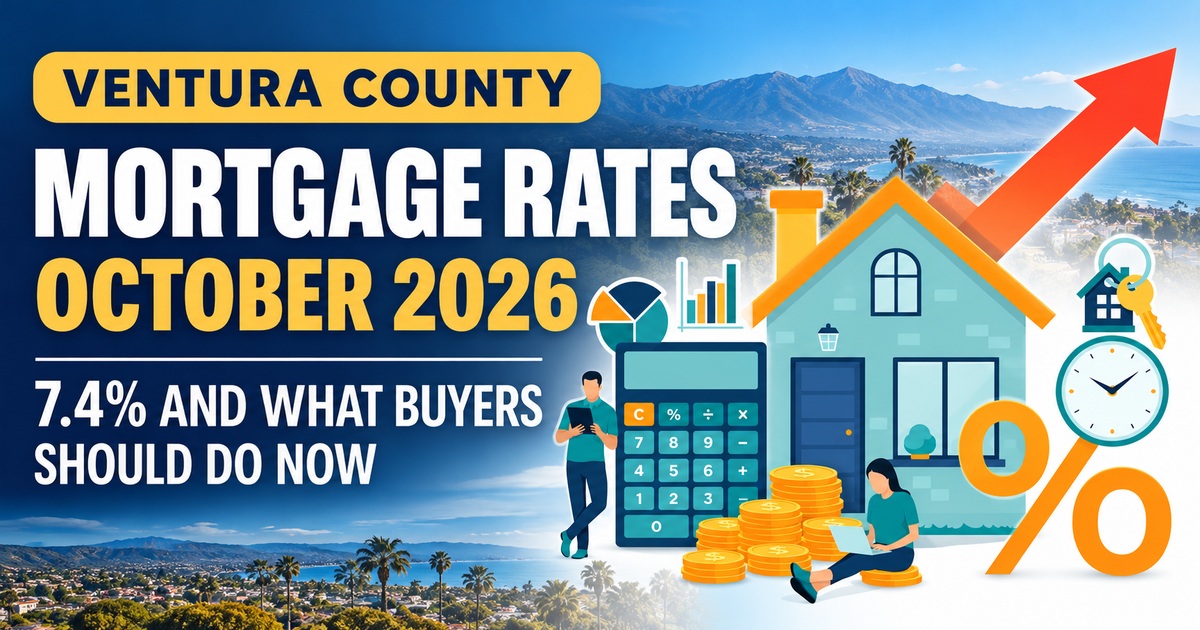
Ventura County Mortgage Rates October 2026 October 2026 Mortgage Market Update Ventura County Mortgage Rates October 2026: 7.4% and What...
Ventura County Home Seller Guide | Fall / Winter 2026 Should You Sell Now or Wait Until Spring? Ventura County...
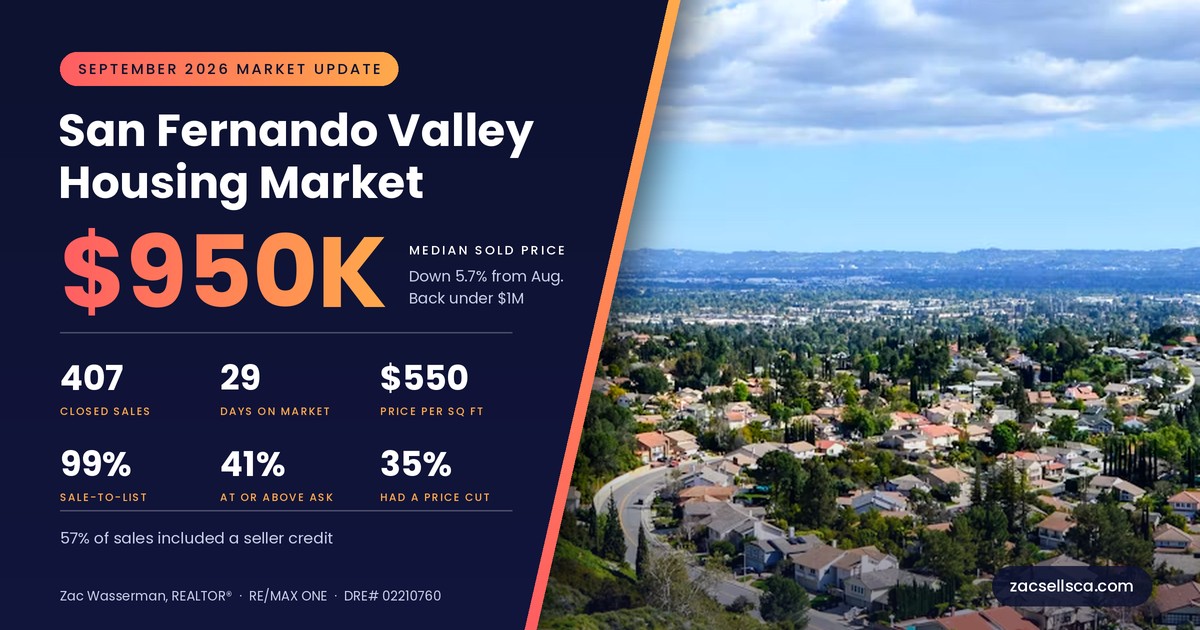
SEPTEMBER 2026 · MARKET UPDATE San Fernando Valley Housing Market Update: September 2026 Prices, Trends & City-by-City Data The median...
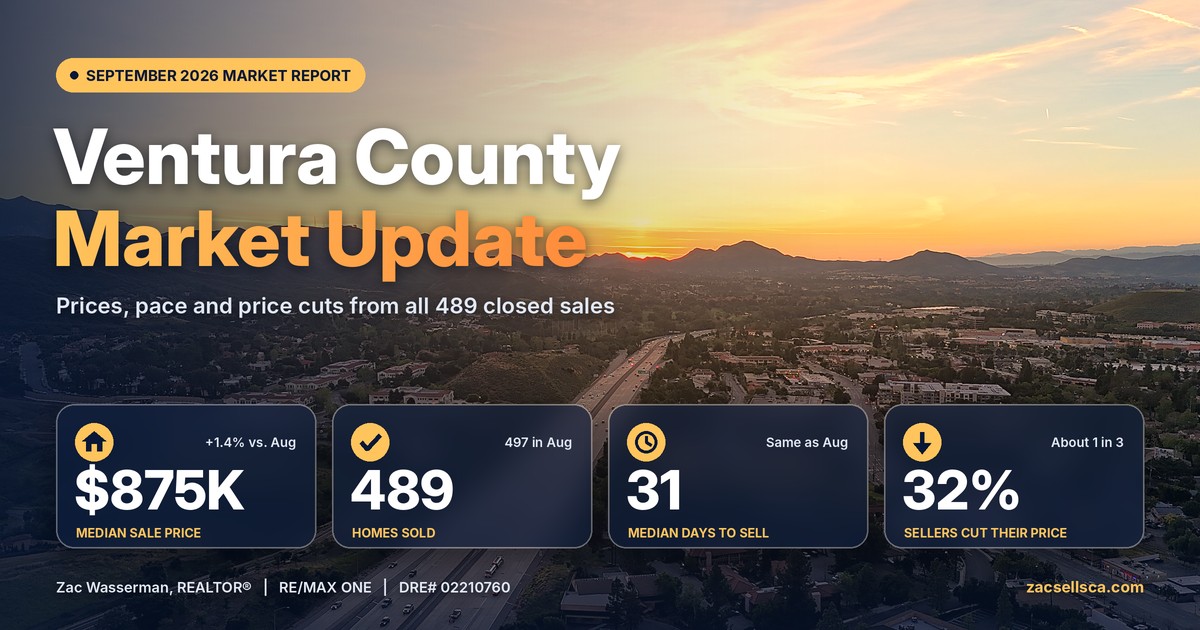
Ventura County’s September 2026 housing market: $875K median price, 489 closed sales, 31 days on market, and city-by-city data for...

State Farm filed to start writing new California home policies again, but only for homes with an IBHS Wildfire Prepared...

Encino real estate in 2026: see median home and condo prices, 494 closed sales, 91436 vs. 91316 trends, neighborhood insights,...