
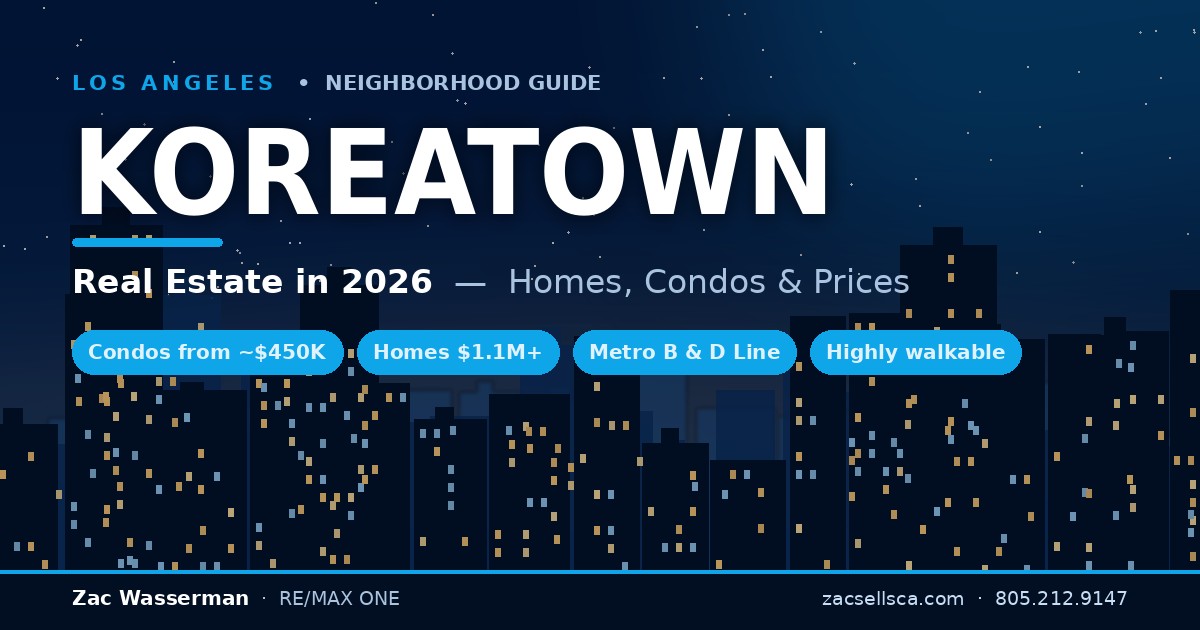
2026 Los Angeles Buyer Guide
Koreatown Real Estate in 2026: Homes, Condos & What Buyers Should Know
A practical look at Koreatown prices, condos, homes, lifestyle, neighborhoods, and what Los Angeles buyers should understand before making an offer.
Few Los Angeles neighborhoods pack as much energy into a single square mile as Koreatown. If you are researching Koreatown real estate in 2026, you have probably already noticed the contrast: pre-war courtyard buildings sitting beside glassy high-rises, 24-hour restaurants, and some of the most walkable blocks in the city. As a licensed REALTOR® serving Los Angeles and Ventura County, I get asked about K-Town constantly, and for good reason. It remains one of the few central LA neighborhoods where buyers can still find condos under seven figures with genuine upside.
However, buying here is not as simple as picking a listing you like. The Koreatown market rewards buyers who understand the building types, the pockets, and the quirks of a neighborhood that shifts block by block. Therefore, this guide walks you through everything you need: current prices, condos versus homes, what daily life actually feels like, and how to make a smart offer in 2026.
Thinking about buying in Koreatown?
I can help you compare buildings, HOA costs, recent comparable sales, and individual blocks before you commit.
Talk With ZacWhy Koreatown Is One of LA's Most Talked-About Neighborhoods
Koreatown sits just west of Downtown Los Angeles, bounded loosely by Beverly Boulevard, Pico, Vermont, and Western. Additionally, it is one of the densest neighborhoods in the entire country, which explains the wall-to-wall energy. You get nightlife, spas, karaoke, and world-class food within steps of your front door, all at a scale that genuinely surprises first-time visitors.
For buyers, that density is the whole appeal. Because so much is packed into so little space, Koreatown consistently ranks among the most walkable and transit-connected areas in LA. The Metro B and D (Purple) Line stations at Wilshire/Vermont and Wilshire/Western put Downtown, Hollywood, and eventually the Westside within an easy ride, and the Metro D Line extension is steadily widening that reach. As a result, many buyers here happily skip the second car, which is rare in car-dependent Los Angeles.
Furthermore, the neighborhood draws a mix of young professionals, creatives, and long-term investors. That diversity keeps demand steady across price points, from entry-level condos to renovated Spanish-style income properties. If you are weighing K-Town against other central options, my guide to the best neighborhoods in Los Angeles County puts it in context alongside the rest of the city.
The Koreatown Real Estate Market in 2026: Prices & Trends
Let's talk numbers, because this is where things get interesting. The neighborhood is overwhelmingly a condo and multifamily market rather than a single-family one. Consequently, "median price" here depends heavily on what type of property you are looking at, and a single headline figure can be misleading.
2026 Pricing Snapshot
Rule of thumb: Koreatown is a condo-first market, so the right comparison is price per square foot plus monthly HOA — not the headline list price. Budget for both before you tour.
In 2026, most condos in Koreatown trade in a broad range from the mid $400,000s for smaller or older units up to $900,000 and beyond for renovated two-bedrooms in newer buildings. Meanwhile, the rare single-family homes and small income properties, often historic Spanish or Craftsman builds, can list anywhere from $1.1 million to well over $2 million depending on lot size and condition. On a price-per-square-foot basis, K-Town still tends to undercut much of the Westside, which is exactly why value-focused buyers keep circling back to it.
Inventory remains tighter than buyers would like, however, and well-priced units still move quickly. Additionally, HOA dues matter enormously here. A luxury high-rise with a pool, gym, and concierge can carry dues of $600 to $1,000 per month, while a smaller vintage building may run a fraction of that. Therefore, I always tell clients to underwrite the monthly HOA as seriously as the purchase price itself. For current sold data, I cross-reference the MLS against public sources like Zillow's Koreatown market data so my clients see the full picture, not just active listings.
Koreatown Condos vs. Homes: What You Can Actually Buy
Because inventory skews so heavily toward attached housing, most buyers here are choosing among a few distinct building types. Understanding them upfront saves you a lot of wasted showings and false starts.
- Luxury high-rises: Primarily along Wilshire Boulevard, offering amenities, security, and skyline views, but generally carrying the highest HOA dues and price per square foot.
- Mid-century and 1980s mid-rise condos: A large share of Koreatown inventory and often a strong value option, although buyers should inspect aging plumbing and electrical systems carefully.
- Converted vintage buildings and small-lot single-family homes: Less common and often competitive when they come to market at an attractive price.
For first-time buyers especially, the math matters more than the marketing. Before you fall in love with a high-rise, it is worth running the full monthly picture, including HOA and taxes, against your budget. My Los Angeles home affordability guide is a good place to pressure-test your numbers before you start touring, since the payment on a $700,000 condo with high dues can rival a much pricier home elsewhere.
The HOA payment can change the entire affordability equation.
When comparing Koreatown condos, look beyond the list price. Monthly dues, insurance, reserves, upcoming assessments, parking, and building condition can materially change what a property really costs to own.
What It's Like Living in Koreatown
Numbers only tell half the story, so let's talk about daily life. Living in Koreatown means trading square footage and a private yard for convenience, culture, and walkability that almost no other LA neighborhood can match.
On the plus side, you are surrounded by extraordinary food, late-night options, grocery stores, gyms, and nightlife, most of it walkable from your door. Public transit is genuinely usable here, and the central location shortens commutes to Downtown, Hollywood, and Mid-Wilshire. On the other hand, parking is famously tight, some blocks are noisier than others, and green space is limited compared to the suburbs. Consequently, K-Town tends to suit buyers who prioritize lifestyle and location over space and quiet.
It is also a neighborhood that rewards a test run. Because the character changes so quickly from street to street, I often suggest clients spend an evening in a target pocket before writing an offer. For buyers weighing this urban lifestyle against something calmer, an honest comparison helps. Many of my clients ultimately debate central LA versus a quieter commute from the suburbs; if that is you, my guide on moving to Ventura County from Los Angeles lays out that trade-off clearly.
The Best Pockets and Streets to Know Before You Buy
Koreatown is not one uniform neighborhood, and where you buy inside it matters as much as what you buy. Therefore, knowing the pockets is a real advantage that pays off at resale.
The Wilshire corridor holds most of the luxury high-rises and the strongest resale liquidity. The area around Windsor Square and Larchmont, on the northwest edge, blends into some of the priciest historic streets and commands a clear premium. Meanwhile, the blocks near Vermont and 6th have seen heavy investment and newer construction, while the southern and eastern edges tend to offer the best entry-level pricing. Because values can swing meaningfully from one block to the next, I strongly recommend touring at different times of day, on both weekdays and weekends, before committing to anything. A unit two blocks apart can differ in price, noise, and resale demand far more than the listing photos suggest. For that reason, I map every serious buyer's shortlist against nearby comparable sales so we can tell whether a given block is trending up or simply riding the neighborhood's overall momentum.
Is Koreatown Real Estate a Good Investment in 2026?
This is the question I hear most from investors, and the honest answer is nuanced. Koreatown real estate has real long-term fundamentals: extreme density, chronic housing demand, strong rental absorption, and ongoing transit investment. As a result, well-located units have historically held value and rented easily, even through softer stretches in the broader market. Few central-LA neighborhoods combine this much walkability with this much remaining upside on price per square foot.
However, an investment here lives or dies on the details. Rent-control rules apply to many older multifamily buildings under the LA Rent Stabilization Ordinance, so you must verify a building's status before you underwrite it. Additionally, HOA health, deferred maintenance, and building reserves can make or break a condo purchase, since a special assessment can erase a year of cash flow overnight. For pure cash flow, K-Town can be competitive; for appreciation plus livability, it is genuinely compelling. Because the closing math in LA carries its own quirks, I walk investor clients through the closing costs LA buyers actually pay so there are no surprises at the finish line.
How to Buy a Home in Koreatown (Step by Step)
Once you decide the neighborhood is right for you, the path to closing is straightforward if you plan for it.
Throughout the process, my job is to protect your downside while you focus on the upside. Because I work both the urban LA market and the surrounding suburbs, I can give you a clear-eyed take on whether K-Town truly fits your goals or whether another area would serve you better. That objectivity matters most on the biggest purchase of your life.
Want help comparing Koreatown condos and buildings?
I can help you evaluate recent sales, monthly HOA costs, building reserves, parking, location, and resale considerations before you write an offer.
Start Your Koreatown SearchFrequently Asked Questions About Koreatown Real Estate
What is the average price for Koreatown real estate in 2026?
It depends heavily on property type. Most condos trade between the mid $400,000s and roughly $900,000, while renovated units and the rare single-family homes can exceed $1.1 million. HOA dues vary widely and should be factored into every comparison you make.
Are condos in Koreatown a good buy?
For many buyers, yes. Koreatown condos offer central-LA walkability at prices below much of the Westside. However, HOA dues, building reserves, and unit condition vary enormously, so a careful review of the HOA package is essential before you commit.
Is Koreatown a safe place to live?
Like much of central Los Angeles, safety varies block by block. Some pockets feel quiet and residential while others are busier and louder. Touring at different times of day, and getting a local agent's honest read, is the best way to judge a specific street.
Can I invest in a Koreatown property with rental income in mind?
You can, and many do. Rental demand is strong given the density and transit access. That said, many older buildings fall under LA rent-control rules, so you must confirm a property's status and run conservative numbers before buying.
How competitive is the Koreatown market right now?
Inventory stays relatively tight, so well-priced, move-in-ready units still attract multiple offers. Overpriced or dated listings, by contrast, tend to sit. As a result, pricing strategy and speed both matter a great deal in this market.
Ready to Explore Koreatown Real Estate?
Koreatown is one of the most dynamic places to buy in Los Angeles, but it rewards buyers who go in informed. If you are ready to explore Koreatown real estate with someone who knows both the neighborhood and the numbers, let's talk. Contact Zac Wasserman at RE/MAX ONE, your local Los Angeles and Ventura County expert, at zacsellsca.com or call 805.212.9147. I will help you find the right building, the right pocket, and the right price in 2026.
Contact Zac Call 805.212.9147About the Author
Zac Wasserman, REALTOR® | CA DRE# 02210760 | RE/MAX ONE
Zac Wasserman is a licensed California REALTOR® serving buyers and sellers throughout Los Angeles and Ventura County. His real estate guides focus on practical neighborhood insight, property-level due diligence, market data, and the financial details buyers need to make informed decisions.
- All Posts
- Buyer Guides
- California Home Insurance & Wildfire Risk
- Home Financing (Mortgage & Loan Guides)
- Market Updates & Forecasts
- Seller Guides
- Back
- Ventura County Real Estate Market Updates
- San Fernando Valley Real Estate Market Updates (Monthly): Prices, Inventory & Trends

Ventura County & Los Angeles Real Estate What the September 2026 Fed Rate Hike Means for Ventura County & LA...
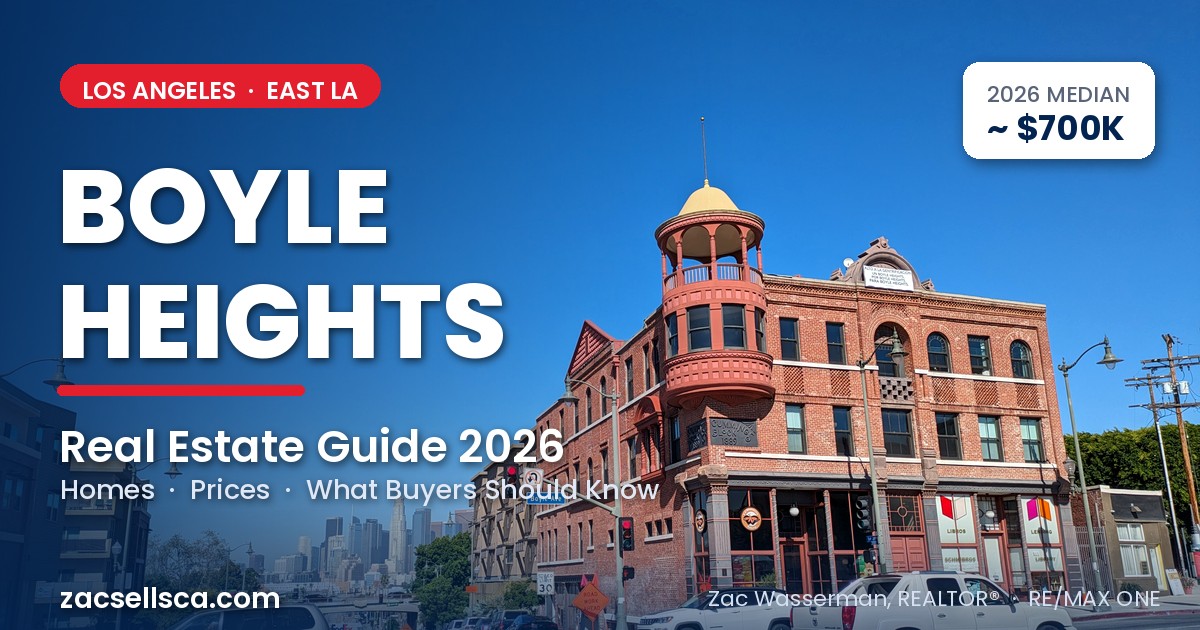
East Los Angeles Real Estate Guide • 2026 Boyle Heights Real Estate Guide 2026: Homes, Prices & What Buyers Should...
Koreatown Real Estate in 2026: Homes, Condos & What Buyers Should Know 2026 Los Angeles Buyer Guide Koreatown Real Estate...

Explore Port Hueneme investment properties in 2026, from multifamily and NNN opportunities to owner-financed and commercial real estate near the...
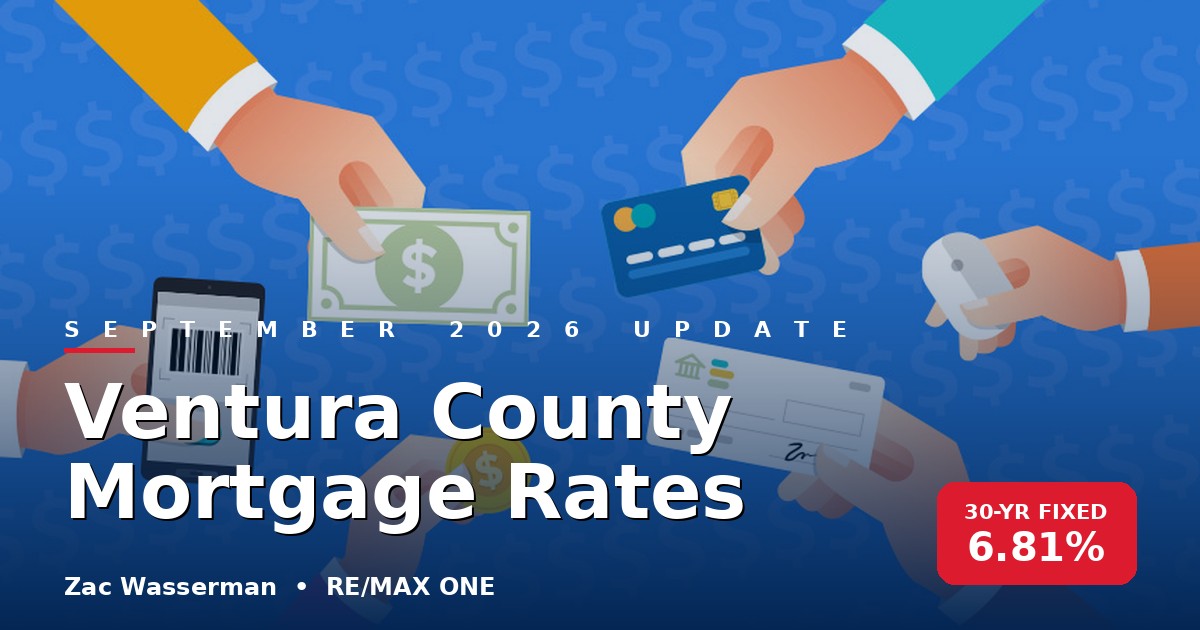
Ventura County mortgage rates are near a one-year high in September 2026. See current 30-year, 15-year, and ARM rates, real...

Can You Sell an ADU Separately in California? Your 2026 AB 1033 Guide for LA & Ventura County Sell an...