
Updated February 13, 2026
How Much House Can I Afford in Los Angeles? (2026 Buying Power Guide)

Real LA County affordability, simplified: how lenders look at DTI, what your down payment changes, and what payment ranges look like across condos, townhomes, and single-family homes—without guessing.
Quick Answer / Summary (Los Angeles County, 2026)
- Most buying power starts with DTI: many buyers aim for ~28/36 (housing / total debt), but the “real” number depends on program, credit, and reserves.
- In LA, HOA + insurance are deal-shapers—a condo with a $650 HOA can reduce your purchase price more than you expect.
- Jumbo territory shows up fast in many LA areas; structure matters (down payment, debt cleanup, cash reserves).
- Affordability vs commute is often the core trade-off: Valley SFH vs Westside condo is usually a payment-first decision.
- Common LA entry strategy: studio/1BR or starter condo to build equity, then trade up.
If you're searching "how much house can I afford in Los Angeles", this guide walks you through the lender math (DTI), LA-specific costs (tax, insurance, HOA), and real payment examples so you can answer "how much house can I afford in Los Angeles" with confidence.
Los Angeles County is one of the most “range-y” housing markets in the country: the difference between a Downtown condo, a Westside starter, a South Bay townhome, and a San Fernando Valley single-family home can be hundreds of thousands—sometimes for the same monthly payment once HOA, insurance, and commuting are factored in. If you’re asking how much house can I afford in Los Angeles, you don’t need a generic calculator—you need the right framework for LA pricing and LA monthly costs.
In this 2026 guide, I’ll show you how much house can I afford in Los Angeles using the exact lens lenders use (DTI), then translate it into LA reality: condo-heavy inventory, higher HOA prevalence, more jumbo-loan scenarios, and neighborhood trade-offs that are basically “payment vs commute.”
Table of Contents
- Quick estimate (2026)
- The 28/36 rule (how lenders think)
- DTI math step-by-step
- LA County pricing by area (why “LA” isn’t one market)
- Real payment examples (5 incomes)
- Down payment impact (3% vs 10% vs 20%)
- LA County costs: tax, insurance, HOA
- Condo-first strategy (studio/1BR entry point)
- Jumbo loans in LA County
- Affordability vs commute: the LA trade-off
- Loan programs (FHA / Conventional / VA)
- Buyer checklist: boost buying power
- Common mistakes (and fixes)
- FAQ (7 questions)
- Related resources
How much house can I afford in Los Angeles? Quick estimate (2026)
Here’s the fastest way to estimate affordability without pretending every buyer is identical: start with a target monthly housing payment range, then back into a purchase price after adding the LA-specific “extras” (especially HOA and insurance). The reason this works: lenders approve a payment, not a lifestyle.
Step 1: Pick a realistic housing payment target.
Many buyers anchor to a monthly number they can live with comfortably, then confirm the lender math (DTI) supports it.
Step 2: Add LA recurring costs.
For condos/townhomes, HOA can be $300–$800+ per month. Insurance can be higher in fire zones or coastal areas.
Step 3: Back into price using a rate assumption.
Rates move. Your lender will quote your actual scenario. This guide shows the framework so you can adjust quickly.
Step 4: Sanity-check with neighborhood reality.
A “max approval” isn’t always a smart target—especially in LA where commute and HOA can change everything.
Payment-first rule (LA County): If two homes cost the same monthly amount, the “better deal” is usually the one with less HOA burden, lower insurance friction, and an area you can realistically live in for 5+ years.
How much house can I afford in Los Angeles using the 28/36 rule?
You’ll hear “28/36” constantly because it’s an easy framework: 28% of gross monthly income toward housing, and 36% toward total monthly debt (housing + other debts). But it’s not a hard law—some programs allow higher, and some buyers should aim lower for comfort.
| Metric | What it means | Why it matters in LA County |
|---|---|---|
| Front-end DTI (housing) | Housing payment ÷ gross monthly income | HOA pushes this up quickly; a condo can “feel” affordable until HOA is counted. |
| Back-end DTI (total) | (Housing + all monthly debts) ÷ gross monthly income | Car payments + student loans are common buying-power killers—especially when prices are already high. |
| Housing payment (PITI + HOA) | Principal + Interest + Taxes + Insurance (+ HOA if applicable) | LA buyers often underestimate HOA and insurance more than taxes. |
How much house can I afford in Los Angeles after debts (DTI math step-by-step)
Let’s do the exact DTI math lenders use. You’ll need two numbers: your gross monthly income and your monthly debt payments. If you want an official explainer of DTI concepts, the CFPB has a clear overview here: consumerfinance.gov/ask-cfpb/what-is-a-debt-to-income-ratio-en-1791.
DTI formula: Back-end DTI = (housing + debts) ÷ gross monthly income.
Example inputs: $120,000 income = $10,000/month gross. Debts: $650 car + $250 student loan = $900/month.
If targeting 36% back-end: Max total debt ≈ 0.36 × $10,000 = $3,600/month.
Max housing payment ≈ $3,600 − $900 = $2,700/month (before you even pick a neighborhood).
From there, you convert the max housing payment into a price by subtracting monthly taxes/insurance/HOA, then seeing what’s left for principal + interest. This is why “I can afford $900K” is incomplete in LA: a $900K condo with a $750 HOA can be tougher than a $950K SFH with no HOA.
LA County affordability reality check: prices vary wildly by area
“Los Angeles” is not one market. Use this as a buyer’s mental map (not a promise of specific pricing): the same budget can land you totally different home types depending on location, commute patterns, and HOA prevalence.
| Area | What tends to be “more affordable” here | What often surprises buyers |
|---|---|---|
| San Fernando Valley | More SFH opportunities vs Westside at similar budgets | Heat/AC usage + insurance variation; commute to Westside job centers can be the trade-off |
| West LA / Westside | Condos/townhomes as common entry point | HOA and competition; “starter SFH” is rare at many budgets |
| South Bay | Townhomes/condos; some pockets with value | Beach proximity premium; inventory constraints |
| Downtown LA | Condo-heavy inventory, commute-friendly for some | HOA, building financials, and lifestyle fit matter a lot |
| Northeast / East LA | Emerging affordability pockets depending on micro-neighborhood | Street-by-street variability; renovation vs turnkey pricing gaps |
| South / Southeast LA | Entry-level opportunities (varies by city + block) | Program eligibility + appraisal dynamics; buyer competition still exists in “value” zones |
If you’re exploring Valley options, I also publish regular local context—see my San Fernando Valley market update and use it as the pricing/competition backdrop for the numbers in this guide.
Real monthly payment examples (5 income levels with LA price points)
These examples are intentionally “clean” to illustrate buying power. Your lender will run your exact scenario (credit score, debts, rate, HOA, taxes, insurance). The goal is to give you a practical framework you can adjust quickly—especially if you’re comparing a condo vs SFH or a longer commute vs higher price.
| Household income | Illustrative “max price” target | What that often looks like in LA County | Best strategy lens |
|---|---|---|---|
| $80K | ~$475,000 | Studios/1BRs + select condos in some areas | Minimize HOA + keep reserves |
| $100K | ~$600,000 | Entry condos; some townhomes; occasional SFH pockets depending on city | Payment-first, then location |
| $120K | ~$700,000 | Better condo options; starter homes in some submarkets | Debt cleanup = big leverage |
| $150K | ~$900,000 | Competitive near countywide median territory; still neighborhood-dependent | Structure + speed wins |
| $200K | ~$1,200,000 | Westside/closer-to-coast options improve; more SFH choices | Watch jumbo thresholds |
Why these are “max targets,” not always “smart targets”: Your max approval may leave you house-poor, especially if HOA, commuting, and insurance friction stack up. The best plan is usually: pick a comfortable monthly payment → verify DTI → then shop neighborhoods that fit that payment.
Down payment impact: 3% vs 10% vs 20% (what changes most)
Down payment isn’t only about avoiding PMI—it also changes your monthly payment, your interest cost, and sometimes your approval. In LA County, it can also change whether you land in conforming vs jumbo territory (and the underwriting experience that comes with it).
| Down payment | Pros | Trade-offs | Best for |
|---|---|---|---|
| 3%–5% | Gets you in sooner; preserves cash | Higher payment + PMI; underwriting may be tighter | Buyers with strong income stability and reserves |
| 10% | Meaningful payment reduction; often better pricing/approval | Still may have PMI; cash-to-close still significant | Most “balanced” LA buyers |
| 20% | Lower payment; PMI often avoided; stronger offers | Opportunity cost (tying up cash); not always necessary | Buyers optimizing monthly payment and competitiveness |
Don’t forget the “hidden” down payment factor: cash reserves. Especially if you’re near jumbo thresholds, lenders often want to see reserves after closing. This is one reason a 10% down plan with reserves can beat a 20% down plan that leaves you tight. (If you want the full “cash-to-close” picture, see my California closing costs guide.)
How Much House Can I Afford in Los Angeles? Property Tax, Insurance & HOA Impact
LA County affordability is not just purchase price. It’s monthly carry cost. These three items change buying power the most: property tax, home insurance, and HOA (if applicable). Here are practical ranges buyers should budget for.
Property tax: often ~1.0%–1.2% (varies by city and special assessments). Even small differences add up monthly.
Home insurance: commonly ~$1,800–$4,000+ annually, and higher in fire zones or certain areas. Insurance availability can be the bigger issue than cost.
HOA (condos/townhomes): commonly $300–$800+/month. HOA can “eat” purchase price fast because it counts in DTI.
Maintenance reality: SFH may have no HOA, but you should plan for repairs. Condos shift some of that into HOA dues.
If insurance is a big variable for your target areas, I strongly recommend reading: Home Insurance 2026 (FAIR Plan + DIC), Earthquake Insurance 2026, and Flood Insurance 2026. In 2026, insurance is not an afterthought in Southern California—it’s part of qualifying.
Condo-first strategy in LA: studio/1BR as an entry point
In LA County, many buyers build their first chunk of equity in a condo—often a studio or 1BR—because it’s the most realistic entry point in a high-price market. The strategy is simple: buy a home you can afford now, then trade up later once equity + income growth do their thing.
Condo-first entry strategy (when it works best):
1) Your payment is stable and comfortable.
2) HOA is reasonable for the building quality and reserves.
3) The location fits your lifestyle so you’ll actually stay long enough to benefit (often 3–5+ years).
4) You can see a clear “trade-up path” in your budget timeline.
When evaluating "how much house can I afford in Los Angeles" as a condo buyer, the key warning is: an HOA is a permanent payment. So we evaluate condos with two lenses: (1) the monthly payment, and (2) the building’s health (budget/reserves/insurance). If you want help evaluating condo HOAs and building documents, reach out and I’ll help you build a clean shortlist.
Jumbo loan territory in LA County: what buyers need to know
LA buyers run into jumbo territory more often because purchase prices can jump quickly from “starter” to “median” to “premium.” The most important takeaway: jumbo loans can be absolutely doable, but they often come with tighter requirements (credit, reserves, documentation) and different pricing dynamics than conforming loans.
Two practical moves when you’re near jumbo territory: (1) Know the current conforming loan limit and price your search accordingly (see my 2026 loan limits guide), and (2) optimize your profile early (debt cleanup, reserves, clean deposits, stable income documentation).
Neighborhood trade-offs: affordability vs commute time
In LA County, the affordability conversation is often a commute conversation. Many buyers face one of these decisions: Valley SFH vs Westside condo, South Bay beach premium vs inland space, or Downtown convenience vs HOA-heavy buildings.
| Trade-off | What you usually gain | What you usually give up |
|---|---|---|
| Valley vs Westside | More space / more SFH options at similar budget | Commute time to certain job centers |
| Condo vs SFH | Location and entry price (sometimes) + less exterior maintenance | HOA + building rules; sometimes less privacy |
| Coastal vs Inland | Lifestyle + climate premium | Higher prices; tighter inventory |
The winning approach is not “pick the cheapest” or “stretch for the dream.” It’s: define the monthly payment that protects your life, then pick the area that gives you the best long-term fit at that payment. For current Valley context, keep an eye on my SFV market update.
Loan programs in LA County: FHA vs Conventional vs VA
The “best” program is scenario-specific. Here’s the practical buyer lens in LA County: choose the program that (1) gets you approved confidently, (2) keeps the monthly payment manageable, and (3) makes your offer competitive.
FHA (low down payment, flexible credit)
FHA can be a strong entry option, especially for first-time buyers—but mortgage insurance rules are different than conventional. It can also impact competitiveness in some multiple-offer situations depending on property condition and appraisal dynamics.
Conventional (flexible structures, strong competitiveness)
Conventional loans cover a wide range of down payments and can be very competitive. PMI can be avoidable or removable depending on structure. If you’re near conforming limits, this is where knowing the 2026 loan limits matters.
VA (powerful benefit for eligible buyers)
VA loans can be extremely strong for eligible buyers, often with favorable terms and low down payment options. The key is pairing it with a clean offer strategy. If you’re VA-eligible and buying in LA County, we’ll map neighborhoods that match your payment goals without forcing you to overreach.
Buyer checklist: how to increase approval + buying power fast
If you want to afford more (or at least avoid surprises), this is the highest ROI checklist in LA County:
| Move | Why it matters | LA-specific benefit |
|---|---|---|
| Reduce monthly debts (car, revolving) | Directly improves back-end DTI | Often unlocks the next price tier in LA without changing income |
| Shop HOA intelligently | HOA counts in DTI like interest does | A $600 HOA can reduce your price ceiling dramatically |
| Build reserves | Underwriting and comfort factor | Especially important near jumbo territory |
| Plan cash-to-close | Down payment + closing costs + prepaid items | Avoid last-minute stress—see closing costs guide |
| Insurance early check | Availability can be the issue, not just price | Use Home Insurance 2026 as your playbook |
Fastest affordability win for many LA buyers: pay down (or restructure) the highest monthly debt item. A single car payment can be the difference between “only condos” and “townhome or starter SFH” in the right pocket.
Common affordability mistakes LA buyers make (and fixes)
Mistake #1: Asking "how much house can I afford in Los Angeles" by price instead of payment
Two homes at the same price can have totally different payments once HOA and insurance are included. Fix: create a payment-based target range, then filter listings by payment reality (PITI + HOA).
Mistake #2: Ignoring HOA “quality”
Not all HOAs are equal. Some fund real maintenance and reserves; some are underfunded and risky. Fix: review HOA docs and building insurance early—especially for condo-heavy areas like DTLA.
Mistake #3: Waiting for “perfect” while prices and rent keep moving
In LA, a smart “entry home” can be a strategic move. You don’t need your forever home first. Fix: consider the condo-first strategy if it fits your life and your payment.
Mistake #4: Not planning cash-to-close
Buyers often focus on down payment and forget closing costs and prepaids. Fix: use my closing costs guide and build a conservative buffer.
FAQ: How much house can I afford in Los Angeles?
1) What DTI should I target in LA County?
Many buyers start with a 28/36 framework, but your program and credit matter. If you want comfort (not just approval), aim lower—especially with HOA-heavy condos.
2) Do HOAs count in DTI?
Yes. HOA is treated like a recurring monthly housing cost. In LA, HOA is one of the biggest reasons affordability differs between condos and SFHs.
3) Is 20% down required in LA?
No. Many buyers use low-down options. The trade-off is monthly payment and mortgage insurance. The best plan is the one that protects your cash reserves and keeps the payment sane.
4) How do jumbo loans change affordability?
Jumbo loans can come with tighter qualification and reserve expectations. If you’re near the conforming limit, loan structure and documentation quality become extra important.
5) Can I afford a single-family home in LA County, or should I start with a condo?
It depends on your payment target and location preferences. Many buyers start with a studio/1BR or starter condo, build equity, then trade up—especially in high-price job-center areas.
6) What costs do buyers underestimate most in LA?
HOA dues, insurance variability (especially fire-zone friction), and cash-to-close. Price is only half the equation; monthly carry cost is the real affordability metric.
7) What’s the best first step if I want a real affordability number?
Get a lender pre-approval and pair it with a payment-first neighborhood plan. If you want, I’ll help you translate approval into realistic LA areas and home types.
Related resources (to build your LA buyer plan)
Use these next to round out your “buyer education cluster” and avoid surprise costs:
- Ventura County affordability guide (sister post)
- San Fernando Valley market updates (pricing + competition context)
- 2026 loan limits (conforming vs jumbo awareness)
- California closing costs guide (cash-to-close planning)
- Home insurance 2026 guide (FAIR Plan + DIC)
- Earthquake insurance 2026 (CEA vs private)
- Flood insurance 2026 guide
- Home value report
- All Posts
- Buyer Guides
- California Home Insurance & Wildfire Risk
- Home Financing (Mortgage & Loan Guides)
- Market Updates & Forecasts
- Seller Guides
- Back
- Ventura County Real Estate Market Updates
- San Fernando Valley Real Estate Market Updates (Monthly): Prices, Inventory & Trends
Ventura County Mortgage Rates: September 2026 Update September 2026 Mortgage Update Ventura County Mortgage Rates: September 2026 Update Rates have...

Can You Sell an ADU Separately in California? Your 2026 AB 1033 Guide for LA & Ventura County Sell an...

Conejo Valley Market Update · Fall 2026 Thousand Oaks Real Estate Market Update: Fall 2026 Prices remain firm, inventory is...
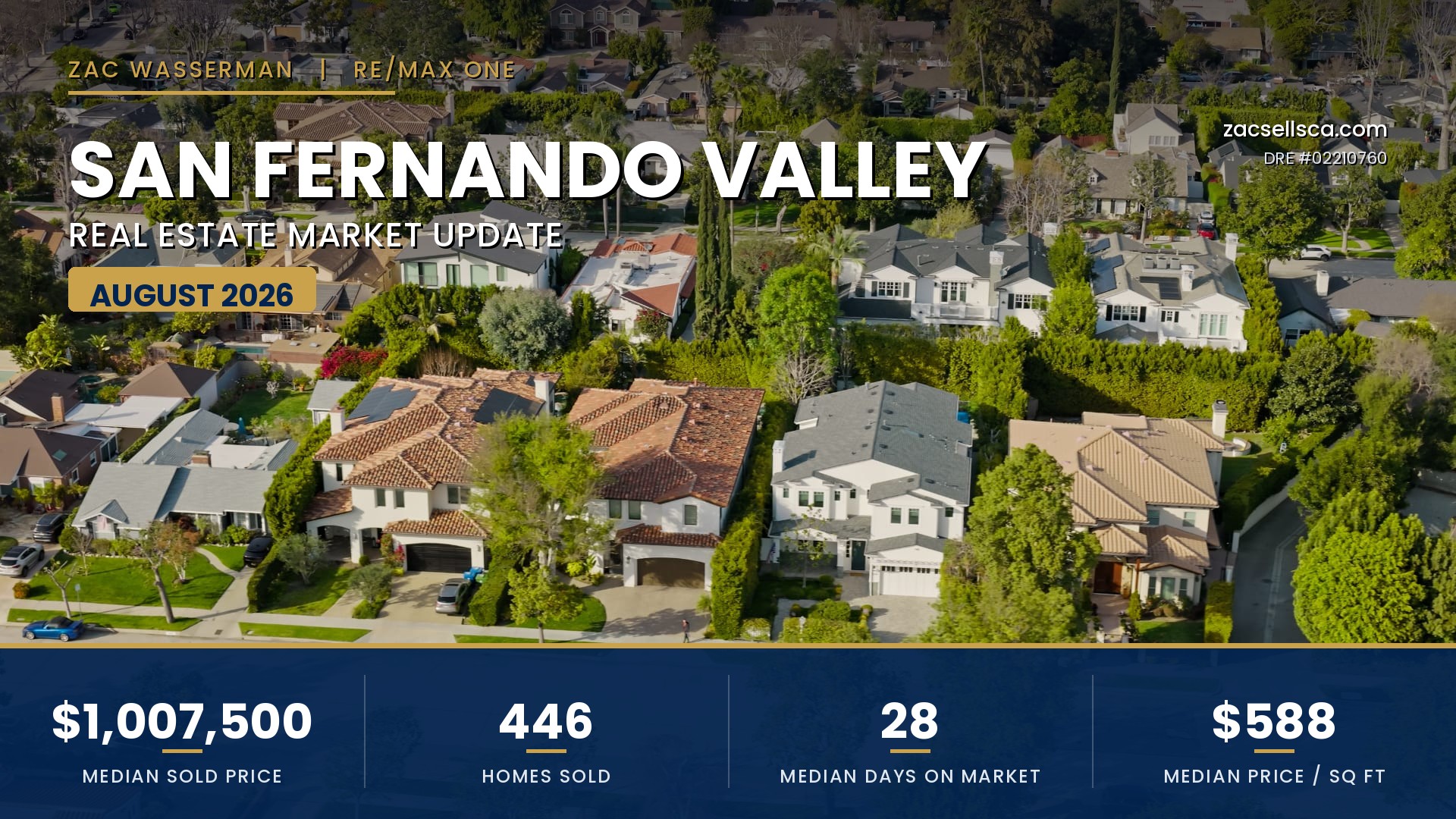
August 2026 • Local Market Report San Fernando Valley Housing Market Update: August 2026 Prices, Trends & City-by-City Data By...

Ventura County Real Estate Market Update: August 2026 Ventura County Market Update — August 2026 Ventura County Real Estate Market...

Ventura County Real Estate Guide • 2026 Ventura County Foreclosures in 2026: How to Buy Smart or Sell Fast A...