

Ventura County Foreclosures in 2026: A Buyer & Seller Guide
Buying a distressed property? Facing missed payments or a possible foreclosure? This local guide breaks down what Ventura County buyers and homeowners need to know before making their next move.
If you have been searching for Ventura County foreclosures — whether you want to buy one below market, or you are a homeowner falling behind and worried about losing your house — you have probably noticed the same thing I have. The information out there is thin, out of date, or written for a national audience that has never set foot in Oxnard, Ventura, or Simi Valley. As a licensed REALTOR® with RE/MAX ONE right here in Ventura County, I want to give you the real, local picture for 2026, and I want to serve both sides of this conversation: the buyers hunting for deals and the owners quietly hoping to avoid a foreclosure altogether.
Let me start with the honest truth that shapes everything else on this page. Ventura County foreclosures are far rarer today than most people assume, and that single fact changes how you should approach buying one — and why, if you are struggling, you almost certainly have better options than you think.
Buyers: genuine REO and auction inventory is limited, so preparation matters. Homeowners: existing equity may give you a path to sell before foreclosure and protect more of what you have built.
The Ventura County Foreclosure Market in 2026
Here is the context that national headlines miss. After the 2008 crash, foreclosures flooded the market and prices collapsed. That is the mental image most people still carry. However, the 2026 market looks nothing like that era. Homeowners across Ventura County are sitting on historically high levels of equity, because prices climbed steadily for more than a decade. As a result, when an owner runs into trouble, they usually have enough equity to sell on the open market and walk away with cash rather than surrender the home to the bank.
Consequently, the supply of genuine Ventura County foreclosures is thin. You will still find distressed listings, trustee sales, and bank-owned (REO) properties scattered across the county, from Ventura and Oxnard down to Simi Valley and Thousand Oaks. Nevertheless, they are the exception, not the rule — and the good ones attract heavy competition, often from cash investors who move fast. Therefore, if you are a buyer, patience and preparation matter more than they would in a buyer's market. And if you are a distressed owner, that equity cushion is your leverage.
It also helps to understand the difference between the terms you will see thrown around. A "pre-foreclosure" simply means the owner has received a notice of default but still owns the home — it is not for sale unless they choose to sell. A trustee sale, or foreclosure auction, is the public sale that happens if the default is never cured. Finally, an REO is a property the lender took back after the auction produced no buyer, and that is the category most everyday buyers actually purchase. Because these three stages get lumped together online, a lot of searchers waste weeks chasing homes that were never available. For a broader view of the pricing and inventory conditions shaping all of these dynamics, see my overview of the Ventura County housing market 2026.
Before considering a cash offer or foreclosure, find out what your home may actually be worth.
Your equity position determines which options are realistically available — and whether selling could allow you to pay off the loan and keep the remaining proceeds.
Get a Free Home ValuationWhere to Find Ventura County Foreclosures for Sale
When people search for Ventura County foreclosures for sale, they usually land on a portal, get a wall of "pre-foreclosure" pins, and quickly realize most of those are not actually for sale. So let me clarify where the real inventory lives.
First, bank-owned (REO) homes appear on the regular MLS just like any other listing, which means a local agent can set you up with alerts the moment one hits. Additionally, government agencies list foreclosed properties through official channels — the HUD Home Store publishes federally owned homes, and Fannie Mae and Freddie Mac run their own REO portals. Furthermore, trustee (auction) sales are published in public notices and on county records, though those are a very different animal, which I will cover below.
The strongest foreclosure search uses three sources
For example, a buyer who wants exposure to every genuine opportunity should combine three feeds at once: MLS alerts for REO listings, the federal HUD and GSE portals, and a relationship with an agent who hears about distressed situations before they are broadly marketed. In contrast, relying on a single consumer app will leave you chasing stale "pre-foreclosure" leads that never become available. Because timing is everything here, having someone local watching the MLS on your behalf is the single biggest advantage you can give yourself.
How to Buy a Foreclosure in Ventura County (Step by Step)
Buying distressed property is not the same as buying a standard listing. However, the process is very learnable, and the payoff can be a home below full market value. Here is the path I walk buyers through.
- Get fully pre-approved first. Since foreclosures move fast and many require proof of funds up front, financing readiness is non-negotiable. If you are unsure of your budget, my guide on how much house can I afford in Ventura County is the place to start.
- Choose your channel. REO (bank-owned) purchases feel closest to a normal transaction and allow financing and inspections. Trustee auctions, by contrast, typically demand all cash, offer no inspection, and transfer the property with any existing liens — high risk, expert territory only.
- Inspect aggressively where you can. Distressed homes are often sold as-is and may have deferred maintenance, so budget for repairs and always inspect on REO deals.
- Write a clean, strong offer. Because banks favor certainty, a well-documented offer with solid financing (or cash) and few contingencies wins more often than a slightly higher but messier one.
- Plan for a slower close on REO. Banks move on their own timeline, so patience through paperwork is part of the deal.
If this is your first purchase of any kind, my step-by-step home buying guide covers the fundamentals that apply here too. Additionally, working with an agent who has closed distressed deals will keep you out of the traps that catch first-timers at auction.
I can help you separate properties that are actually available from the pre-foreclosure noise and compare the numbers against conventional Ventura County listings.
Talk With Zac About Your SearchCash Home Buyers and Foreclosures: How the Numbers Really Work
A lot of the searches in this space come from owners who see billboards and mailers promising to "buy houses in foreclosure" for cash. So let me be straight about how cash home buyers in Ventura County actually operate, because understanding the math protects you.
Cash buyers and "we buy houses" investors serve a real purpose: speed and certainty. They can close in days, take the home as-is, and remove the stress of showings. However, that convenience has a price. Typically, an investor offer lands well below what the same home would fetch on the open market, because their business model depends on buying at a discount, renovating, and reselling. Therefore, an owner with equity almost always nets more by listing — even a quick, as-is listing — than by taking the first cash offer that arrives.
That said, cash sales are not automatically a bad deal. For an owner facing an imminent trustee sale date with no time to list, a fast cash close can be the difference between a controlled sale and a foreclosure on their credit. Additionally, some owners simply value certainty over squeezing out the last dollar, and there is nothing wrong with that choice when it is made with clear information. The key is to know what you are trading away before you sign. Because these investors count on you not comparing offers, even one competing bid can move the price meaningfully. As a result, the right answer depends entirely on your timeline and your equity position — which is exactly the kind of situation where a quick conversation with a local agent pays for itself many times over.
How to Sell a Distressed Property in Ventura County
If you are the one searching how to sell a distressed property in Ventura County, first, take a breath — you have more control than the situation feels like it gives you. Because of today's equity levels, most distressed owners in our area can still sell traditionally and keep their proceeds. Here is how I approach it.
I start by pulling your true equity picture: current market value against what you owe, including any missed payments. Then we weigh your timeline. If you have weeks or months before any legal deadline, a standard or lightly-prepped listing usually nets you the most money, and I can market it as-is so you spend nothing on repairs. If the home simply is not attracting offers, the fix is often positioning and pricing rather than condition — I break that down in why your house isn't selling in Ventura County.
However, if a trustee sale date is bearing down, we shift to speed: a quick as-is listing to competing cash buyers, or a direct cash sale if the calendar demands it. The point is that you choose the path with the facts in front of you, rather than letting the bank choose for you. The very first step is simply knowing your number, and you can get a free home valuation to see where you stand before you decide anything.
A valuation gives us the starting point for estimating equity and comparing an open-market sale, an as-is sale, and a direct cash offer.
Request My Free Home ValuationAlternatives to Foreclosure for Struggling Homeowners
Foreclosure is not the only door, and it is rarely the best one. Before anything else, if you have fallen behind, contact your loan servicer and a HUD-approved housing counselor — the Consumer Financial Protection Bureau maintains free resources and counselor directories. Additionally, several options may keep foreclosure off your record entirely.
Potentially changes loan terms to make payments manageable.
May provide a path through a temporary financial hardship.
May be considered when the home's value cannot cover the debt owed.
For owners with equity, selling can resolve the loan while preserving remaining proceeds.
For instance, loan modifications, repayment plans, and forbearance can bridge a temporary hardship. Furthermore, for owners without enough equity to sell profitably, a short sale — where the lender accepts less than the full balance — can be far less damaging to your credit than a completed foreclosure. And for the majority of local owners who do have equity, a traditional sale simply resolves the whole problem while protecting your cash and your credit. Since every one of these paths has deadlines, the earlier you act, the more doors stay open.
Foreclosures vs. Standard Listings: What to Expect on Price
Buyers often assume every foreclosure is a steal. However, the discount varies widely. REO homes sometimes sell close to market value once you factor in needed repairs and competition from other buyers. Auction properties can carry deeper discounts, but they also carry deeper risk — unknown condition, possible liens, and no financing.
In contrast, a standard resale gives you disclosures, inspections, and negotiating room. Therefore, the smart way to think about Ventura County foreclosures is not "cheaper is always better," but "what is my true all-in cost, including repairs and risk, versus a comparable standard listing?" Frequently, once you run that math honestly, a well-negotiated standard home wins. Nevertheless, the right distressed deal at the right price is still a genuine opportunity — which is why having someone run the comparison with you matters.
| Property Type | Financing | Inspection | Typical Risk |
|---|---|---|---|
| Standard resale | Generally available | Generally available | Lower |
| REO / bank-owned | Often available | Often available | Moderate |
| Trustee auction | Typically cash | Typically unavailable | High |
Frequently Asked Questions
Are there a lot of foreclosures in Ventura County right now?
No — foreclosures are historically rare here in 2026. High homeowner equity means most owners in trouble sell on the open market rather than lose the home, so genuine bank-owned and auction properties are the exception, not the norm.
How do I find Ventura County foreclosures for sale?
Combine three sources: MLS alerts for bank-owned (REO) listings through a local agent, official government portals like the HUD Home Store and the Fannie Mae/Freddie Mac REO sites, and public trustee-sale notices. Consumer apps often show "pre-foreclosures" that are not actually for sale.
Should I sell my distressed Ventura County home to a cash buyer?
Only if your timeline demands it. Cash offers close fast but usually come in well below market value. Because most local owners have equity, a traditional or quick as-is listing typically nets more money. Compare your options before accepting any offer.
Can I stop a foreclosure once it starts?
Often, yes. Loan modifications, repayment plans, forbearance, a short sale, or simply selling before the trustee sale date can all prevent a completed foreclosure. Contact your servicer and a HUD-approved counselor early — the sooner you act, the more options you keep.
Can I use a regular mortgage to buy a foreclosure?
For bank-owned (REO) homes, usually yes — they sell much like standard listings and allow financing and inspections. Trustee auction properties, however, typically require all cash and offer no inspection, so they are best left to experienced investors.
Is buying a Ventura County foreclosure actually cheaper than a normal home?
Sometimes, but not always. REO homes often sell close to market value once you add repair costs and account for competing buyers, while auction homes can be cheaper but carry real risk from unknown condition and possible liens. The smart move is to compare your true all-in cost — purchase price plus repairs plus risk — against a comparable standard listing before you decide.
Ready to make your move on Ventura County foreclosures?
Whether you are hunting for the right distressed deal or you are an owner who needs a plan before a deadline arrives, you do not have to navigate this alone. I will run the numbers with you honestly — no pressure, no billboard tactics. Contact Zac Wasserman at RE/MAX ONE, your local Ventura County expert, at 805.212.9147 or ZacSellsCA@gmail.com, or start with a free home valuation to see exactly where you stand today.
30699 Russell Ranch Rd #100, Westlake Village, CA 91362
This article is provided for general real estate information and is not legal, tax, credit, or financial advice. Foreclosure procedures and deadlines are situation-specific. Homeowners facing foreclosure should contact their loan servicer and, when appropriate, a qualified attorney, tax professional, or HUD-approved housing counselor.
- All Posts
- Buyer Guides
- California Home Insurance & Wildfire Risk
- Home Financing (Mortgage & Loan Guides)
- Market Updates & Forecasts
- Seller Guides
- Back
- Ventura County Real Estate Market Updates
- San Fernando Valley Real Estate Market Updates (Monthly): Prices, Inventory & Trends

Ventura County Mortgage Rates October 2026 October 2026 Mortgage Market Update Ventura County Mortgage Rates October 2026: 7.4% and What...
Ventura County Home Seller Guide | Fall / Winter 2026 Should You Sell Now or Wait Until Spring? Ventura County...

SEPTEMBER 2026 · MARKET UPDATE San Fernando Valley Housing Market Update: September 2026 Prices, Trends & City-by-City Data The median...
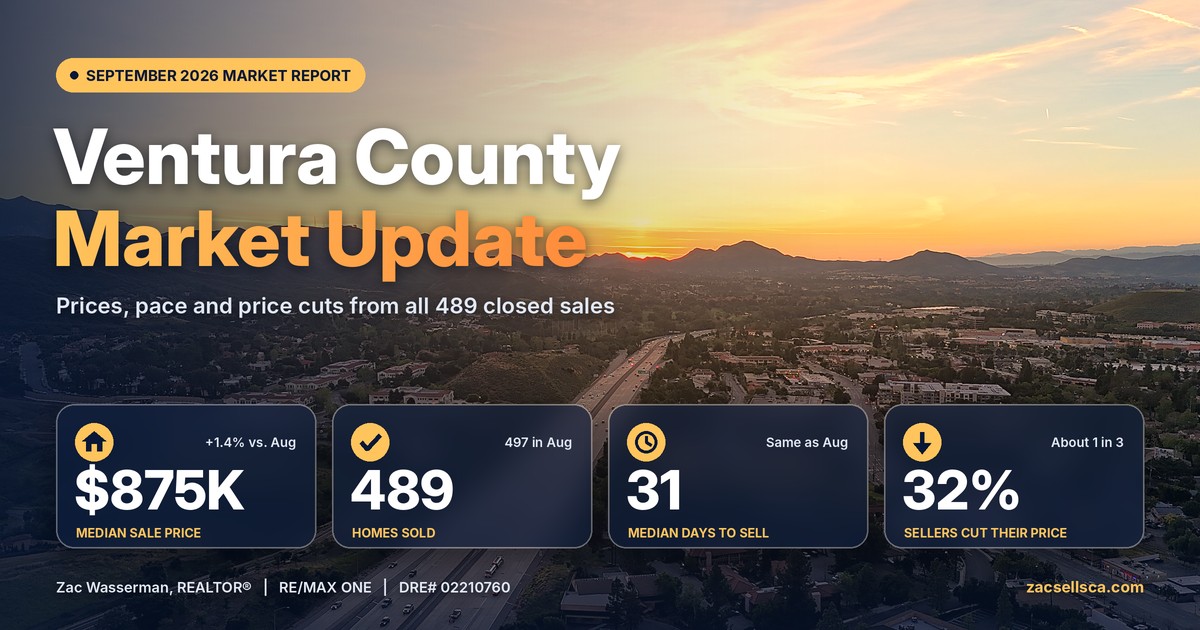
Ventura County’s September 2026 housing market: $875K median price, 489 closed sales, 31 days on market, and city-by-city data for...

State Farm filed to start writing new California home policies again, but only for homes with an IBHS Wildfire Prepared...

Encino real estate in 2026: see median home and condo prices, 494 closed sales, 91436 vs. 91316 trends, neighborhood insights,...