
Down Payment Assistance in California 2026: What’s Still Available After Dream For All Closed
Dream For All closed its 2026 application window, but California buyers still have access to grants, deferred loans, forgivable assistance and zero-interest closing-cost help.
Zac Wasserman, REALTOR® · RE/MAX ONE · CA DRE #02210760
If you have been waiting on the sidelines for down payment help, you already know the news: California’s flagship Dream For All program closed its 2026 application window on March 16, and no new applications are being accepted. For a lot of would-be buyers across Ventura County and the San Fernando Valley, that felt like the door slamming shut. However, the good news is that Dream For All was never the only game in town. There is still strong down payment assistance California 2026 buyers can tap right now — grants, deferred loans, and zero-interest closing-cost help that most people have never heard of.
I’m Zac Wasserman, a licensed REALTOR® with RE/MAX ONE here in Ventura County, and I walk buyers through these programs all the time. So let’s clear up the confusion. Below, I’ll break down exactly what closed, what’s still open, how much money you can actually get, and how to qualify — without the jargon.
The key takeaway
Dream For All closed, but down payment assistance did not.
CalHFA MyHome, CalPLUS with ZIP, GSFA Platinum, Golden Opportunities and certain local housing programs may still help qualified buyers reduce their upfront cash requirement.
Dream For All update
What Happened to Dream For All?
First, let’s address the program everyone is asking about. The California Dream For All Shared Appreciation Loan was the most generous down payment program the state has ever offered. It provided up to 20% of a home’s purchase price, capped at $150,000, with no monthly payments, in exchange for the state sharing in a portion of the home’s future appreciation.
Because demand always far outstripped funding, CalHFA switched to a lottery-style system. For 2026, the pre-registration portal opened on February 24 and closed on March 16, 2026. After that date, no new applications could be started or submitted. CalHFA has been issuing vouchers to selected applicants through a randomized drawing, and that process is expected to continue until funds run out, likely by the end of 2026.
Bottom line: If you did not apply before the March 16, 2026 deadline, you cannot enter the current Dream For All round. Therefore, the practical move is to evaluate programs that are still accepting qualified buyers.
Programs still available
Down Payment Assistance in California 2026: What’s Still Available
The truth is, the down payment assistance California 2026 offers goes far beyond a single program. California still has a whole stack of options that did not close, do not use the Dream For All lottery, and may accept applications throughout the year. As a result, many buyers who missed Dream For All can still get substantial help. The major options include CalHFA MyHome, CalPLUS paired with ZIP, GSFA Platinum and Golden Opportunities, plus several local Ventura County and city resources.
Deferred second loan
CalHFA MyHome
Up to 3.5% with a CalHFA FHA loan or up to 3% with a CalHFA conventional loan.
Generally intended for eligible first-time buyers and repaid when the home is sold, refinanced or the first mortgage is paid off.
Closing-cost assistance
CalPLUS + ZIP
ZIP may provide approximately 2% to 3% of the loan amount as a deferred, 0% interest loan.
Designed to help cover closing costs and may be combined with MyHome in qualifying transactions.
Gift + second mortgage
GSFA Platinum
Up to 5.5% of the first mortgage loan amount, with a portion potentially structured as a gift.
No first-time homebuyer requirement. The home must generally be used as the buyer’s primary residence.
Flexible qualification
Golden Opportunities
Up to approximately 5% in assistance with a potentially forgivable component.
May allow lower credit scores and higher debt-to-income ratios than some other assistance options.
CalHFA MyHome Assistance Program
The MyHome Assistance Program is CalHFA’s workhorse down payment program, and unlike Dream For All, it is generally available throughout the year. It offers a deferred-payment “silent second” loan to help cover your down payment or closing costs.
Specifically, MyHome provides up to 3.5% of the purchase price, or appraised value, whichever is lower, when paired with a CalHFA FHA loan, or up to 3% when paired with a CalHFA conventional loan. The phrase “silent second” matters here: there are no monthly payments on this loan. Instead, you repay it only when you sell, refinance, or pay off your first mortgage. As a result, your monthly housing cost stays based on your primary mortgage alone.
To qualify, you generally must be a first-time homebuyer, meaning you have not owned a home in the past three years, occupy the home as your primary residence, complete a homebuyer education course, and meet CalHFA’s income limits for your county. Because MyHome must be combined with a CalHFA first mortgage, you will work through a CalHFA-approved loan officer rather than applying directly with the state.
Review CalHFA homebuyer programsClosing-cost strategy
CalPLUS + ZIP: Help With Your Closing Costs
Down payments get all the attention, but closing costs in Ventura County can blindside first-time buyers. That is where the CalHFA CalPLUS loan paired with the Zero Interest Program, commonly called ZIP, comes in.
CalPLUS is a CalHFA first mortgage with a slightly higher fixed interest rate than the standard product, and in exchange it bundles in extra assistance. The ZIP portion is a deferred-payment loan with a 0% interest rate, used specifically for closing costs.
Depending on the option selected, ZIP can cover roughly 2% to 3% of the loan amount. Furthermore, CalPLUS with ZIP can often stack with MyHome, allowing qualified buyers to address both their down payment and closing costs at the same time.
GSFA Platinum and Golden Opportunities: Grants You Don’t Repay
If you are not a first-time buyer — or you simply want the chance at money you never have to pay back — the Golden State Finance Authority deserves a hard look. GSFA runs two programs that, importantly, have no first-time homebuyer requirement at all. You can own a home today and still qualify, as long as the new property will be your primary residence.
GSFA Platinum
Offers up to 5.5% of the first mortgage loan amount in assistance, delivered as a combination of a second mortgage and a gift portion.
The gift portion does not have to be repaid.
Golden Opportunities
May allow credit scores as low as 620 and higher debt-to-income ratios, with part of the assistance structured as a forgivable loan.
This can make the program more flexible for buyers with tighter qualification profiles.
To put real numbers on it, 5% assistance on a $600,000 loan is roughly $30,000 toward your down payment and closing costs. GSFA programs work with FHA, VA, USDA and conventional loans, generally require a 640 credit score for Platinum, and allow debt-to-income ratios up to 50% in many cases.
For Ventura County, income eligibility currently extends to roughly $259,000 — far higher than many buyers assume. One timing note worth flagging: the broadest version of GSFA’s Platinum “Select” benefit runs through June 30, 2026, so buyers considering it should ask a participating lender about the current terms immediately.
Review GSFA PlatinumLocal Down Payment Help in Ventura County
Beyond the statewide programs, do not overlook local resources. The County of Ventura administers housing programs funded through federal HOME and CDBG dollars, and individual cities sometimes offer their own homebuyer assistance or resale-restricted affordable homeownership opportunities. These programs change with funding cycles and are frequently first-come, first-served, so availability shifts throughout the year.
In addition, buyers in nearby Los Angeles County can look at the LACDA Affordable Homeownership Program for down payment help. Because local funds can sometimes be layered on top of an FHA first mortgage and a statewide program, they may meaningfully reduce your cash to close when the timing lines up. The key is working with a lender and agent who track what is open in your specific city.
Low- and No-Down Loan Options: FHA, VA and USDA
Sometimes the best “assistance” is simply a loan that does not demand 20% down in the first place. Three loan types do exactly that, and each may pair with the assistance programs above.
FHA
Requires as little as 3.5% down and offers flexible credit guidelines.
VA
Eligible veterans and active service members may qualify for zero-down financing.
USDA
Certain eligible properties in more rural areas may qualify for zero-down USDA financing.
Consequently, between a low-down first mortgage and a down payment assistance program, many buyers can reach the closing table with far less cash than they originally expected.
Side-by-side comparison
How Much Down Payment Assistance Can You Get in California in 2026?
The amount and repayment terms depend on the program, loan type and buyer qualification profile.
Here is a quick comparison. MyHome provides up to 3% to 3.5% of the purchase price as a deferred second. ZIP adds roughly 2% to 3% of the loan amount for closing costs. GSFA Platinum reaches up to 5.5% of the loan amount, with a gift portion that is never repaid, while Golden Opportunities offers up to 5% with a forgivable component. However, the right choice depends on whether you value the largest dollar amount or the most flexible qualification.
| Program | Potential Assistance | Repayment Structure | First-Time Buyer? |
|---|---|---|---|
| CalHFA MyHome | Up to 3%–3.5% of purchase price | Deferred silent second | Generally yes |
| CalPLUS + ZIP | About 2%–3% of loan amount | Deferred loan at 0% interest | Program rules apply |
| GSFA Platinum | Up to 5.5% of first mortgage | Second mortgage plus possible gift | No |
| Golden Opportunities | Up to about 5% | May include forgivable assistance | No |
On a typical Ventura County purchase, stacking the right combination can translate into tens of thousands of dollars in help. For context on what homes actually cost here, it helps to know the current median home price in Ventura County before you build your budget.
However, more assistance is not automatically better. Some help is a true grant, some is a deferred loan you repay at sale, and some may carry monthly payments. Reading the fine print on each option is where a knowledgeable lender earns their keep.
The application process
How to Qualify and Apply, Step by Step
Because none of these programs let you apply directly with the state, the process runs through an approved lender. If you are early in the process, my full first-time homebuyer guide for Ventura County walks through every step in detail.
Find an approved lender
Get pre-approved with a loan officer who actively works with CalHFA and GSFA. Not every lender does.
Complete buyer education
Finish the required homebuyer education course early so your certificate is ready before closing.
Verify eligibility
Confirm your income, credit score, debt-to-income ratio and the program’s purchase-price limits.
Choose the right combination
Match the appropriate first mortgage and assistance program to your finances and long-term plans.
Get the terms in writing
Confirm the assistance amount, repayment terms and cash-to-close estimate before writing offers.
Before you begin touring, it is also smart to determine how much house you can afford in Ventura County.
Is Down Payment Assistance Worth It?
For most buyers who are otherwise mortgage-ready but short on cash, the answer is a clear yes. These programs can be the difference between buying this year and waiting another two or three years to save.
That said, there are trade-offs to weigh. A repayable second loan adds to what you owe, deferred loans get paid back at sale, and CalPLUS carries a slightly higher first-mortgage rate in exchange for the bundled help.
The smartest approach is to compare the all-in cost of each option against waiting and saving. Buying sooner with assistance can make sense, but it is a personal math problem. If you are still deciding on timing overall, it is worth reading whether now is a good time to buy a home in Ventura County before you commit.
Get a personalized assistance plan
Find Out Which Programs Fit Your Budget Before You Start Touring
Zac can help you connect with an experienced assistance-program lender, compare your likely cash-to-close options and build a realistic Ventura County home search.
Frequently asked questions
Down Payment Assistance California 2026 FAQ
Ready to move forward?
Ready to Find Your Down Payment Help?
Dream For All closing does not mean your homeownership plans are over — far from it. Between CalHFA MyHome, CalPLUS with ZIP, GSFA Platinum, Golden Opportunities and local Ventura County resources, there is real down payment assistance California 2026 buyers can still use this year.
That is exactly what I help buyers do every day. Contact Zac Wasserman at RE/MAX ONE to identify the programs that may fit your situation and map a practical path to the closing table.
Zac Wasserman, REALTOR® · RE/MAX ONE · CA DRE #02210760
- All Posts
- Buyer Guides
- California Home Insurance & Wildfire Risk
- Home Financing (Mortgage & Loan Guides)
- Market Updates & Forecasts
- Seller Guides
- Back
- Ventura County Real Estate Market Updates
- San Fernando Valley Real Estate Market Updates (Monthly): Prices, Inventory & Trends

Ventura County Mortgage Rates October 2026 October 2026 Mortgage Market Update Ventura County Mortgage Rates October 2026: 7.4% and What...

Ventura County Home Seller Guide | Fall / Winter 2026 Should You Sell Now or Wait Until Spring? Ventura County...

SEPTEMBER 2026 · MARKET UPDATE San Fernando Valley Housing Market Update: September 2026 Prices, Trends & City-by-City Data The median...
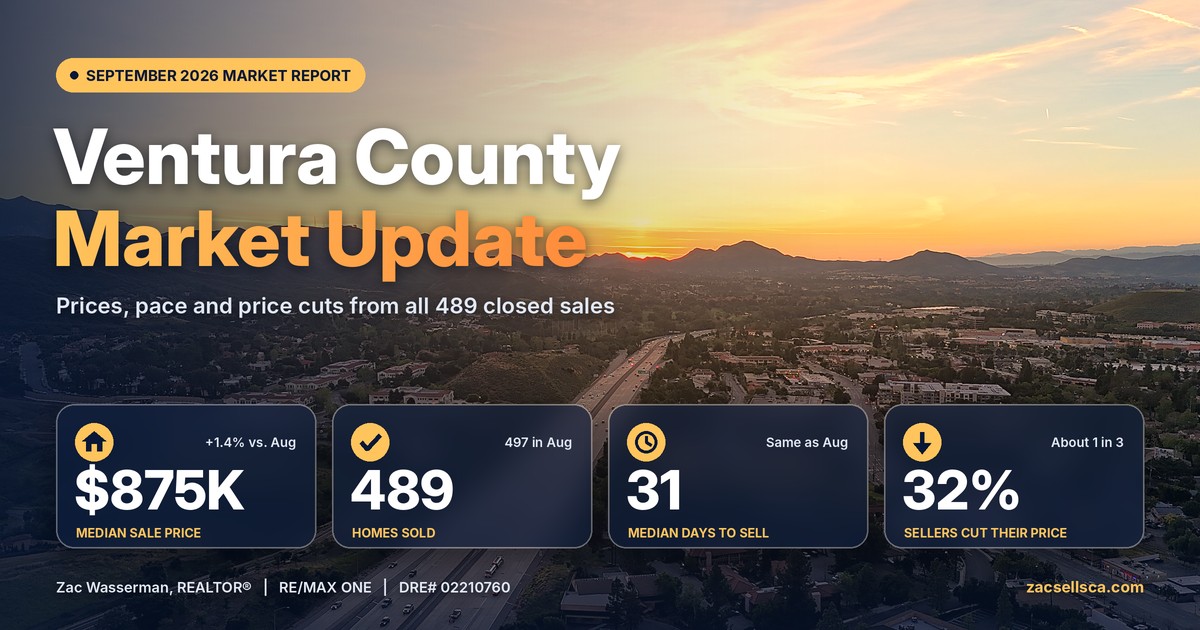
Ventura County’s September 2026 housing market: $875K median price, 489 closed sales, 31 days on market, and city-by-city data for...

State Farm filed to start writing new California home policies again, but only for homes with an IBHS Wildfire Prepared...

Encino real estate in 2026: see median home and condo prices, 494 closed sales, 91436 vs. 91316 trends, neighborhood insights,...