

Ventura County Homeowner Update
California FAIR Plan Rate Increase 2026: What It Means for Ventura County Homeowners
The 29.1% increase begins October 15, 2026. Here is what homeowners, buyers, and sellers need to know—and how to plan with confidence.
Talk With Zac About Your Next MoveThe California FAIR Plan rate increase 2026 is now official, and it lands on October 15, 2026. If you own a home in a wildfire-exposed part of Ventura County or the San Fernando Valley, this change matters — and if you are buying or selling this fall, it matters even more. As a licensed REALTOR® with RE/MAX ONE, I watch insurance shifts closely, because insurability increasingly decides whether a deal closes at all. Below, I break down exactly what the 29.1% increase does, why it is happening, and what it means for your home value and your next move.
The short version
Insurance is now part of the price, financing, and marketability of a home. Quote early, document mitigation work, and build the real premium into every decision.
What the California FAIR Plan Rate Increase Means for 2026
First, the headline. The California Department of Insurance approved a statewide average increase of 29.1% for the FAIR Plan, the state's insurer of last resort. Furthermore, the new rates take effect on all new and renewal dwelling policies dated October 15, 2026 or later. The FAIR Plan originally requested a 35.8% hike; however, the Department trimmed it to 29.1%. Even so, this remains the largest single-year increase in the plan's history.
It helps to remember what the FAIR Plan actually is. Essentially, it is a shared pool that provides basic fire coverage to homeowners who cannot find a policy on the standard market. Additionally, it is dwelling-fire coverage only — it covers fire, smoke, lightning, and internal explosion, but not theft, liability, or water damage. As a result, most FAIR Plan policyholders also carry a separate "wrap" or Difference in Conditions (DIC) policy to fill the gaps. For a full breakdown of how those two policies fit together, see my guide to home insurance and the FAIR Plan across Ventura and LA.
Why the FAIR Plan Rate Increase Is Happening
The reasons behind the California FAIR Plan rate increase 2026 are not complicated, though they are sobering. Over the past several years, major carriers such as State Farm and Allstate pulled back from wildfire-prone areas across California. Consequently, hundreds of thousands of homeowners were pushed onto the FAIR Plan because they had nowhere else to go.
The numbers tell the story. As of mid-2026, the FAIR Plan's total exposure reached roughly $768 billion — an increase of about 250% since 2022. Meanwhile, the plan now covers close to 700,000 policyholders. Then came the January 2025 Los Angeles wildfires, which generated an estimated $4 billion in FAIR Plan losses and forced the plan to assess its member insurers $1 billion just to pay claims. Therefore, the rate increase is essentially the plan catching up to a risk pool that has grown far faster than its reserves.
For local context, Ventura County is not a bystander here. In fact, FEMA ranks the county in the 99th percentile nationally for overall natural-disaster risk, with wildfire at the 100th percentile. The 2017 Thomas Fire and the 2018 Woolsey Fire are still fresh memories for many families, and both accelerated the insurer pullback we feel today. To understand the local risk picture in depth, my Ventura County wildfire insurance guide walks through it street by street.
How the 29.1% Increase Actually Hits Your Premium
Here is the part most headlines skip. The 29.1% figure is a statewide average, not a flat number applied to every policy. Because the increase is concentrated in the wildfire portion of the premium, your actual change depends heavily on where your home sits.
Specifically, homeowners with significant wildfire exposure will see far more than the average — in some cases, the wildfire portion of their premium will roughly double. On the other hand, homeowners in lower-risk zones may see a smaller increase, and a few may even see their premium hold steady or dip slightly. In short, a hillside home backing to open space and a valley-floor home a few miles away can land in very different places, even on the same street grid.
Simple example
$3,500 premium + 29.1% ≈ $1,000 more per year
That is roughly $85 more each month.
To put rough dollars on it, the FAIR Plan already averaged around $3,000 per year as of late 2025, compared with a statewide private-market average closer to $1,571. Once you add a DIC wrap, the combined cost often runs two to three times a standard homeowners policy. Apply the 29.1% increase on top of an already-elevated base, and the monthly impact becomes real money — money that lenders fold directly into your qualifying payment. Because underwriters count that premium against your debt-to-income ratio, a higher insurance bill can quietly shrink your purchasing power by tens of thousands of dollars.
What the FAIR Plan Rate Increase Means for Ventura County Home Values
Now for the question I get most from clients: does the California FAIR Plan rate increase 2026 actually move home values? The honest answer is that it moves affordability, and affordability moves values.
Here is why. When insurance costs climb, the buyer's total monthly payment climbs with it. Consequently, buyers either qualify for less or negotiate harder on price to offset the carrying cost. Additionally, insurability has become a financing gate: a lender will not fund a loan without proof of coverage, so a home that can only be insured through the FAIR Plan may draw fewer offers or sit longer on the market. For a broader look at where prices are heading, see my Ventura County housing market 2026 update.
Importantly, this is not a countywide discount. Rather, it is a sorting effect. Valley-floor and lower-risk neighborhoods may actually gain relative appeal, while some high-exposure hillside pockets face more pricing pressure. As a result, two comparable homes can now diverge in value largely because of their fire-risk profile and insurance path.
High-Risk vs. Lower-Risk Areas Across Ventura County and the SFV
Wildfire risk is never uniform, and neither is the insurance impact. Generally, the homes most exposed sit in or near the wildland-urban interface — the zones where neighborhoods press against open brush, chaparral, or steep terrain.
In Ventura County, hillside and canyon pockets near Thousand Oaks, along with foothill areas in Simi Valley and Moorpark, tend to face tighter underwriting. Meanwhile, many valley-floor neighborhoods enjoy broader standard-carrier availability. Across the county line in the San Fernando Valley, the western foothills around Woodland Hills — where the terrain climbs into the Santa Monica Mountains — carry some of the highest exposure. However, risk is highly street-specific, so two neighbors can receive very different quotes. That is exactly why I always tell clients to quote insurance early, by address, before falling in love with a home.
If You're Buying a Home Before October 15, 2026
For buyers, timing and diligence matter more than ever this fall. First, quote insurance the moment you identify a target property — not after your offer is accepted. Because the new rate applies to policies effective October 15 and later, a quote you receive in August may look different by the time you close in October.
Next, ask your broker for a clear "FAIR covers X, wrap covers Y" breakdown so you understand your true all-in cost. Additionally, factor the premium into your affordability math from day one. If you would like a framework for that, my step-by-step Ventura County home buying guide walks through budgeting, financing, and due diligence in order. Ultimately, an informed buyer is a confident buyer — and confident buyers win in negotiations.
If You're Selling a Home This Fall
If you are selling, insurability is now part of your listing strategy, not an afterthought. Buyers and their lenders will scrutinize coverage, so it pays to get ahead of it. Therefore, gather your insurance history, any defensible-space documentation, and hardening receipts before you list.
Moreover, a home that demonstrates strong fire mitigation gives buyers confidence and can protect your price. Because insurance surprises during escrow are a leading cause of renegotiation and fall-through, transparency up front keeps deals together. In addition, pricing a fire-zone home correctly from the start matters more than ever, since an overpriced listing that lingers only invites tougher insurance scrutiny and lowball offers. Curious what your home is worth in today's market, insurance realities included? You can start with a free home valuation and we can build a pricing strategy from there.
How to Lower Your FAIR Plan Premium
Fortunately, you are not powerless against the California FAIR Plan rate increase 2026. The California FAIR Plan runs a wildfire hardening discount program that lets qualifying dwelling-fire policyholders stack multiple mitigation measures for meaningful savings on the wildfire portion of their premium.
Common qualifying upgrades include Class-A fire-rated roofing, a five-foot noncombustible zone directly around the home, ember-resistant vents, and maintained defensible space. Individually, each helps; together, they can add up to a real reduction. Additionally, keeping your defensible space compliant is not just a discount lever — in many Ventura County fire zones, it is a legal requirement that protects your ability to keep coverage at all. In other words, hardening your home is both a safety move and a financial one. Start the paperwork early, keep your receipts and inspection records organized, and share them with your broker at every renewal, because documentation is often what separates an approved discount from a denied one.
Frequently Asked Questions
When does the California FAIR Plan rate increase take effect?
The 29.1% average increase takes effect on all new and renewal FAIR Plan dwelling policies with an effective date of October 15, 2026 or later. Existing customers will see the change at their next renewal on or after that date.
Will my premium go up by exactly 29.1%?
Not necessarily. The 29.1% is a statewide average, and the increase is concentrated in the wildfire portion of the premium. As a result, higher-risk homes may see much larger jumps, while lower-risk homes may see smaller increases or, in some cases, a slight decrease.
Does the FAIR Plan cover everything a normal policy does?
No. The FAIR Plan is dwelling-fire coverage only — fire, smoke, lightning, and internal explosion. Therefore, most homeowners pair it with a separate DIC or "wrap" policy to add liability, theft, and other standard protections.
How does the increase affect buying a home in Ventura County?
Because insurance is a financing requirement, higher premiums raise your total monthly payment and can affect how much you qualify for. Consequently, buyers should quote insurance by address early and factor it into their budget before making an offer.
Can I reduce my FAIR Plan premium?
Yes. The FAIR Plan's wildfire hardening discount program rewards measures such as Class-A roofing, ember-resistant vents, and a noncombustible zone around the home. Additionally, maintaining defensible space supports both your discount eligibility and your insurability.
Does this increase affect homeowners who aren't on the FAIR Plan?
Indirectly, yes. When the insurer of last resort grows more expensive and more crowded, pressure builds across the whole market. Moreover, industry groups have floated the possibility of added statewide costs to help stabilize the system, so even standard-market homeowners should watch their renewals closely.
I can't find any insurance for a home I want. What now?
This is more common than it used to be, especially in hillside zones. In that situation, a FAIR Plan plus DIC combination is often the pathway, and an experienced local agent and broker can help you map it out before the deal is at risk.
About Zac Wasserman
Licensed REALTOR® · CA DRE# 02210760 · RE/MAX ONE
Zac Wasserman serves homeowners, buyers, and sellers across Ventura County and the San Fernando Valley. He helps clients account for local insurance, financing, wildfire-risk, and market conditions before they make a high-stakes real estate decision.
Ready to Make Your Move With Confidence?
The California FAIR Plan rate increase 2026 is one more reason to work with someone who understands how insurance, financing, and local risk intersect. Whether you are buying, selling, or simply trying to understand what this means for your home's value, I am here to help. Contact Zac Wasserman at RE/MAX ONE — your local Ventura County and San Fernando Valley expert — and let's build a plan that protects your investment and your peace of mind. You can reach me directly or find out what your home is worth in today's market.
Get Your Free Home Valuation- All Posts
- Buyer Guides
- California Home Insurance & Wildfire Risk
- Home Financing (Mortgage & Loan Guides)
- Market Updates & Forecasts
- Seller Guides
- Back
- Ventura County Real Estate Market Updates
- San Fernando Valley Real Estate Market Updates (Monthly): Prices, Inventory & Trends

Ventura County Mortgage Rates October 2026 October 2026 Mortgage Market Update Ventura County Mortgage Rates October 2026: 7.4% and What...
Ventura County Home Seller Guide | Fall / Winter 2026 Should You Sell Now or Wait Until Spring? Ventura County...

SEPTEMBER 2026 · MARKET UPDATE San Fernando Valley Housing Market Update: September 2026 Prices, Trends & City-by-City Data The median...
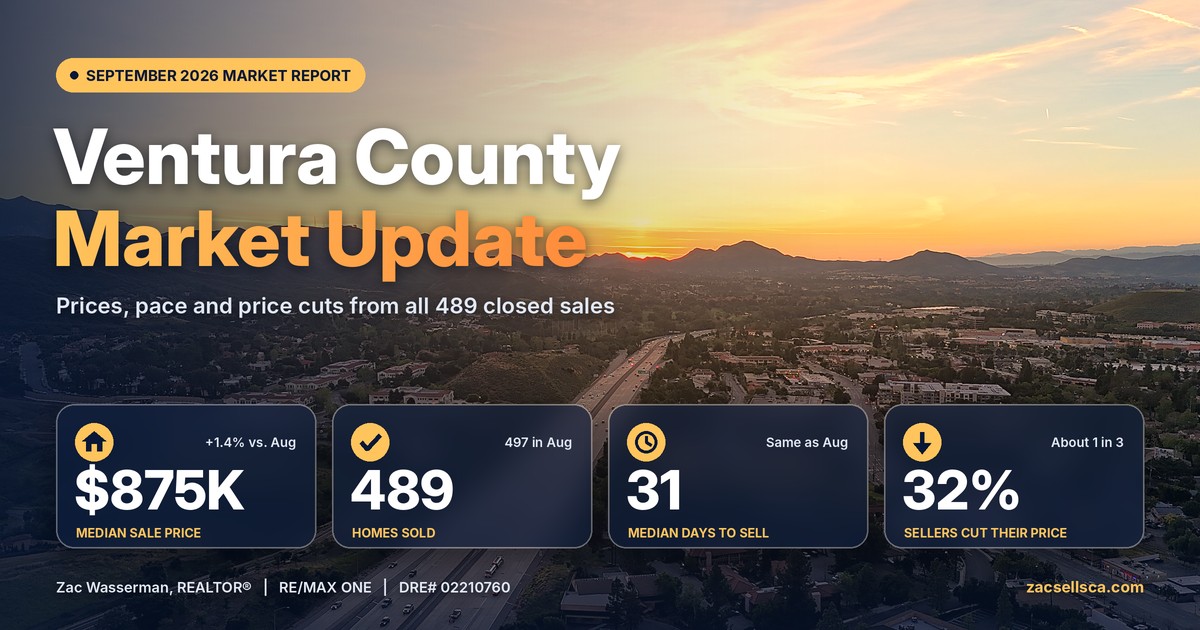
Ventura County’s September 2026 housing market: $875K median price, 489 closed sales, 31 days on market, and city-by-city data for...

State Farm filed to start writing new California home policies again, but only for homes with an IBHS Wildfire Prepared...

Encino real estate in 2026: see median home and condo prices, 494 closed sales, 91436 vs. 91316 trends, neighborhood insights,...