

Ventura County Buyer Guide · 2026 Mortgage Rate Update
How the Iran War Is Pushing Mortgage Rates Higher — And What Ventura County Buyers Should Do Now
Mortgage rates rising Ventura County 2026 is now one of the biggest buyer affordability stories of the year. Rates briefly dipped below 6% in late February, then climbed back into the mid-6% range as global conflict, oil prices, inflation fears, and Treasury yields moved higher.
If you've been watching mortgage rates in 2026, you already know the story feels frustrating. At the end of February, the average 30-year fixed mortgage rate dipped to 5.98% — the first time it had fallen below 6% since 2022. For Ventura County buyers who had been waiting on the sidelines, that felt like a green light.
Then the U.S. and Israel launched strikes on Iran on February 28th. Within weeks, mortgage rates rising in Ventura County and across the country became the dominant housing story of 2026. As of June 8, 2026, the 30-year fixed rate sits at approximately 6.48–6.53%, according to Freddie Mac's latest data — and the Iran conflict is the primary reason why.
This post explains exactly what's happening, what it means for Ventura County buyers specifically, and — most importantly — what you should actually do about it right now.
Buyer Takeaway
The mistake right now is not “buying at the wrong rate.” The bigger mistake is shopping with outdated numbers, waiting without a plan, or missing seller concessions that could lower your effective monthly payment.
What Happened to Mortgage Rates in 2026 (And Why)
To understand where mortgage rates rising in Ventura County fits into the bigger picture, it helps to trace the timeline of 2026.
The year started with genuine optimism. After the Federal Reserve's rate cuts in late 2025, the 10-year Treasury yield had been declining, and mortgage rates followed. By February 26th, Freddie Mac reported the average 30-year fixed rate at 5.98% — a meaningful psychological milestone that had buyers re-engaging across Southern California.
However, two days later, everything shifted. The U.S.-Israeli strikes on Iran triggered a chain reaction in global financial markets. Oil prices surged to their highest levels since 2022. Inflation expectations climbed. And bond investors — nervous about what a prolonged conflict and higher energy costs could mean for the economy — demanded higher yields on long-term Treasuries.
Since mortgage rates closely follow the 10-year Treasury yield, the impact was swift. The 10-year yield rose from roughly 3.96% before the war to 4.25–4.30% in the weeks that followed. Mortgage rates climbed in lockstep — from below 6% in late February to 6.11% by mid-March, 6.22% the following week, and a near seven-month high of 6.46% by early April.
As of early June 2026, the rate has settled into the 6.48–6.53% range. That's approximately half a percentage point higher than where it was when many Ventura County buyers were ready to pull the trigger just a few months ago.
How the Iran War Drives Mortgage Rates Higher
For many buyers, the connection between a Middle East conflict and their monthly mortgage payment isn't immediately obvious. Therefore, it's worth walking through the mechanism clearly.
1. Oil prices → inflation expectations
When Iran-related disruptions tighten global energy supply, oil prices rise. Higher energy costs filter through the entire economy — transportation, manufacturing, food production — and reignite fears of inflation. Economists at Realtor.com have noted that "rising energy prices and renewed trade uncertainty have lifted inflation expectations, putting upward pressure on longer-term interest rates."
2. Inflation fears → bond market sell-off
When investors believe inflation is going to be higher for longer, they sell long-term U.S. Treasury bonds. Bond prices fall, and yields rise. The 10-year Treasury yield is the key benchmark here — it's the primary driver of where 30-year mortgage rates land.
3. Higher Treasury yields → higher mortgage rates
Lenders price their mortgage products off the 10-year Treasury. When that yield rises from 3.96% to 4.25–4.30%, mortgage rates follow almost immediately. This is why mortgage rates rising in Ventura County has happened so quickly — it's a direct transmission from global financial markets to your loan quote.
4. The Fed's hands are tied
Additionally, the Federal Reserve finds itself in a difficult position. Normally, the Fed could help lower long-term rates by cutting the federal funds rate. However, with inflation expectations elevated due to oil prices, the Fed has stayed on hold. Multiple FOMC members have signaled no rate cuts in 2026 if the conflict persists.
What Rising Mortgage Rates Mean for Ventura County Buyers
Ventura County's median home prices have remained strong — hovering in the high $700,000s to low $800,000s depending on the city. Consequently, even a half-point increase in mortgage rates has a significant monthly impact. You can review current conditions in depth in my Ventura County housing market 2026 overview.
Here's what the math looks like on a $750,000 purchase with 20% down ($600,000 loan):
| Rate | Monthly Payment (P&I) | Monthly Difference vs. 5.98% |
|---|---|---|
| 5.98% (Feb. 26 low) | ~$3,590 | — |
| 6.11% (mid-March) | ~$3,635 | +$45/month |
| 6.46% (early April peak) | ~$3,750 | +$160/month |
| 6.53% (June 8, 2026) | ~$3,780 | +$190/month |
A $190/month difference may not sound catastrophic on paper. However, over 30 years, that's roughly $68,400 in additional interest paid. Furthermore, it changes what some buyers can qualify for — particularly first-time buyers stretching to afford Ventura County prices.
For buyers considering should you wait to buy a house in 2026, this rate environment makes timing more consequential than it's been in years.
Before You Pause Your Search, Recheck the Numbers
A pre-approval from February may not reflect today's payment, buying power, or seller concession opportunities. A fresh strategy can tell you whether buying still makes sense — or whether waiting is actually the smarter move.
Get a Local Buyer StrategyHow Much More Are You Paying Per Month Right Now?
Let's look at how mortgage rates rising in Ventura County plays out across a range of realistic price points. These examples use 20% down and a 6.50% rate, a reasonable current estimate for well-qualified borrowers:
| Purchase Price | Loan Amount | Est. Monthly Payment (P&I) |
|---|---|---|
| $550,000 | $440,000 | ~$2,782 |
| $700,000 | $560,000 | ~$3,541 |
| $800,000 | $640,000 | ~$4,047 |
| $1,000,000 | $800,000 | ~$5,059 |
| $1,200,000 | $960,000 | ~$6,070 |
Note that purchases above $1,249,125 in LA County (or $1,035,000 in Ventura County) enter jumbo loan territory — and jumbo rates are currently running around 6.70%. You can find a full breakdown of 2026 conforming and jumbo loan limits (https://zacsellsca.com/2026-loan-limits-ventura-los-angeles-conforming-jumbo/) for both counties here.
Should You Wait for Mortgage Rates to Drop in Ventura County?
This is the question I get most often right now, and it deserves an honest answer.
The short answer: probably not a good strategy.
The timeline is uncertain. HousingWire's Logan Mohtashami, one of the most respected housing analysts in the country, has noted that the base case range for 2026 mortgage rates is 5.75%–6.75%, with upside risk of an additional 0.375%–0.435% if the conflict continues beyond the summer. A ceasefire would bring rates down — the 10-year yield already fell when a brief two-week ceasefire was announced in April. However, no one can reliably predict when or whether that happens.
Waiting has a price. In Ventura County specifically, home prices have continued to appreciate even in this rate environment. If you wait six months hoping rates fall 0.25%, but home prices rise 2–3% in that time, you may find yourself paying more overall — even at the lower rate.
You can refinance. You can't un-buy at a lower price. The old adage "date the rate, marry the house" has real logic behind it. When rates eventually come down — and most economists believe they will over the next 12–24 months — refinancing is straightforward. But if prices appreciate while you wait, that equity gain is permanent.
That said, this isn't one-size-fits-all. If you're on the edge of qualifying at current rates, waiting and building more savings may be the smarter move. The question is whether the wait is strategic or simply anxiety-driven.
What Smart Ventura County Buyers Are Doing Right Now
Despite the rate environment, serious buyers are still moving. Therefore, here's what the most strategic buyers in the Ventura County market are doing:
1. Locking in a rate quickly once in escrow
With volatility tied to geopolitical news cycles, rates can move significantly week to week. Smart buyers are getting rate lock commitments from their lenders as soon as they open escrow — typically 30–45 day locks, with float-down options if available.
2. Asking about temporary rate buydowns
In the current environment, many sellers are motivated to help close deals. A 2-1 buydown can meaningfully lower your initial payments while you wait for rates to improve. Similarly, asking sellers to cover closing costs frees up cash you can use for a permanent rate buydown.
3. Getting crystal clear on affordability before shopping
Because rates have moved so much in such a short time, pre-approval amounts from even a few months ago may no longer be accurate. I always recommend buyers get a fresh pre-approval letter before writing offers, with the lender running the numbers at current market rates. A useful starting point is my how much house can I afford in Ventura County guide (https://zacsellsca.com/how-much-house-can-i-afford-ventura-county-2026-2/).
4. Targeting properties with equity potential
In a higher-rate environment, buying at a lower price point with room to grow is generally smarter than stretching at the top of your budget. Ventura County cities like Oxnard, Port Hueneme, and eastern Simi Valley offer lower price points than Thousand Oaks or Westlake Village — with strong appreciation potential.
5. Understanding total cash to close
Rising rates affect your monthly payment, but your cash-to-close figure at current rates may also shift depending on how your lender prices the loan. Make sure you understand the full cost structure before committing — my closing costs 2026 Ventura County guide (https://zacsellsca.com/closing-costs-2026-ventura-los-angeles-cash-to-close/) walks through what buyers typically pay in this market.
Mortgage Rate Strategies That Work in a Rising-Rate Environment
Beyond the tactical advice above, there are a few broader strategies worth considering when mortgage rates are rising in Ventura County and uncertainty is high.
Adjustable-rate mortgages (ARMs)
A 5/1 or 7/1 ARM is currently pricing around 5.70% — meaningfully lower than the 30-year fixed. If you expect to sell or refinance within 5–7 years, an ARM can offer real savings. However, this comes with risk if rates are still elevated when your adjustment period hits.
FHA and VA loans
Government-backed loan programs often carry lower rates than conventional financing — particularly VA loans, which have no PMI requirement and competitive rates for veterans and active military. If you qualify, these programs remain excellent options at any rate level.
Larger down payments
In a higher-rate environment, putting more down reduces your loan amount and therefore your payment. Additionally, a larger down payment can help you avoid PMI and potentially qualify for better loan pricing tiers.
Shorter loan terms
The 15-year fixed rate is currently around 5.79–5.89%, almost a full percentage point below the 30-year. If the monthly payment is manageable, a 15-year mortgage dramatically reduces total interest paid over the life of the loan.
Want the real number before you shop?
Get a Ventura County Buying Power Check
I can help you look at current payment ranges, realistic offer strategy, seller concession opportunities, and which Ventura County cities may give you the best value at today’s rates.
Start the ConversationFrequently Asked Questions: Iran War, Mortgage Rates & Ventura County
Why did mortgage rates go up after the Iran war started?
The Iran conflict drove oil prices sharply higher, which raised inflation expectations among investors. When inflation fears rise, bond investors sell long-term Treasuries, pushing yields up. Since mortgage rates closely follow the 10-year Treasury yield, rates climbed from below 6% in late February 2026 to roughly 6.48–6.53% by early June.
Will mortgage rates come back down in 2026?
Most economists project the 30-year rate will stay in the 6.3%–6.75% range through the end of 2026. A ceasefire or significant de-escalation in the Iran conflict could push rates lower relatively quickly, since bond markets respond fast to geopolitical news. However, the baseline expectation is that rates remain elevated for most of the year.
How much does a 0.5% rate increase cost me each month in Ventura County?
On a $600,000 loan, a 0.5% rate increase adds approximately $185–$200 per month to your principal and interest payment. Over 30 years, that amounts to roughly $66,000–$72,000 in additional interest.
Is now a bad time to buy a home in Ventura County?
"Bad" depends on your personal situation. Rates are higher than they were in February, but Ventura County home values are still appreciating, and inventory remains relatively tight. Buyers with stable income and long-term plans are still moving forward — especially with strategies like seller-paid rate buydowns and shorter lock periods.
Should I get an ARM or a fixed mortgage in this rate environment?
If you plan to own the home for 10+ years, a fixed-rate mortgage gives you certainty regardless of where rates go. If you're likely to sell or refinance within 5–7 years, a 5/1 or 7/1 ARM at around 5.70% can offer meaningful monthly savings. Talk to your lender about both options before deciding.
What can I do to get a lower mortgage rate right now?
The biggest levers are your credit score, your down payment percentage, your debt-to-income ratio, and shopping multiple lenders. Even in today's market, borrowers with strong profiles can find rates at the lower end of the range. Working with an experienced local REALTOR® can also help you negotiate seller concessions that effectively reduce your cost of financing.
The Bottom Line for Ventura County Buyers
Mortgage rates rising in Ventura County is a real challenge — and the Iran war has been the primary driver of that move in 2026. The brief window when rates dipped below 6% has closed, at least for now. However, the market hasn't stopped. Buyers who understand the landscape, move strategically, and work with experienced local professionals are still finding opportunities and closing successfully.
The rate environment will eventually change. The question is whether you want to be a homeowner in Ventura County when it does — or whether you'll be watching from the sidelines, waiting for a perfect moment that may never arrive.
If you're ready to talk through your options, I'd love to help you figure out what makes sense for your specific situation.
Contact Zac Wasserman at RE/MAX ONE
Your local Ventura County REALTOR® · CA DRE# 02210760
- All Posts
- Buyer Guides
- California Home Insurance & Wildfire Risk
- Home Financing (Mortgage & Loan Guides)
- Market Updates & Forecasts
- Seller Guides
- Back
- Ventura County Real Estate Market Updates
- San Fernando Valley Real Estate Market Updates (Monthly): Prices, Inventory & Trends
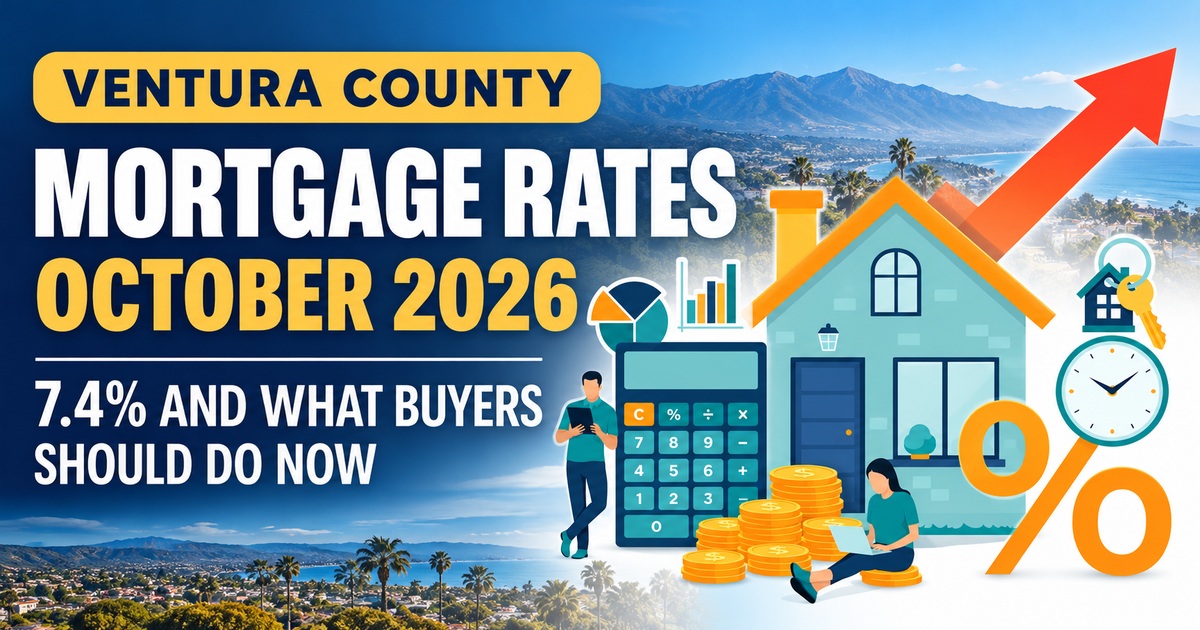
Ventura County Mortgage Rates October 2026 October 2026 Mortgage Market Update Ventura County Mortgage Rates October 2026: 7.4% and What...
Ventura County Home Seller Guide | Fall / Winter 2026 Should You Sell Now or Wait Until Spring? Ventura County...
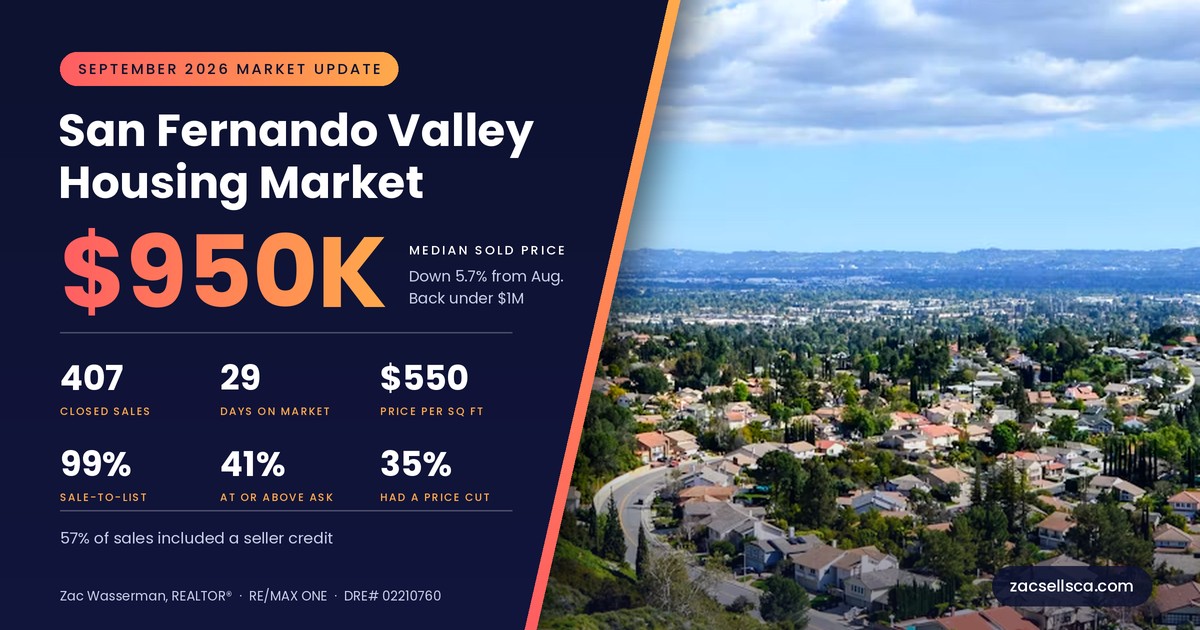
SEPTEMBER 2026 · MARKET UPDATE San Fernando Valley Housing Market Update: September 2026 Prices, Trends & City-by-City Data The median...
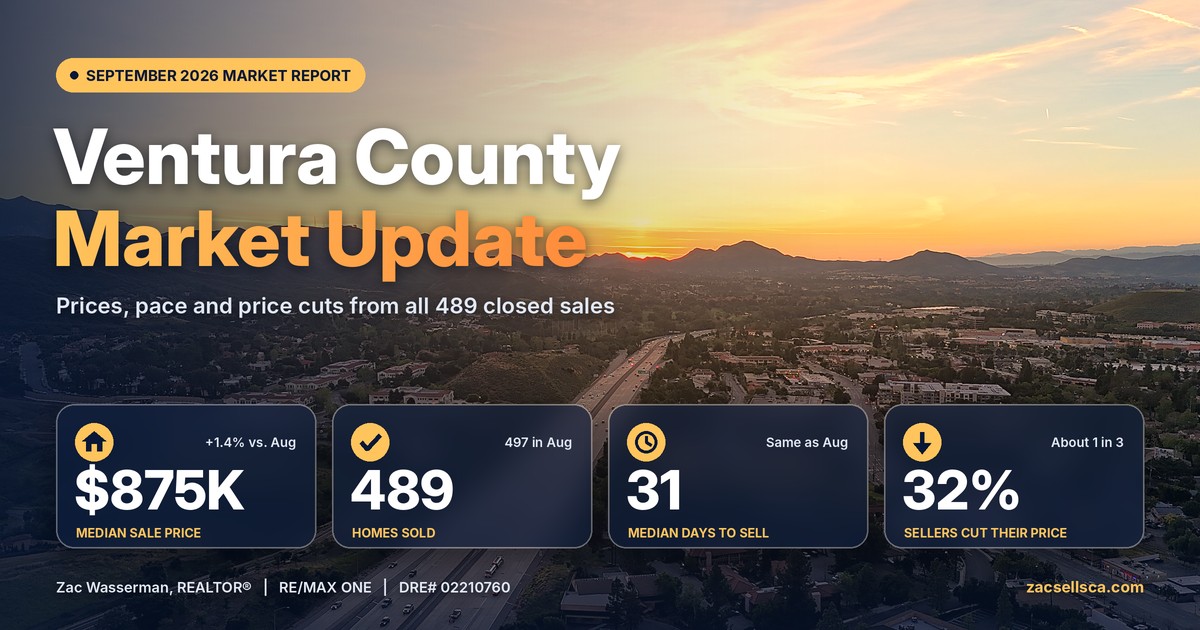
Ventura County’s September 2026 housing market: $875K median price, 489 closed sales, 31 days on market, and city-by-city data for...

State Farm filed to start writing new California home policies again, but only for homes with an IBHS Wildfire Prepared...

Encino real estate in 2026: see median home and condo prices, 494 closed sales, 91436 vs. 91316 trends, neighborhood insights,...

Sherman Oaks real estate in 2026 shows a $1.688M median for single-family homes and $655K for condos and townhomes. See...
Will the housing market crash in 2027? After the Fed's September hike, see what Ventura County prices, inventory and foreclosures...

Ventura County & Los Angeles Real Estate What the September 2026 Fed Rate Hike Means for Ventura County & LA...