

Mortgage Rates Today in Ventura County: What Changed This Week
Rates moved higher—but a major development in the oil market may have created a more favorable path for buyers heading into summer.
Local market guidance from Zac Wasserman, REALTOR® with RE/MAX ONE
If you are tracking mortgage rates today, Ventura County buyers got a genuinely interesting week. Rates nudged up over the past several days as stubborn inflation and elevated oil prices placed renewed pressure on the market—yet a major weekend development shifted part of the outlook in the other direction.
So which way are rates actually heading? Below, I will break down where rates sit right now, what moved them, and what it could mean if you are buying a home in Ventura County this summer.
I am Zac Wasserman, a local REALTOR® with RE/MAX ONE, and I update this rate snapshot regularly so you can make decisions using current numbers rather than a headline from three months ago.
The Bottom Line
Rates rose slightly, but the near-term outlook improved
The latest completed Freddie Mac survey placed the 30-year fixed at 6.52%. Inflation remains the main obstacle, but falling oil prices could reduce some pressure if the U.S.–Iran framework holds and energy markets continue stabilizing.
Current Rate Snapshot
Mortgage Rates Today in Ventura County: This Week at a Glance
Here is where several common loan categories stood around June 17, 2026. Mortgage rates today in Ventura County tend to track national markets because home loans are priced largely through national bond and mortgage-backed securities markets.
| Loan Type | Average Rate |
|---|---|
| 30-Year Fixed | ~6.53% |
| 15-Year Fixed | ~5.84% |
| 5/1 ARM | ~5.84% |
| 30-Year Jumbo | ~6.67% |
| 30-Year Refinance | ~6.64% |
Rates shown are informational national averages, not an offer to lend. Your available rate may vary based on credit, down payment, loan amount, occupancy, property type, points, lender fees, and market conditions.
For context, the 30-year fixed averaged 6.52% in Freddie Mac’s latest completed weekly survey, up from 6.48% the week before. One year earlier, the same loan averaged 6.84%. Despite the latest increase, the benchmark rate remained approximately 32 basis points below its year-earlier level.
What Changed This Week—and Why
The simple answer is that rates drifted higher, but the reasons behind the move matter more than a few basis points.
Inflation accelerated
May’s Consumer Price Index increased 4.2% year over year, the highest annual reading in approximately three years and well above the Federal Reserve’s long-term 2% inflation objective.
Energy costs stayed elevated
Oil and other energy costs remained sensitive to the Middle East conflict, adding to inflation concerns and reinforcing expectations that borrowing costs could remain elevated.
Higher inflation typically creates upward pressure on mortgage rates because investors demand greater returns to offset the declining purchasing power of future payments.
The Federal Reserve does not directly set mortgage rates. However, its policy outlook influences bond yields, investor expectations, and the broader cost of borrowing. A higher-for-longer outlook can therefore keep pressure on home-loan rates even when the Fed does not change its benchmark rate at a particular meeting.
The New Variable
The Iran Wildcard: Why the Proposed Peace Framework Matters
A tentative U.S.–Iran framework announced over the weekend created a potential path toward restoring commercial traffic through the Strait of Hormuz, a critical shipping route for global energy supplies. Oil prices initially fell sharply as markets reacted to the prospect of improved supply.
Why does that matter for your mortgage? Because part of the recent inflation pressure was connected to the conflict’s effect on oil and transportation costs. I covered that relationship in depth when I wrote about how the Iran war is pushing rates higher. If oil prices continue easing and that eventually produces cooler inflation data, some pressure on mortgage rates could also ease.
However, the agreement was still fragile as of June 17, and full implementation was not guaranteed. Rates rose during the latest completed survey period, but the near-term path became somewhat more favorable than it appeared one week earlier.
Real-World Affordability
How Mortgage Rates Today Affect Ventura County Buyers
Rate percentages can feel abstract. These examples translate today’s rates into estimated principal-and-interest payments at price points Ventura County buyers commonly encounter. Property taxes, homeowners insurance, mortgage insurance, closing costs, and HOA dues are not included.
Example 1
$850,000 home with 20% down
Estimated loan amount: $680,000
Estimated rate: 6.53%
Loan term: 30-year fixed
Principal & Interest
$4,311
estimated monthly
Condo or Townhome Example
$650,000 with 10% down
Estimated $585,000 loan at 6.53%
$3,709
estimated monthly principal and interest
Jumbo Example
$1.3 million with 20% down
Estimated $1.04 million loan at 6.67%
$6,690
estimated monthly principal and interest
To see how these numbers compare with your income, cash reserves, and other monthly obligations, my guide on how much house can I afford in Ventura County walks through the calculation step by step.
Your Number Will Be Different
See what today’s rate means for your actual budget
A small change in rate, down payment, or loan structure can materially change your monthly payment and purchasing power.
30-Year vs. 15-Year vs. ARM: What Makes Sense Right Now?
With the 30-year fixed near 6.53% and the 15-year fixed near 5.84%, the difference is meaningful. However, the lowest advertised rate is not automatically the best loan structure for every buyer.
| Loan | Potential Advantage | Primary Tradeoff | May Fit Buyers Who... |
|---|---|---|---|
| 30-Year Fixed | Lower required payment and predictable rate | More total interest over the full term | Value flexibility and plan to own long term |
| 15-Year Fixed | Faster equity growth and less total interest | Substantially higher required payment | Have strong cash flow and prioritize rapid payoff |
| 5/1 ARM | Potentially lower introductory rate | Rate and payment may adjust later | Understand the adjustment risk and may move or refinance |
Adjustable-rate mortgages have become more interesting because their introductory pricing can reduce the initial payment. Still, refinancing later is not guaranteed. For many buyers planning to stay long term, the 30-year fixed remains the simplest foundation because the payment is predictable and the loan may still be refinanced if market rates eventually improve.
Jumbo Loans and Ventura County’s High-Balance Reality
Ventura County home prices frequently push buyers into high-balance conforming or jumbo financing. For 2026, the baseline conforming limit for a one-unit property is $832,750. Ventura County’s one-unit high-balance conforming limit is $1,035,000, while the national ceiling for the country’s most expensive high-cost areas reaches $1,249,125.
Why the cutoff matters
The difference between a standard conforming, high-balance conforming, and jumbo loan can affect pricing, reserves, underwriting, down-payment options, and documentation requirements. Structuring the purchase price and down payment around a loan-limit threshold can sometimes produce a better overall financing outcome.
I break the thresholds down fully in my post on the 2026 conforming and jumbo loan limits, which is worth reviewing before you settle on a financing structure.
Will Mortgage Rates Drop Soon?
This is the question I hear most often. The honest answer is that rates could move modestly lower, but buyers should not build an entire housing strategy around a dramatic return to the 3% or 4% mortgage rates seen during the pandemic era.
Inflation remains elevated, and that limits how quickly borrowing costs can improve. At the same time, lower oil prices and a sustained reduction in geopolitical risk could support better inflation readings later in the summer.
There is another consideration: lower rates increase purchasing power, but they can also bring more buyers back into the market. A future rate drop may reduce the payment on a given loan while simultaneously increasing competition for desirable homes.
For a broader look at local prices, inventory, and buyer demand, see my breakdown of the Ventura County housing market in 2026.
Practical Next Steps
What Ventura County Buyers Should Do Right Now
Get fully pre-approved before shopping
Rates, lender fees, insurance estimates, and your available budget can shift. A current pre-approval gives you a realistic payment range and strengthens your position when the right home appears.
Compare multiple lenders and loan structures
Compare the interest rate, annual percentage rate, points, lender credits, fees, mortgage insurance, and total cash required—not merely the headline rate.
Do not make perfect timing the requirement
No one can reliably identify the exact bottom in advance. Focus on whether the home fits your needs, the payment leaves sufficient financial breathing room, and the purchase supports your longer-term goals.
If you are still weighing whether to enter the market, my guide on whether you should buy a home in Ventura County right now addresses the timing question directly. My step-by-step home buying guide also explains what to expect from pre-approval through closing.
Local Buyer Strategy
Find out what you can comfortably buy at today’s rates
I can help you evaluate neighborhoods, price ranges, current inventory, likely competition, and the payment implications of different purchase strategies.
No pressure—just a clear plan based on your goals and budget.
Buyer Questions
Frequently Asked Questions
What are mortgage rates today in Ventura County?
As of June 17, 2026, national lender averages placed the 30-year fixed mortgage rate near 6.53%, the 15-year fixed near 5.84%, and 30-year jumbo loans near 6.67%. Ventura County rates track national markets closely, but your personal rate will depend on your credit, down payment, loan size, property type, points, and lender.
Why did mortgage rates go up this week?
Rates moved higher as May inflation reached 4.2% year over year and elevated energy costs reinforced expectations that interest rates may remain higher for longer. Mortgage rates are particularly sensitive to inflation expectations and bond-market movements.
Could mortgage rates drop later this summer?
They could improve modestly if energy costs continue falling and inflation begins to cool. However, the geopolitical outlook remains uncertain, and no single peace announcement or inflation report guarantees consistently lower rates.
Is now a good time to buy a home in Ventura County?
It depends on your finances, housing needs, expected ownership timeline, and monthly payment—not on finding a perfect rate. If the home fits your goals and the payment is comfortably sustainable, you may have the option to refinance later if rates decline.
What credit score do I need for the best mortgage rate?
A score of approximately 740 or higher commonly qualifies borrowers for more competitive conventional pricing, although lenders evaluate your entire financial profile. Available terms also depend on the loan program, down payment, debt-to-income ratio, reserves, property type, and occupancy.
Should I choose a 15-year or 30-year mortgage right now?
A 15-year fixed loan can reduce total interest and build equity faster, but it also produces a much higher required payment. For many Ventura County buyers, a 30-year fixed offers greater monthly flexibility and can potentially be refinanced later if rates decline.
Ready to Take the Next Step?
Build a home-buying plan around your goals—not the headlines
Contact Zac Wasserman at RE/MAX ONE for local Ventura County guidance on neighborhoods, inventory, negotiations, and your next move.
Are you a homeowner weighing your options? Request a free home valuation to see where you stand.
Sources and methodology: Mortgage-rate data includes the Freddie Mac Primary Mortgage Market Survey and national lender averages available as of June 17, 2026. View the Freddie Mac Primary Mortgage Market Survey. For neutral guidance on comparing loan offers, visit the Consumer Financial Protection Bureau.
Mortgage rates change daily and may change without notice. The rates and payment examples on this page are for general educational purposes only and are not an offer, approval, quote, or commitment to lend. Payment examples show estimated principal and interest only and exclude property taxes, homeowners insurance, mortgage insurance, HOA dues, closing costs, lender fees, and other expenses. Consult a licensed mortgage professional for loan-specific advice and pricing.
- All Posts
- Buyer Guides
- California Home Insurance & Wildfire Risk
- Home Financing (Mortgage & Loan Guides)
- Market Updates & Forecasts
- Seller Guides
- Back
- Ventura County Real Estate Market Updates
- San Fernando Valley Real Estate Market Updates (Monthly): Prices, Inventory & Trends
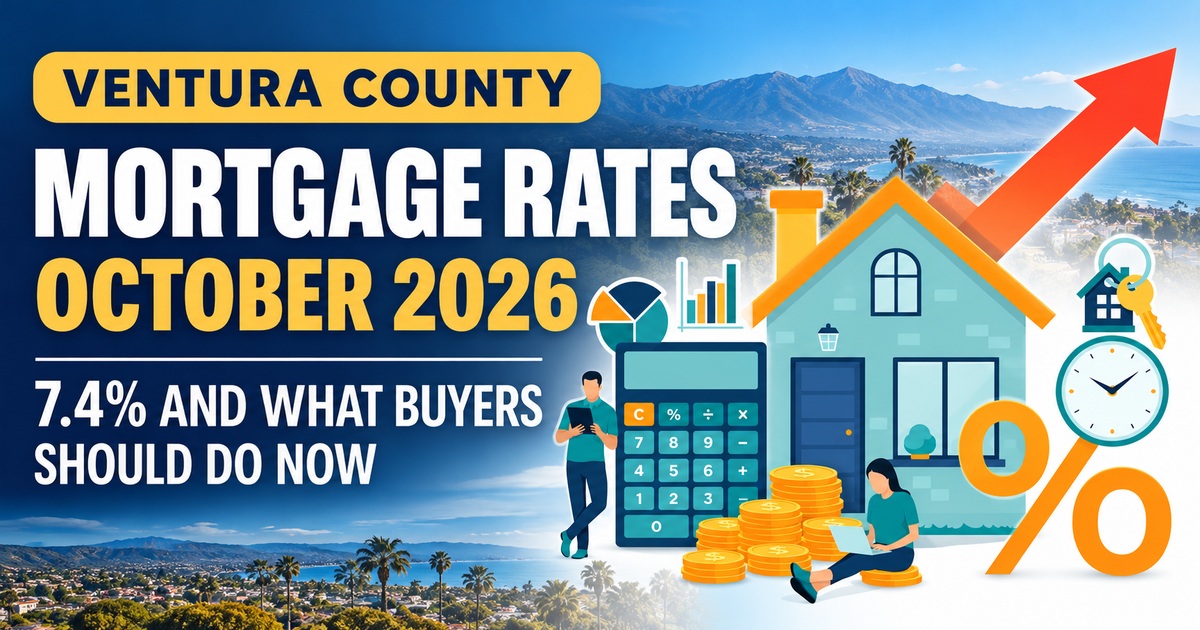
Ventura County Mortgage Rates October 2026 October 2026 Mortgage Market Update Ventura County Mortgage Rates October 2026: 7.4% and What...
Ventura County Home Seller Guide | Fall / Winter 2026 Should You Sell Now or Wait Until Spring? Ventura County...
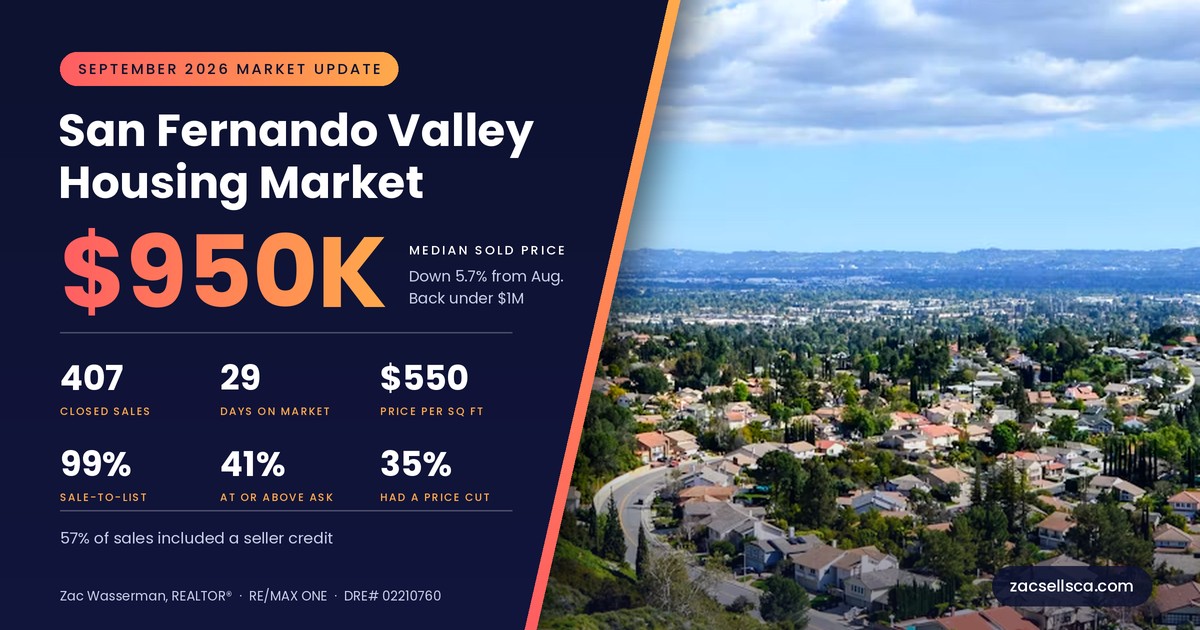
SEPTEMBER 2026 · MARKET UPDATE San Fernando Valley Housing Market Update: September 2026 Prices, Trends & City-by-City Data The median...
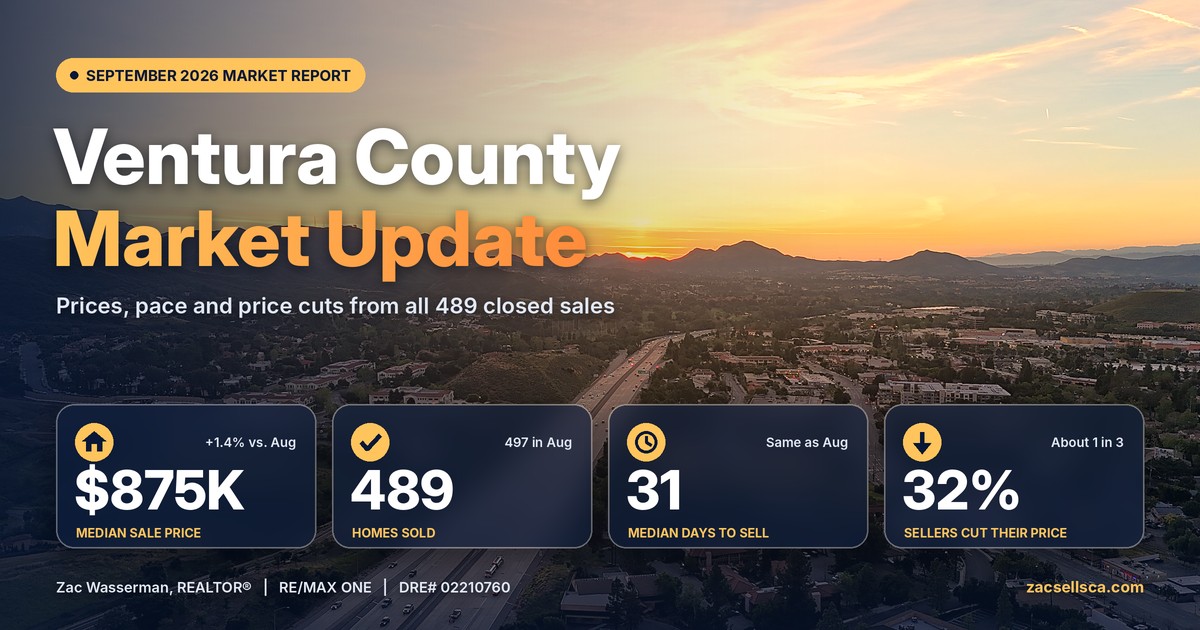
Ventura County’s September 2026 housing market: $875K median price, 489 closed sales, 31 days on market, and city-by-city data for...

State Farm filed to start writing new California home policies again, but only for homes with an IBHS Wildfire Prepared...

Encino real estate in 2026: see median home and condo prices, 494 closed sales, 91436 vs. 91316 trends, neighborhood insights,...