
If you own a home in Ventura County and you've been thinking about listing, you're probably asking one question: should you sell now or wait until spring? It's a fair question, because the market changed this fall. Mortgage rates climbed to 7.40% in early October. The Federal Reserve raised rates for the first time since 2023, and the holidays are only a few weeks away. However, the local numbers tell a more useful story than the headlines do. In this guide, I'll walk through what September's MLS data shows and what each choice is likely to cost you. I'll also explain how to decide based on your own situation.
Should You Sell Now or Wait Until Spring? The Short Answer
For most Ventura County homeowners, selling this fall makes sense if you need to move within the next six months. It also makes sense if you're buying another home in the same market or if your home is ready to show today. On the other hand, waiting makes sense if your home needs work and your timeline is flexible. You should also be able to carry the home comfortably through winter. Therefore, the right answer depends less on the calendar and more on your price, your preparation, and your next move.
One thing is clear from the data, though: timing matters far less than pricing. In September, homes that were priced correctly sold in a median of 20 days at full price. Meanwhile, homes that needed a price reduction took a median of 70 days. As a result, a well-priced November listing can outperform an overpriced April listing.
What the Ventura County Market Looks Like Heading Into Winter
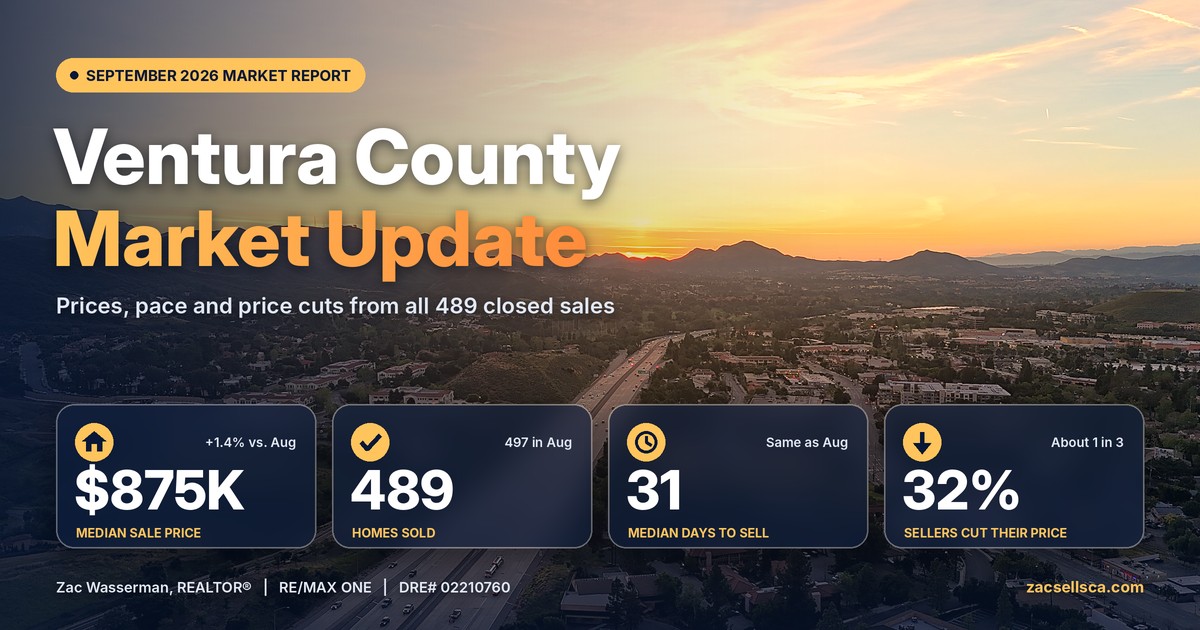
I pulled every closed sale in the county for September, and the full breakdown is in my September 2026 Ventura County market update. Here are the numbers that matter most for sellers:
In other words, the market is steady but no longer forgiving. Prices are holding, and homes are still selling in about a month. However, roughly one in three sellers had to cut their price. In addition, nearly four in ten paid part of the buyer's costs. Furthermore, most of those September closings went under contract in August, before rates jumped. Consequently, I expect the October and November data to show somewhat longer market times and more negotiation.
How 7.40% Mortgage Rates Change the Math for Sellers
According to Freddie Mac's Primary Mortgage Market Survey, the average 30-year fixed rate reached 7.40% on October 8, 2026. That is up from 7.28% a week earlier and 6.30% a year ago. In addition, the September Fed rate hike lifted the federal funds range to 3.75%–4.00%, and several Fed officials have signaled that one more increase is possible before year-end. You can check upcoming meeting dates on the Federal Reserve's FOMC calendar.
So what does that mean for your buyer? For example, consider someone purchasing the county's median-priced home at $875,000 with 20% down. At 6.30%, the principal and interest payment on a $700,000 loan is about $4,333 a month. At 7.40%, that same payment is about $4,847. Therefore, today's buyer pays roughly $514 more every month than a buyer did a year ago for the same house.
Because of that, buyers are more payment-sensitive than they were last spring. They negotiate harder, they ask for credits, and they walk away from homes that feel overpriced. Still, the buyers who are shopping right now are serious, because nobody tours homes at 7.40% for fun. Many of them have a job relocation, a lease ending, or a home they've already sold.
It's also worth being honest about what nobody knows. Rates could ease by next year if inflation cools. Alternatively, they could move higher if the Fed raises again. For that reason, waiting for a better rate environment is a bet, not a plan.
The Case for Selling Now
First, you'll typically face less competition. Many homeowners delay listing once the holidays approach. As a result, the buyers who are still looking have fewer homes to choose from. A clean, well-priced home stands out.
Second, you stop the clock on carrying costs. Every month you wait, you keep paying the mortgage, property taxes, insurance, and maintenance. For example, those costs might total $5,000 a month on your home. If so, waiting from November to April costs about $25,000 before you ever accept an offer. Your number will differ, so run it with your own bills.
Third, if you're also buying, the same conditions work in your favor on the purchase. In September, 39% of sellers paid a buyer credit and 32% cut their price. As a result, you'll likely have room to negotiate on your next home. In fact, selling and buying in the same market often cancels out much of the timing risk.
Finally, you avoid the uncertainty. Today's prices are known: the county median is $875,000. In addition, well-priced homes are selling at full price in about three weeks. Next year's prices and rates, however, are only a forecast. If you're worried about where things are headed, I covered the longer outlook in my post on a possible housing market crash in 2027.
The Case for Waiting Until Spring
Waiting is a perfectly reasonable choice for some sellers, and I'd rather tell you that than push you to list.
First, the spring market usually brings more buyers. Families often prefer to move between school years, and longer days make it easier to tour homes after work. Consequently, a listing that launches in March or April typically gets more showings in its first two weeks.
Second, some homes simply show better in warmer months. Your biggest selling points may be a pool, a garden, or a big backyard. If so, April photos will likely do more for you than December photos.
Third, you may need the time. Your home may need paint, flooring, repairs, or a serious declutter. If so, rushing to market before the holidays can cost more than waiting. Similarly, you may have a tenant in place or a lease ending in the new year. In that case, a later listing may be the cleaner path.
However, waiting has a real downside: you'll have more competition. Because so many sellers hold off, inventory tends to rise at the same time buyer traffic does. In addition, you'll be carrying the home for several more months with no guarantee that rates will be lower.
Sell Now or Wait Until Spring: A Side-by-Side Comparison
| Factor | Selling this fall or winter | Waiting for the spring market |
|---|---|---|
| Competing listings | Typically fewer | Typically more |
| Buyer traffic | Lower, but more motivated | Higher |
| Mortgage rates | Known: 7.40% as of October 8 | Unknown |
| Carrying costs | End sooner | Continue for four to six more months |
| Prep time | Limited | Plenty |
| Best for | Move-ready homes, firm timelines, and sellers who are also buying | Homes that need work, flexible timelines, and outdoor-focused homes |
As the table shows, neither choice is right for everyone. Instead, match each column to your own situation and see which one fits.
How to Price and Prepare a Fall or Winter Listing
If you decide to list before the new year, then the September data points to a clear playbook.
Price it right on day one. Homes that never needed a reduction sold in a median of 20 days at 100% of their original list price. In contrast, homes that needed a reduction took a median of 70 days. They sold for roughly 93% of their original price. On an $875,000 listing, that gap is about $61,000. Moreover, homes that sold within 14 days beat asking four times as often as homes that sat about two months. I explain how I set that number in my guide to home pricing strategy in Ventura County.
Plan for a buyer credit. Since 39% of sellers paid one in September, build a credit into your net sheet from the start. That way, a request for $7,750 toward closing costs won't feel like a surprise. For a full breakdown of what you'll pay, see my guide to seller closing costs in Ventura County.
Watch the calendar. If closing before December 31 matters to you, then you should be on the market by early November. You should also be priced to sell in the first three weeks. Otherwise, a typical escrow will push your closing into January.
Make the home easy to tour. Because the sun sets early, schedule photos for midday and keep exterior lights on for evening showings. Additionally, keep holiday decor light so buyers can see the rooms. Finally, handle small repairs before you list, because winter buyers pay close attention to roofs, drainage, and heating.
City-by-City: Where Fall Sellers Have the Most Leverage
Conditions vary quite a bit across the county. Here is how September looked in every city with at least eight closed sales.
| City | Median price | Closed sales | Median days on market | Sale-to-list ratio |
|---|---|---|---|---|
| Westlake Village | $1,717,500 | 24 | 36 | 96.7% |
| Ojai | $1,335,000 | 9 | 18 | 96.4% |
| Oak Park | $1,135,000 | 8 | 59 | 96.0% |
| Thousand Oaks | $1,100,000 | 74 | 28 | 98.9% |
| Moorpark | $920,000 | 23 | 27 | 99.0% |
| Newbury Park | $897,500 | 26 | 35 | 98.0% |
| Ventura | $850,000 | 75 | 22 | 99.1% |
| Oxnard | $850,000 | 59 | 32 | 98.4% |
| Camarillo | $849,000 | 57 | 29 | 99.4% |
| Simi Valley | $822,500 | 89 | 38 | 99.3% |
| Santa Paula | $684,495 | 16 | 26 | 99.5% |
| Port Hueneme | $609,000 | 13 | 27 | 97.6% |
Several patterns stand out. First, Ventura was the fastest-moving large market at a median of 22 days. In addition, sellers in Ventura, Camarillo, Simi Valley, and Santa Paula all kept more than 99% of their asking price. Therefore, sellers in those cities still have solid leverage this fall.
In contrast, sellers in Westlake Village, Oak Park, and Ojai gave up between 3% and 4% off their list price. This suggests that higher-priced homes are seeing more negotiation. As a result, pricing precision matters even more at the top of the market. Keep in mind, however, that Ojai and Oak Park each had fewer than ten sales. That means their numbers can swing from month to month.
What Your Home Could Be Worth Right Now
Countywide medians are useful, but your home isn't a median. Instead, its value depends on your street, your floor plan, and your condition. It also depends on the three or four homes buyers will compare it to this month. That's why I start every seller conversation with a custom analysis rather than an online estimate. If you'd like to see your number before you decide, then request a free home valuation. There's no cost and no obligation, and the estimate is built on real MLS comparables from your neighborhood.
FAQ: Selling a Home in Ventura County in Fall and Winter 2026
Should I sell now or wait until spring in Ventura County?
It depends on your timeline and your home's condition. Sell this fall if you need to move within six months or if you're also buying. The same goes if your home is ready to show. Wait if your home needs work and you can comfortably carry it through winter. In either case, pricing matters more than timing.
Is winter a bad time to sell a house in Ventura County?
Not necessarily. Buyer traffic is usually lower from November through January. However, there are also fewer competing listings, and the buyers who are looking tend to be motivated. In addition, Ventura County's mild winters mean homes show well year-round.
Will home prices drop in Ventura County this winter?
Nobody can predict that with certainty. So far, prices have held, because the countywide median was $875,000 in September, up from $862,500 in August. However, higher rates are increasing price reductions and seller credits. As a result, your net proceeds can soften even when the median doesn't.
How long does it take to sell a home in Ventura County right now?
The median was 31 days on market in September 2026. Homes that were priced correctly from the start sold in a median of 20 days. Meanwhile, homes that needed a price reduction took a median of 70 days. After that, plan for an escrow of roughly 30 to 45 days.
When should I list if I want to close before the end of 2026?
You should be on the market by early November and priced to go under contract within about three weeks. Otherwise, a typical escrow will carry your closing into January.
Should I wait for mortgage rates to drop before selling?
Waiting for lower rates is a gamble. The average 30-year rate rose to 7.40% in early October, and the Fed has signaled that another increase is possible. If rates do fall, more buyers will return. However, more sellers will list as well. Therefore, base your decision on your own timeline rather than a rate forecast.
Ready to Decide? Let's Run Your Numbers
You might list in November or hold off until next year. Either way, the best decision starts with accurate numbers for your specific home. Contact Zac Wasserman at RE/MAX ONE, your local Ventura County expert, to get your home's value and a clear plan for either path. Call or text 805.212.9147, or email ZacSellsCA@gmail.com.
Zac Wasserman | REALTOR® | CA DRE# 02210760 | RE/MAX ONE | 30699 Russell Ranch Rd #100, Westlake Village, CA 91362
Market statistics are based on MLS closed sales in Ventura County, September 1–30, 2026, all residential property types. Information is deemed reliable but not guaranteed. Mortgage rate data is from Freddie Mac's Primary Mortgage Market Survey as of October 8, 2026. This article is for general information and is not financial, tax, or legal advice.
About the Author
Zac Wasserman | REALTOR® | CA DRE# 02210760
RE/MAX ONE
30699 Russell Ranch Rd #100, Westlake Village, CA 91362
805.212.9147 | ZacSellsCA@gmail.com
- All Posts
- Buyer Guides
- California Home Insurance & Wildfire Risk
- Home Financing (Mortgage & Loan Guides)
- Market Updates & Forecasts
- Seller Guides
- Back
- Ventura County Real Estate Market Updates
- San Fernando Valley Real Estate Market Updates (Monthly): Prices, Inventory & Trends

Ventura County Mortgage Rates October 2026 October 2026 Mortgage Market Update Ventura County Mortgage Rates October 2026: 7.4% and What...
Ventura County Home Seller Guide | Fall / Winter 2026 Should You Sell Now or Wait Until Spring? Ventura County...

SEPTEMBER 2026 · MARKET UPDATE San Fernando Valley Housing Market Update: September 2026 Prices, Trends & City-by-City Data The median...
Ventura County’s September 2026 housing market: $875K median price, 489 closed sales, 31 days on market, and city-by-city data for...

State Farm filed to start writing new California home policies again, but only for homes with an IBHS Wildfire Prepared...

Encino real estate in 2026: see median home and condo prices, 494 closed sales, 91436 vs. 91316 trends, neighborhood insights,...