

Can You Sell an ADU Separately in California? Your 2026 AB 1033 Guide for LA & Ventura County
If you built a backyard unit to add income or house family, you have probably wondered whether you can sell an ADU separately from your main home and cash in on that equity. It is one of the most common questions I hear from homeowners across Ventura County and the San Fernando Valley, and the honest 2026 answer has real nuance. A California law called AB 1033 made separate sales possible in theory. However, whether it applies to your property depends entirely on where you live. In this guide, I will walk you through exactly what AB 1033 does, where it stands locally right now, and how to position yourself if your city eventually opts in.
I am Zac Wasserman, a licensed REALTOR with RE/MAX ONE, and I help buyers and sellers navigate exactly these kinds of gray areas every week. Let's clear up the confusion.
What AB 1033 Actually Does (and What It Doesn't)
Assembly Bill 1033 was signed into law in October 2023 and took effect on January 1, 2024. In plain terms, it added a new section to California's planning code that gives cities and counties the authority to let homeowners sell an accessory dwelling unit as its own condominium, separate from the primary house on the same lot. Before this law, an ADU was legally tied to the main home and could not be sold on its own.
Here is the catch that trips up most homeowners, though. AB 1033 is permissive, not mandatory. In other words, the state did not automatically unlock separate ADU sales everywhere. Instead, each individual city or county must affirmatively pass its own local ordinance before any homeowner in that jurisdiction can take advantage of the law. As a result, the map of where this actually works is patchy, and it is changing slowly.
Additionally, it helps to understand what the law does not do. AB 1033 does not create new types of ADUs, loosen construction rules, or override your local zoning. Furthermore, it does not turn your existing rental unit into an instant sellable asset. It simply changes what can legally happen to a permitted ADU after it is built, and only in places that have opted in.
Can You Sell an ADU Separately in California Right Now?
For most of the state, the short answer is still no. As of 2026, only a small number of California jurisdictions have adopted the local ordinance required for a separate ADU sale. San Jose led the way and completed the state's first separate ADU sale in 2025. Santa Monica followed with its own ordinance, and unincorporated San Diego County adopted a program that took effect in April 2026. A few other cities are studying or drafting ordinances, but the list of places where this is fully operational remains short.
Consequently, whether this option is even available to you comes down to one question: has your specific city or county opted in? If the answer is no, then under default state law your ADU still cannot be sold apart from the main house, no matter how nice or independent the unit is. This is why I always tell homeowners to confirm their local status before making any decision based on AB 1033.
AB 1033 Status in Los Angeles and Ventura County (2026)
Now for the part that matters most to my clients. As of 2026, neither Los Angeles nor Ventura County allows the separate sale of an ADU. Let's break it down by area.
That said, local policy can shift quickly, and housing pressure keeps AB 1033 on the agenda. For that reason, it is worth understanding how the process would work so you are ready to move the moment your city acts.
If you own a home with an ADU in Ventura County or the San Fernando Valley, I can help you look at the property as a whole and understand how buyers may value the additional living space and income potential.
Get a Free Home Valuation Call or Text 805.212.9147How the ADU Condo Conversion Process Works
Selling an ADU separately is not as simple as listing it and finding a buyer. Because the law treats the ADU as a condominium, you essentially convert your single lot into a two-unit condo project. Here is the general path in jurisdictions that allow it.
In addition, you must record CC&Rs and form a homeowners association under California's Davis-Stirling Act, because two separately owned units on one parcel share common elements. Finally, if you have a mortgage, your lender must typically consent to the arrangement, since dividing the property affects the collateral securing your loan. As a result, the timeline usually runs several months from start to finish, even in cities that welcome these conversions.
What It Costs to Sell an ADU Separately
The financial side is where many homeowners pump the brakes. To sell the unit on its own, you take on the legal and engineering costs of creating a small condominium project, and those costs are not trivial for a two-unit property.
Depending on complexity, professional preparation of the condominium map, plan, and CC&Rs generally runs somewhere in the range of $15,000 to $40,000. On top of that, forming an HOA usually requires a reserve study, which can add a few thousand dollars, plus ongoing monthly dues that both owners share going forward. Because the Davis-Stirling framework was designed for large condo communities, the administrative overhead can feel heavy when it is spread across just two units.
For that reason, the math only makes sense when the standalone value of the ADU clearly exceeds these conversion costs and the ongoing HOA burden. In high-value markets like the Conejo Valley and coastal Ventura County, that gap can be significant, which is exactly why so many local homeowners are watching this law closely.
The Financing Catch Buyers and Sellers Need to Know
Even in cities that have opted in, there is a real hurdle waiting on the buyer's side. As of 2026, Fannie Mae and Freddie Mac have not issued guidance classifying AB 1033 ADU-condos as warrantable. In practical terms, that means many conventional lenders are hesitant to finance the purchase of a separately sold ADU, because they cannot easily sell that loan on the secondary market.
Consequently, early buyers in this space often rely on cash, portfolio loans from local banks, or other creative financing rather than a standard 30-year conventional mortgage. This financing gap is one of the biggest reasons the AB 1033 market has grown slowly, even where it is legal. For sellers, it is important to understand that a smaller buyer pool can affect both your timeline and your final price.
What You Can Do With Your ADU Right Now in Ventura County & LA
Separate ownership may not be available locally yet, but a legal ADU can still create rental income, improve the usefulness of your property, attract buyers, and contribute to the resale value of the property as a whole.
Since separate ADU sales are not yet allowed here, let's focus on the value you can capture today. An ADU is still one of the smartest investments a homeowner can make in our market, even without separate-sale rights.
For one, a permitted ADU generates rental income that can meaningfully offset your mortgage, which is a powerful advantage in a region with high housing costs. Additionally, a well-built ADU adds real resale value to your overall property when you sell the home as a whole. If you are weighing a project, my guide on what adds the most value to a home in Ventura County breaks down where your renovation dollars go furthest. And if you are just starting to plan, the state's ADU standard plans program can shorten permitting timelines and cut design costs.
If your long-term goal is to eventually sell your ADU on its own, the best move right now is to build or maintain it as a fully permitted, code-compliant, independent unit. That way, if your city adopts AB 1033 down the road, you will already have cleared the hardest prerequisite.
How to Prepare to Sell an ADU Separately Before Your City Opts In
Even though the door is closed locally today, smart homeowners are getting ready now. Here is what I recommend if selling an ADU separately is part of your long-term plan.
If you are curious what your property is worth today, with or without a future ADU sale, I offer a free home valuation so you can make decisions based on real numbers rather than guesswork. And if an ADU is part of a bigger buying or investing strategy, my first-time homebuyer guide for Ventura County is a helpful next step for understanding local financing and price points.
Frequently Asked Questions
No. As of 2026, no jurisdiction in Ventura County, including the unincorporated county and all ten incorporated cities, has adopted an AB 1033 ordinance. Therefore, your ADU cannot legally be sold apart from your primary residence here yet.
Not currently. The City of Los Angeles introduced a council motion in 2025 but has not adopted an ordinance, and unincorporated Los Angeles County has not opted in either. As a result, separate ADU sales are not available in the LA market as of 2026.
Only a handful so far. San Jose, Santa Monica, and unincorporated San Diego County are among the early adopters. Because adoption changes frequently, you should always verify the current status with your local planning department.
In jurisdictions that allow it, the legal and engineering work typically ranges from about $15,000 to $40,000, plus the cost of a reserve study and ongoing shared HOA dues once the homeowners association is formed.
When an ADU is sold as a separate condominium, that unit is reassessed at its sale value, while your primary residence generally keeps its existing tax base. Because rules can vary, I recommend confirming the details with the county assessor before proceeding.
In most cases, yes. A permitted ADU still delivers rental income and adds resale value to your whole property, and it positions you for a separate sale later if your city adopts AB 1033.
Ready to Make a Smart Move With Your ADU?
Whether you are thinking about building an ADU, wondering how it affects your home's value, or planning ahead for a future separate sale, having a local expert in your corner makes all the difference. I stay on top of these policy changes so my clients never miss an opportunity. Ready to talk through your options? Contact Zac Wasserman at RE/MAX ONE, your local Ventura County and San Fernando Valley expert, and let's build a plan that fits your property and your goals. Call or text me anytime at 805.212.9147.
Whether you are planning to sell soon or preparing for future AB 1033 changes, start with a clear picture of your property's value in today's market.
Request My Free Home Valuation Call or Text ZacZac Wasserman is a licensed California REALTOR® with RE/MAX ONE serving homeowners, buyers, and sellers throughout Ventura County and the San Fernando Valley. He focuses on helping clients understand local market conditions, property value, financing considerations, and real-estate decisions that can affect both short-term and long-term goals.
Phone: 805.212.9147 | Website: zacsellsca.com
- All Posts
- Buyer Guides
- California Home Insurance & Wildfire Risk
- Home Financing (Mortgage & Loan Guides)
- Market Updates & Forecasts
- Seller Guides
- Back
- Ventura County Real Estate Market Updates
- San Fernando Valley Real Estate Market Updates (Monthly): Prices, Inventory & Trends
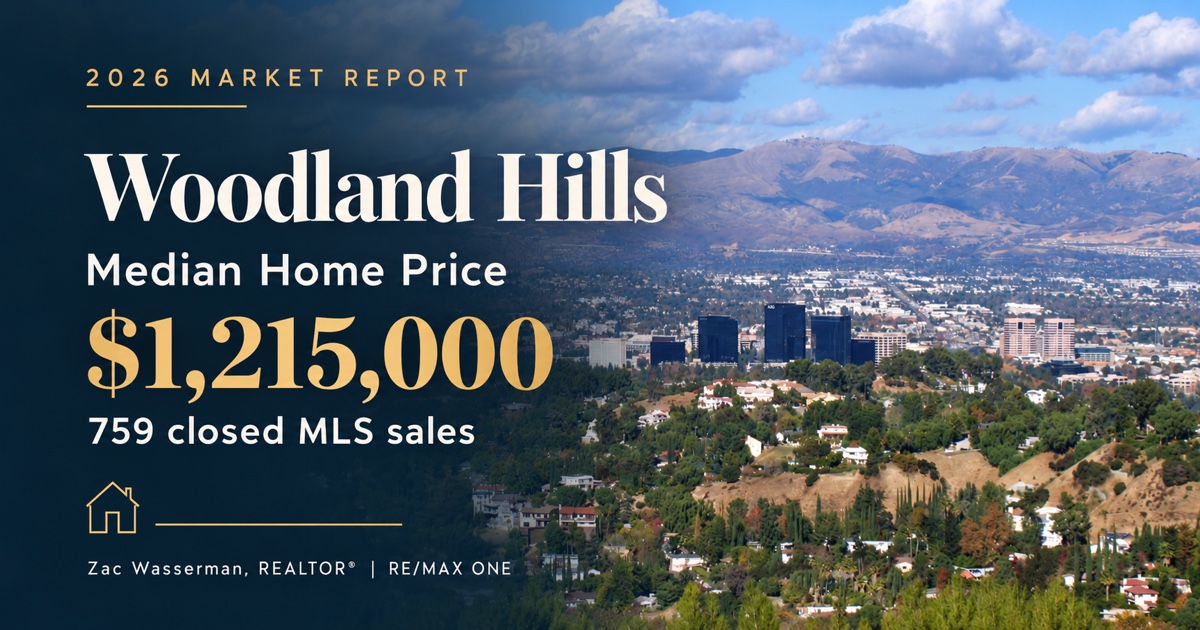
MLS closed residential sales • October 1, 2025–October 16, 2026 Median Home Price Woodland Hills CA (2026) Woodland Hills ...

New California real estate laws 2027 change what you can build, what your HOA can block, and how much notice...

Ventura County Mortgage Rates October 2026 October 2026 Mortgage Market Update Ventura County Mortgage Rates October 2026: 7.4% and What...
Ventura County Home Seller Guide | Fall / Winter 2026 Should You Sell Now or Wait Until Spring? Ventura County...
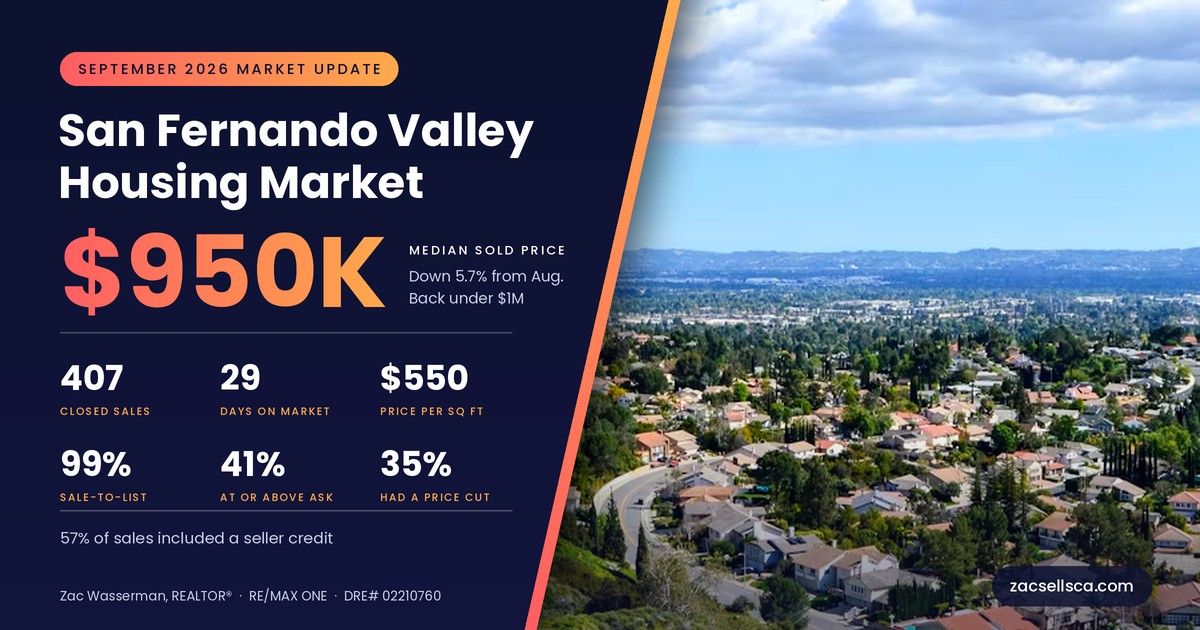
SEPTEMBER 2026 · MARKET UPDATE San Fernando Valley Housing Market Update: September 2026 Prices, Trends & City-by-City Data The median...
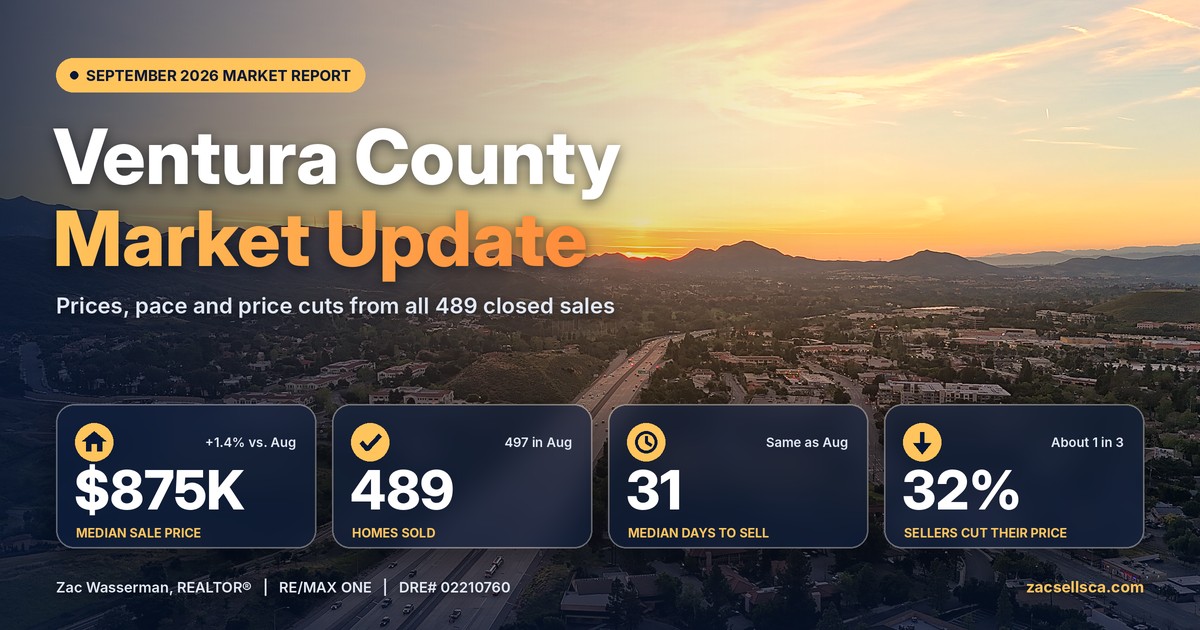
Ventura County’s September 2026 housing market: $875K median price, 489 closed sales, 31 days on market, and city-by-city data for...