

Should You Wait to Buy a House in 2026? What Ventura County and LA Buyers Need to Know
Buyers in 2026 are stuck in the same mental tug-of-war: rates still feel high, prices did not collapse, and nobody wants to be the person who buys right before a better opportunity shows up. If you are asking should you wait to buy a house in 2026, the real answer is less about timing the perfect headline and more about how payment, local price direction, and your own runway fit together.
Trying to decide whether to buy now or wait comes down to what 2026 home prices and mortgage rates actually mean in Ventura County versus Los Angeles. For many buyers, the best move is not waiting for a dramatic reset that may never show up. It is choosing the market, price point, and payment structure that gives you room to move forward without forcing the wrong purchase.
Our Take
If you have stable income, enough cash for a sound down payment and reserves, and you can buy the right home with a payment you can carry comfortably, buying now usually makes more sense than waiting in Ventura County and much of Los Angeles. On the other hand, if you are stretched, relying on a major rate drop to make the math work, or unsure you will stay put long enough to offset closing costs, waiting is smarter. In other words, the question is not simply whether rates feel high. It is whether the deal in front of you works for your budget, timeline, and market choice right now. That is the real framework for answering should you wait to buy a house in 2026 in any market.
Why So Many Buyers Are Asking This Question Right Now
The reason this question feels so urgent is simple: 2026 is not giving buyers an easy signal. Rates are lower than the peak panic levels many buyers feared, yet they are still elevated enough to change affordability. That is exactly why so many people keep asking should you wait to buy a house in 2026 before they make a move. At the same time, prices in many Southern California submarkets have stayed firm, especially where inventory remains tight and higher-income households can still compete.
That tension is exactly why should you wait to buy a house in 2026 has become one of the defining buyer questions this year. Buyers are looking at monthly payment shock on one side and fear of missing more appreciation on the other. Meanwhile, renters are watching lease costs continue month after month, which makes “waiting” feel safe emotionally but expensive financially.
There is also a local layer to this. The ventura county housing market 2026 is not behaving the same way as every LA County neighborhood, and broad national headlines often miss that. A buyer targeting Oxnard or Simi Valley is dealing with different entry points than a buyer trying to land in Thousand Oaks or a more expensive pocket of Los Angeles County. That is why countywide averages help, but local decision-making matters more.
Another reason buyers hesitate is that they are comparing today’s payment to yesterday’s rates instead of comparing today’s purchase to their likely alternatives. That is understandable. However, the decision is not “Would I rather buy at 3%?” because that market is gone. The real comparison is whether buying now beats renting longer, saving longer, or waiting for a market shift that might not improve both price and payment at the same time.
For buyers who want context beyond this post, it also helps to understand 2026 conforming loan limits for Ventura and LA, because the financing structure can materially affect what is realistic in each county.
What Mortgage Rates in 2026 Actually Mean for Your Payment
Mortgage rates 2026 are important, but buyers often treat the rate itself as the whole story. It is not. Buyers asking should you wait to buy a house in 2026 often frame the question around the headline rate before they ever run the monthly payment numbers. What really matters is the monthly payment created by the combination of rate, loan size, taxes, insurance, HOA if applicable, and how much cash you are putting down. In this post, the payment examples use a 30-year fixed rate estimate of 6.75%, with 20% down and principal plus interest only so the comparison stays clean.
At that rate, the difference between a $680,000 house and a $1,050,000 house is not abstract. It is substantial every month. Therefore, a buyer shopping the wrong price bracket can feel like the entire market is unaffordable, when the real problem may be that they are trying to force a payment that does not match their budget.
Using the figures provided here, a Ventura County single-family median around $955,000 points to an estimated principal and interest payment near $4,955 per month. A Los Angeles County single-family median around $875,000 comes in around $4,540. Simi Valley is materially lower, while Thousand Oaks is materially higher. That spread matters because two households with the same income could reach completely different decisions depending on which submarket they target.
It is also worth noting that Ventura County’s 2026 conforming loan limit of $1,077,550 gives buyers more flexibility before they cross into jumbo territory. That does not erase affordability pressure, but it can simplify the loan path for buyers in parts of Ventura County where pricing has moved up but has not yet pushed far beyond the conforming threshold.
If you want to pressure-test your own number instead of guessing, review how much house you can afford in Ventura County. That is often the fastest way to move from anxiety into an actual decision framework. And if you want to track the broader direction of rates, Freddie Mac’s weekly mortgage rate survey is one of the more useful baseline references.
Buyers who say “I am waiting for rates to drop” are not always wrong. Still, they often leave out two hard truths. First, nobody can guarantee when a meaningful drop will happen. Second, if rates fall enough to bring more buyers back at once, stronger demand can push prices higher or intensify competition. As a result, waiting for better rates does not always mean a lower total cost. In short, should you wait to buy a house in 2026 is not a rate question — it is a payment and timeline question.
Ventura County Home Prices in 2026: Are They Still Rising?
The short answer is yes, Ventura County pricing still looks firm based on the provided Q1 2026 numbers. For buyers still asking should you wait to buy a house in 2026, the Q1 data does not give them an easy exit from the market. The countywide median for all property types sits at $880,000, while the median single-family residence price is $955,000. Closed sales totaled 1,211 in Q1 2026, which shows there is still real transaction activity even with borrowing costs above the ultra-low era buyers remember.
That matters because many buyers are still waiting for a dramatic drop that the current data does not support. If anything, the ventura ca real estate market forecast 2026 looks more like a steady market with selective appreciation than a broad reset. In practical terms, that means buyers who are payment-qualified and planning to hold for several years may be better served by buying the right home than by trying to perfectly time a lower entry price.
Ventura County is also not one thing. Thousand Oaks, Simi Valley, and Oxnard/Port Hueneme are very different entry points. Thousand Oaks median SFR pricing around $1,050,000 is a different affordability conversation than Simi Valley around $780,000 or Oxnard/Port Hueneme around $680,000. Therefore, the question is not merely whether Ventura County is “too expensive.” It is whether your targeted submarket makes sense relative to your income, cash, and lifestyle priorities.
For buyers comparing local options, the county is still attractive because it can offer a more manageable blend of price, space, and quality of life than many Los Angeles County submarkets. That is one reason more households continue looking at moving from Los Angeles to Ventura County. Even so, buyers should not confuse “better value” with “cheap.” Ventura County can still be highly competitive in the right neighborhoods and school zones.
If you want a more detailed local read on pricing direction, sales activity, and what those numbers mean on the ground, see Ventura County home prices in Q1 2026. For many buyers, that local context is more useful than broad statewide commentary. Because prices remain firm, most buyers who are asking should you wait to buy a house in 2026 will not find a more favorable entry point by holding off another quarter.
Los Angeles Home Prices in 2026: A Different Story
The los angeles housing market 2026 is broader, more fragmented, and less useful when reduced to one simple headline. Using the figure provided here, LA County’s median single-family price is about $875,000, which is actually below the Ventura County SFR median of $955,000. However, that broad county average hides major variation. Some LA County neighborhoods remain far more expensive than Ventura County counterparts, while others can compete surprisingly well on entry price.
This is why a buyer cannot make the right decision by treating LA County as one market. If your work, commute, and lifestyle allow flexibility, some Ventura County markets may offer more house for the money. On the other hand, if your target area in Los Angeles County is one of the more accessible submarkets, staying closer to work or family may outweigh the appeal of moving west.
Another difference is buyer psychology. In LA County, some buyers are still expecting cracks to appear because the broader county has more price bands, more investor activity, and more neighborhoods that react differently to financing pressure. Yet broad averages alone do not show a collapse. Instead, they suggest a market that is adjusting unevenly, not one that has fully broken lower.
That is why “buy now or wait 2026” depends so heavily on where in LA County you are targeting. Some buyers will find better monthly-payment math in Ventura County. Others will find that staying in LA County makes more sense because the move cost, commute burden, or desired home type cancels out the pricing advantage elsewhere. If you are deciding between counties, it is also smart to compare the broader cost of living in Ventura County vs. Los Angeles, not just the purchase price on a listing sheet. Ultimately, should you wait to buy a house in 2026 is a question that lands differently depending on which LA County neighborhood you are actually targeting.
The Real Cost of Waiting: What a Year Costs You in Equity and Rent
Waiting feels risk-free because you are not locking into a mortgage today. The problem is that waiting has its own cost structure, and buyers often undercount it. If prices rise modestly while you keep renting, you may lose ground on both the purchase price and the principal paydown you could have started building. Even conservative appreciation can add up quickly on Southern California housing.
Take Ventura County’s median SFR of $955,000. If that market appreciates at a conservative 4% to 5% over the next year, that implies roughly $38,000 to $48,000 in price movement. A buyer does not lose that amount dollar for dollar in cash, of course, but they may need a larger down payment and borrow more to buy the same home later. Even LA County at an estimated 3% to 4% appreciation can create meaningful distance for a buyer who was almost ready this year.
Buyers asking should you wait to buy a house in 2026 often focus on the rate side of the equation without fully accounting for appreciation. Rent compounds the issue. One more year of renting is not just a pause button. It is twelve more rent payments, often with little or no equity outcome at the end. Because no standardized countywide rent figure was provided for this post, the exact cost will vary by unit type and location. Still, the concept is straightforward: if you spend another year renting while prices and wages both keep moving, the “safer” choice may leave you further behind.
There is a second layer here. If rates do ease later, that can help buyers who waited. However, those same lower rates can also bring more demand back into the market. Therefore, you do not automatically get a cleaner deal by waiting. In many cases, you are trading today’s rate for tomorrow’s price and competition.
That does not mean everyone should rush. Buyers who are genuinely ready should not let uncertainty around timing turn should you wait to buy a house in 2026 into a reason to stay on the sidelines indefinitely. If your emergency reserves are thin or the payment leaves no breathing room, waiting may absolutely be the better move. But buyers who can already afford the right home in the right market should be honest about the cost of trying to time the perfect moment.
Who Should Buy Now (And Who Should Wait)
This is the most useful way to answer the question. The right move depends less on fear and more on fit. Should you wait to buy a house in 2026 comes down to one thing: whether your personal financial position is ready, not whether the market is perfect. Buyers who should move now usually have stable income, enough liquidity after closing, and a time horizon long enough to ride out normal market swings. Buyers who should wait usually need more financial flexibility, more certainty about location, or a lower payment than today’s market can offer.
Put differently, the best buyers in 2026 are not necessarily the ones chasing the lowest possible rate. They are the ones who can buy a property that works now, hold it long enough to smooth out short-term noise, and refinance later if conditions improve. Meanwhile, the buyers who are already maxed out at approval often benefit from more time, because being technically approved is not the same thing as being financially comfortable.
Buy Now If…
You have stable income, a solid credit profile, and enough funds for your down payment, closing costs, and reserves without emptying everything you have.
You expect to stay in the home long enough for ownership costs and normal market fluctuations to make sense over several years rather than several months.
You can comfortably handle today’s payment at current mortgage rates 2026, even before any future refinance opportunity appears.
You have identified a submarket such as Simi Valley, Oxnard, Port Hueneme, or another target area where the payment and lifestyle fit your real budget.
You are tired of renting, want more control over your housing, and understand that modest appreciation can move the goalposts if you keep waiting.
Wait If…
You would be stretching so far that one unexpected expense, job change, or insurance increase would put real pressure on your monthly budget.
You are counting on a major drop in rates just to make the payment viable, because that usually means the purchase is not comfortable enough today.
You may relocate, change jobs, or need more clarity on where you want to live, which makes a near-term purchase more speculative than strategic.
You still need time to strengthen credit, build savings, or pay down debt so you can shop with better financing options and more confidence.
You have not yet narrowed the right home type, school area, or commute pattern, and buying now would likely lead to the wrong house rather than the right one.
Ventura vs. LA: Which Market Makes More Sense for Your Budget?
For many buyers, this is the real decision. Ventura County may offer more breathing room depending on where you are shopping, while Los Angeles County may still win if commute, lifestyle, or family proximity matter more than raw payment. The table below is not meant to replace a personalized analysis. It is meant to show how different the math can look once you compare real submarkets instead of vague headlines.
| Market | Median Price | Est. Monthly Payment (20% down, 6.75%) | Avg Rent | Annual Appreciation Est. | Verdict |
|---|---|---|---|---|---|
| Ventura County SFR | $955,000 | $4,955/mo P&I only | Varies by city and home type | ~4%–5% est. | Strong long-term buy for qualified buyers who want a balance of stability, lifestyle, and space. |
| Los Angeles County SFR | $875,000 | $4,540/mo P&I only | Varies widely by submarket | ~3%–4% est. | Can work well if staying closer to work or family matters more than moving counties. |
| Oxnard/Port Hueneme | $680,000 | $3,528/mo P&I only | Often more competitive than many ownership options | Within Ventura County trend | One of the more accessible entry points for buyers who want Ventura County without Thousand Oaks pricing. |
| Thousand Oaks | $1,050,000 | $5,448/mo P&I only | High, but still below ownership in many cases | Within Ventura County trend | Best for stronger-income buyers prioritizing schools, location, and long-term hold quality. |
| Simi Valley | $780,000 | $4,047/mo P&I only | Varies by property size and neighborhood | Within Ventura County trend | Often a practical middle-ground option for buyers priced out of higher-cost West County areas. |
Payment estimates shown are principal and interest only and assume 20% down with a 30-year fixed rate of 6.75%. Taxes, insurance, HOA dues, mortgage insurance if applicable, and maintenance are not included.
What this table shows is that Ventura County is not automatically more affordable than Los Angeles County as a whole. Instead, it offers a wider mix of “value stories” depending on the submarket. Thousand Oaks may not save you money versus broad LA County averages, but Oxnard/Port Hueneme and Simi Valley can change the equation in a real way. That is why buyers should compare targeted neighborhoods and monthly payment ranges, not just county labels.
If your budget is tight and you want the cleanest path into ownership, Ventura County may make more sense when you focus on the right city rather than the highest-demand pocket. If your priority is staying closer to LA employment centers, then a better answer may be to refine your LA County search rather than assuming you have to leave the county entirely. That is why should you wait to buy a house in 2026 is really a submarket question more than a county question.
The Bottom Line: What to Do If You're On the Fence
If you are still asking should you wait to buy a house in 2026, the best answer is this: do not wait for a perfect market; wait only if your personal finances or timing are not ready. Ventura County pricing remains firm, Los Angeles County is more nuanced than the headlines suggest, and mortgage rates 2026 still reward buyers who choose the right budget and hold long enough for the decision to mature.
For qualified buyers, especially those who can target the right Ventura County submarket, buying now can make more sense than losing another year to rent and modest appreciation. For buyers who are stretched or still uncertain, waiting can be the disciplined move. If you are ready to move forward, the step-by-step buyer guide for Ventura County walks through the full purchase process from pre-approval to close.
In other words, the wrong reason to wait is fear. Buyers who keep asking should you wait to buy a house in 2026 without running their own numbers are usually letting fear drive a financial decision. The right reason to wait is that the numbers or timing do not work yet. If the payment works, the location fits, and you plan to stay put long enough, buying now may be the smarter move even without a dramatic rate drop. If those pieces are not there yet, build your plan first and buy from a stronger position later.
Frequently Asked Questions
Is it a good time to buy a house in Ventura County in 2026?
It can be a good time to buy in Ventura County in 2026 if your income is stable, your cash reserves are in place, and the monthly payment fits your budget comfortably. The provided Q1 2026 numbers show Ventura County prices holding firm rather than dropping sharply, which means waiting may not automatically improve your position. Buyers who choose the right city and price point can still find solid long-term value. Buyers who would be stretched too thin, however, are usually better off waiting and improving their financial position first.
Will home prices drop in 2026 in Southern California?
The data used in this post does not point to a broad collapse in 2026 Southern California pricing. Ventura County’s Q1 2026 median figures still look steady, and LA County appears more mixed than outright weak. Some neighborhoods may soften, others may flatten, and some may continue rising modestly. Therefore, most buyers should plan around a market that is adjusting unevenly rather than one that is clearly falling across the board.
Should I wait for mortgage rates to go down before buying?
You should wait for lower rates only if today’s payment does not work comfortably for your budget. If you are asking should you wait to buy a house in 2026, the better question is whether the full monthly cost, cash needed, and your likely time horizon already make sense today. If you can already buy the right home and hold it for several years, waiting for rates alone can backfire if prices rise or competition increases once more buyers jump back in. Many buyers are better served by buying a manageable home now and refinancing later if rates improve. The key is that the purchase needs to make sense before any future refinance happens, not only after.
Is Ventura County or Los Angeles better for first-time buyers in 2026?
For first-time buyers asking should you wait to buy a house in 2026, the answer often depends on which county and city you are targeting. Ventura County can offer better value in certain submarkets like Oxnard, Port Hueneme, or Simi Valley, while Los Angeles County may still make more sense if your work, commute, or family ties are centered there. First-time buyers should compare targeted neighborhoods, total monthly cost, and long-term lifestyle fit instead of treating either county as one single market. In many cases, Ventura County wins on space and breathing room, while Los Angeles wins on proximity and convenience.
Need a Clear Buy-Now vs. Wait Strategy?
If you want help sorting out whether buying now makes sense in Ventura County or Los Angeles, reach out to Zac Wasserman, licensed REALTOR® with RE/MAX ONE. Zac can help you map out a free home search, compare neighborhoods and payment ranges, or walk through your home value options if you need to sell before you buy.
You can start at zacsellsca.com and get a real plan based on your budget, timing, and target market instead of guessing from headlines.
- All Posts
- Buyer Guides
- California Home Insurance & Wildfire Risk
- Home Financing (Mortgage & Loan Guides)
- Market Updates & Forecasts
- Seller Guides
- Back
- Ventura County Real Estate Market Updates
- San Fernando Valley Real Estate Market Updates (Monthly): Prices, Inventory & Trends
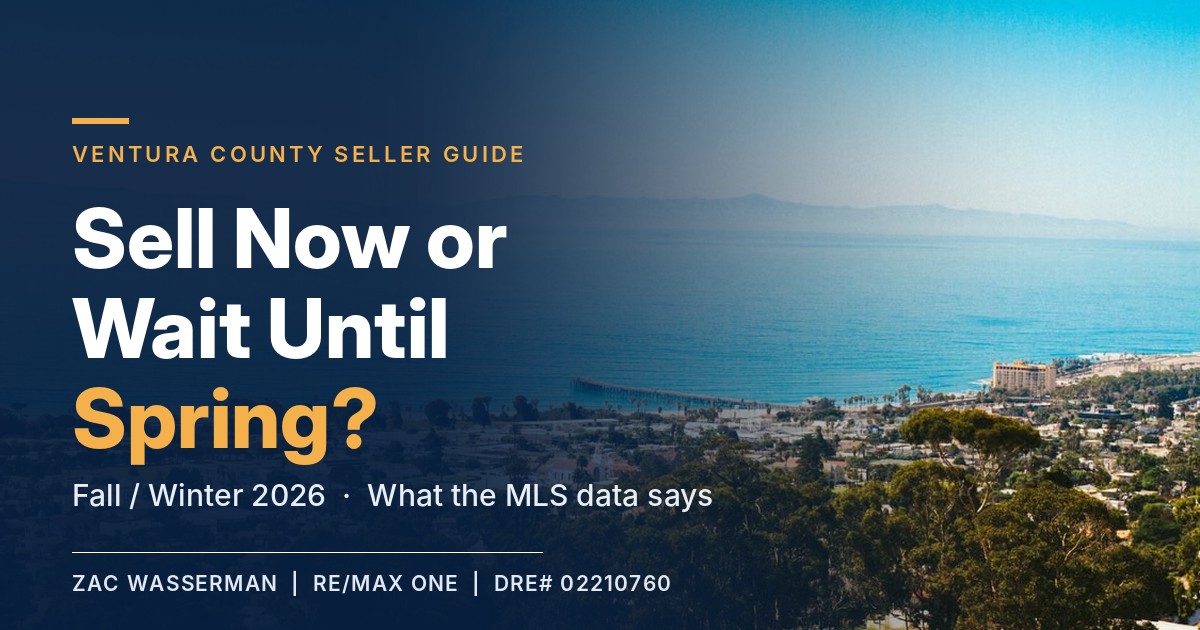
Ventura County Home Seller Guide | Fall / Winter 2026 Should You Sell Now or Wait Until Spring? Ventura County...
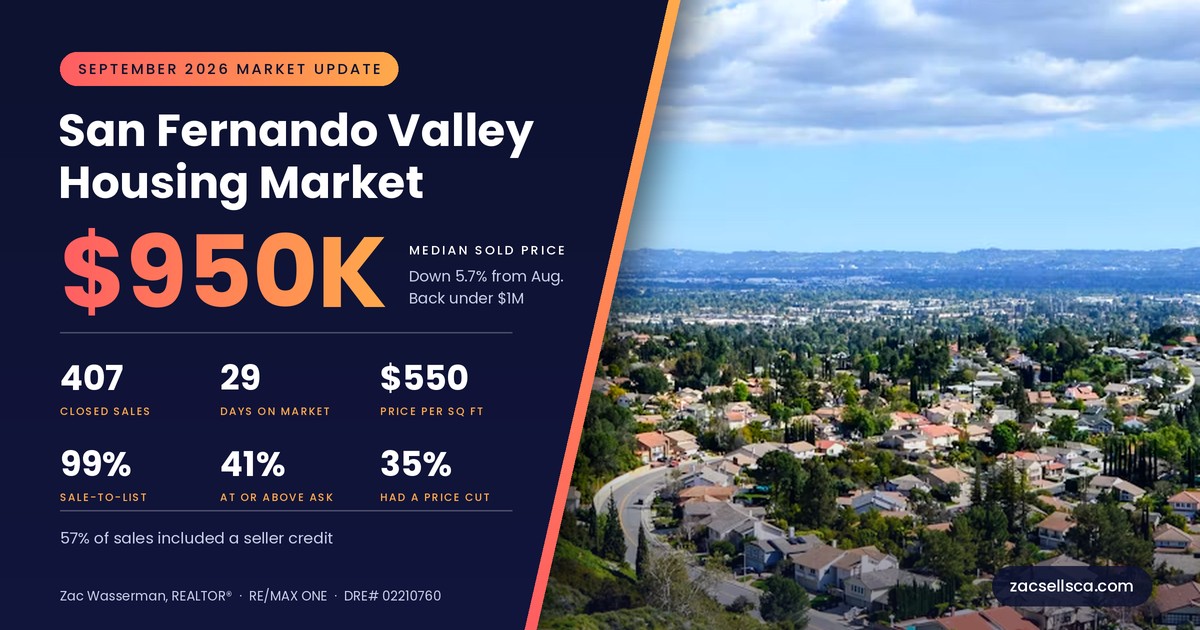
SEPTEMBER 2026 · MARKET UPDATE San Fernando Valley Housing Market Update: September 2026 Prices, Trends & City-by-City Data The median...
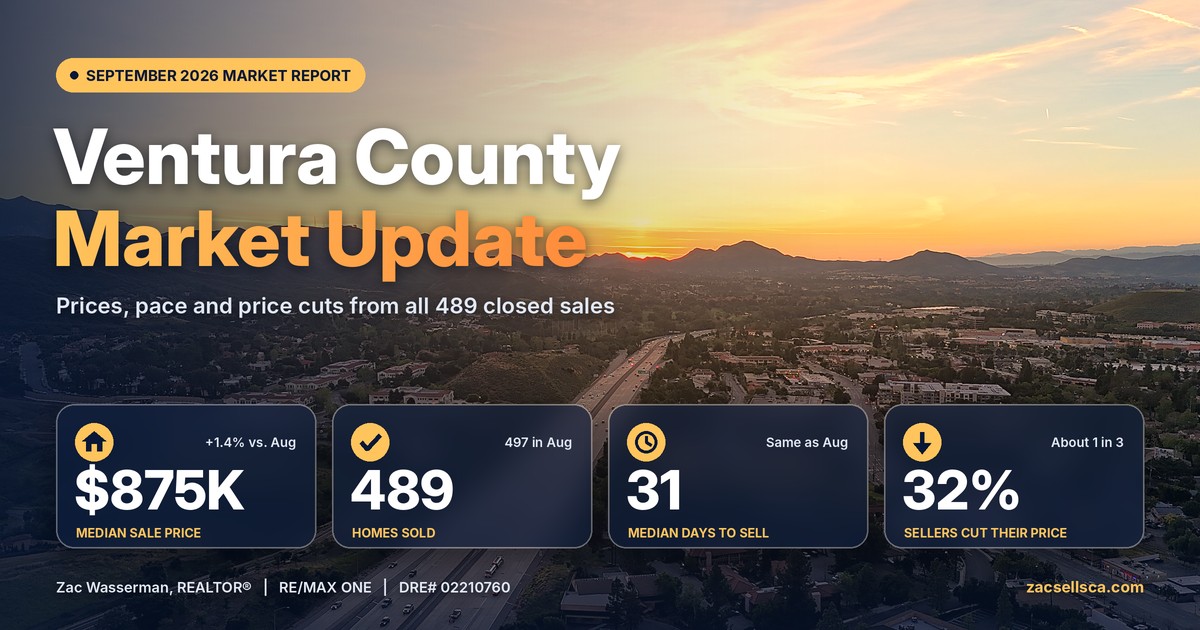
Ventura County’s September 2026 housing market: $875K median price, 489 closed sales, 31 days on market, and city-by-city data for...

State Farm filed to start writing new California home policies again, but only for homes with an IBHS Wildfire Prepared...

Encino real estate in 2026: see median home and condo prices, 494 closed sales, 91436 vs. 91316 trends, neighborhood insights,...

Sherman Oaks real estate in 2026 shows a $1.688M median for single-family homes and $655K for condos and townhomes. See...