

Buying a Home in Ventura County: Your Complete Step-by-Step 2026 Guide
From pre-approval to closing day, here is the local roadmap buyers need to understand pricing, neighborhoods, financing, timing, and strategy in Ventura County.
Buying a home in Ventura County can feel exciting, overwhelming, and highly competitive all at once. However, buyers who understand the local process usually make better decisions, avoid expensive mistakes, and move with more confidence. Whether you are planning your first purchase, relocating within Southern California, or trying to decide how to buy a house in Ventura County in today's market, the key is following a clear plan. Additionally, local pricing, financing, insurance, neighborhood fit, and timing all matter more than most buyers expect. This step-by-step guide breaks down the Ventura County home buying process in a practical way so you know what to do first, what to expect next, and how to stay prepared from search to closing.
Quick Buyer Snapshot
First, study the Ventura County housing market 2026 before setting a target price. Next, compare financing using the latest 2026 conforming and jumbo loan limits and FHA loan limits in Ventura County. Additionally, estimate your payment and cash-to-close by reviewing how much house can I afford in Ventura County and expected closing costs in Ventura County. Finally, build your plan around the neighborhoods, lifestyle, and commute that fit your long-term goals.
Why Ventura County Is a Smart Place to Buy a Home in 2026
First, Ventura County continues to attract buyers who want a strong mix of lifestyle, access, and long-term value. However, the appeal is not just about beaches or weather. Additionally, many buyers are drawn to the balance of suburban space, coastal access, family neighborhoods, commuter options, and a broader range of housing choices than they may find in nearby high-cost pockets of Los Angeles County. As a result, Ventura County remains a serious option for buyers who want both quality of life and a market with multiple entry points.
Furthermore, Ventura County includes distinct communities with very different personalities. For example, Camarillo offers convenience and broad appeal, Ventura blends coastal lifestyle with walkable pockets and hillside neighborhoods, and Thousand Oaks often attracts buyers who want established communities, strong amenities, and commuter access. In contrast, Oxnard and Port Hueneme may offer more approachable condo and townhome options for value-focused buyers, while Moorpark, Santa Paula, and Fillmore can appeal to buyers seeking a different pace or a different price point.
Similarly, the county's housing stock gives buyers options across stages of life. A first-time home buyer Ventura County 2026 may focus on condos, townhomes, or smaller detached properties, while move-up buyers may prioritize schools, yard size, or bedroom count. In addition, buyers watching economic and migration trends should also review the broader 2026 Southern California housing market forecast and local Ventura County real estate market update content to understand how inventory, rates, and demand may affect strategy.
Additionally, Ventura County benefits from real population, employment, and household demand drivers. For example, buyers comparing cities can use the U.S. Census Bureau Ventura County data to better understand demographics, income patterns, and housing context. Therefore, buying a home in Ventura County is not just a lifestyle purchase. It is often a strategic decision based on market access, regional positioning, and long-term livability.
Step 1: Check Your Finances and Get Pre-Approved
First, before you tour homes or scroll listings too seriously, get clear on your numbers. However, many buyers make the mistake of shopping by emotion before they understand payment comfort, debt-to-income ratio, cash reserves, and estimated out-of-pocket expenses. As a result, they either waste time looking above budget or hesitate later when the right property appears. Therefore, the first real step in the Ventura County home buying process is financial clarity.
Additionally, you should look at four numbers before speaking with a lender: target monthly payment, available down payment, emergency reserves, and expected closing cash. In addition, buyers should think beyond principal and interest. For example, property taxes, homeowners insurance, HOA dues, flood exposure, and utility patterns can materially affect affordability depending on the property and city.
Next, talk with a lender and get fully pre-approved rather than casually pre-qualified. Furthermore, a true pre-approval usually carries more weight when you write an offer because it reflects a deeper review of income, assets, and credit. Buyers comparing options should study the CFPB mortgage process guide, along with the National Association of REALTORS® home buying resources and California Association of REALTORS® buyer resources.
Furthermore, if you want a realistic affordability framework, start with current payment scenarios and review how much house can I afford in Ventura County. Similarly, buyers should not ignore insurance early in the process. For example, depending on location and property type, you may need to examine home insurance in Ventura County 2026, a flood insurance guide for Ventura County, or earthquake insurance in Ventura County before finalizing your target price.
Finally, remember that buying a home in Ventura County becomes much easier when your lender, documentation, and budget expectations are aligned before the search begins.
Step 2: Know Your Ventura County Budget and Loan Options
First, once you know your top-end approval amount, the next question is what you actually want to spend. However, approval and comfort are not the same thing. Additionally, your ideal payment should leave room for savings, repairs, travel, childcare, and the unexpected costs of ownership. Therefore, buyers should define both a hard ceiling and a preferred operating range.
Next, compare loan structure as carefully as you compare homes. For example, conventional financing may work well for buyers with stronger credit profiles and moderate down payments, while FHA may help buyers with different qualification needs. In addition, VA financing may provide meaningful advantages for eligible buyers. Similarly, higher-priced purchases may cross into jumbo territory, which is why buyers need to understand the latest 2026 conforming and jumbo loan limits. Buyers considering lower-down-payment paths should also review FHA loan limits in Ventura County.
Furthermore, Ventura County home prices 2026 will vary widely by neighborhood, school district, lot size, view orientation, and property condition. As a result, the same monthly payment may buy a condo in one city, a townhouse in another, or a detached starter home in a different pocket entirely. Therefore, this is the stage where buyers must think in trade-offs: size versus location, condition versus price, and payment versus future flexibility.
Additionally, buyers should understand the full cash requirement, not just the down payment. For example, appraisal fees, inspection costs, reserves, and prepaid items all matter. In addition, many buyers underestimate how much they may need for closing. Reviewing local examples of closing costs in Ventura County can prevent sticker shock later.
Finally, your Ventura County mortgage guide should not end with rate shopping alone. Instead, it should include monthly payment strategy, program fit, reserve planning, and cash-to-close readiness. Therefore, the best loan is the one that supports your goals without stretching your finances too thin.
Step 3: Choose the Right Neighborhood for Your Lifestyle
First, buyers often focus on the home itself before they fully understand the neighborhood decision. However, your daily experience is shaped just as much by commute patterns, walkability, school preferences, noise level, and access to parks, shops, or the coast. As a result, buying a home in Ventura County means evaluating how each city and micro-location supports your routine.
Additionally, one of the smartest things a buyer can do is define a "must-have neighborhood criteria" list before touring homes. For example, your list may include drive time to work, school pickup flow, distance to family, beach access, or a certain lot size. In contrast, buyers who skip this step often get distracted by finishes and forget the larger lifestyle fit.
Next, narrow your shortlist by budget category and priorities. For example, some buyers may be drawn to the more approachable end of the market in Port Hueneme, Oxnard, Santa Paula, or Fillmore. Similarly, others may focus on Camarillo, Ventura, Moorpark, or Simi Valley for a different mix of inventory and neighborhood feel. In addition, buyers targeting premium communities may explore higher-end pockets in Thousand Oaks or Westlake-adjacent areas based on commute and lifestyle. To compare options, review the best neighborhoods in Ventura County guide.
Furthermore, this step is especially important for a first-time home buyer Ventura County 2026 because neighborhood fit can affect future resale flexibility. For example, a buyer who chooses an area with stronger long-term demand drivers may have more options later when it is time to move up. Therefore, think about both your next three years and your next seven years while evaluating location.
Finally, a strong Ventura County real estate agent can help you compare price pockets, off-market trends, school boundaries, commute trade-offs, and neighborhood personality more efficiently than online search alone.
Step 4: Start Your Home Search in Ventura County
First, once your finances and neighborhood criteria are clear, you can begin the actual search with more discipline. However, the goal is not to see everything. Instead, the goal is to see the right homes quickly enough to act when the right one appears. Additionally, buyers should organize their search around budget bands, neighborhood tiers, and must-have features rather than randomly browsing by emotion.
Next, make a clear list of non-negotiables, strong preferences, and nice-to-haves. For example, non-negotiables may include bedroom count, minimum parking, or school area. In addition, preferences may include a larger yard, open kitchen, ADU potential, or no HOA. Similarly, nice-to-haves may include view orientation, updated flooring, or proximity to certain restaurants or parks. Therefore, when inventory shifts quickly, you can evaluate homes faster and with less second-guessing.
Furthermore, buyers should tour enough homes to recognize value, but not so many that every option blurs together. For example, after a handful of serious tours, most buyers begin to understand how pricing differs by condition, location, and lot. As a result, they become better prepared to move decisively. Additionally, you should revisit market signals regularly by tracking the latest Ventura County real estate market updates.
Similarly, your agent should help you filter out homes that look appealing online but present concerns in person. For example, traffic noise, slope, deferred maintenance, awkward layout, insurance complexity, or unpermitted additions may not be obvious in listing photos. Therefore, the search phase is not just about finding a pretty house. It is about identifying the right house at the right price with the right risk profile.
Finally, buying a home in Ventura County gets more efficient when your search is intentional, local, and guided by clear criteria instead of impulse.
Step 5: Make a Competitive Offer
First, writing an offer is where preparation turns into strategy. However, a competitive offer is not always the highest offer. Instead, it is the offer that best balances price, terms, timing, and confidence for the seller while still protecting you as the buyer. Therefore, this step requires both market data and thoughtful positioning.
Next, your agent should evaluate recent comparable sales, current competition, days on market, and the seller's likely leverage. For example, a newly listed turnkey home in a high-demand neighborhood may require stronger terms than a property that has lingered or needs work. In contrast, a home with condition concerns may offer more room for negotiation on price, credits, or repair requests.
Additionally, strong offers often include a well-prepared pre-approval, clean documentation, flexible timelines when appropriate, and contingency decisions that match the situation. Furthermore, buyers should understand that contingencies are protection tools, not obstacles. As a result, the smartest strategy is not blindly removing protections, but using them with precision based on risk, competition, and property quality.
Similarly, price should be viewed in context. For example, paying slightly more for a stronger location, better lot, or more insurable property may be the wiser move than "saving money" on a home with hidden long-term costs. Therefore, offer strategy should account for both current market value and total ownership picture.
Finally, this is where an experienced Ventura County real estate agent can make a measurable difference by framing the offer correctly, anticipating the seller's concerns, and negotiating from a grounded local perspective.
Step 6: Navigate Escrow, Inspections, and Contingencies
First, once your offer is accepted, the transaction moves into escrow, which is where details matter. However, many buyers assume the hard part is over at acceptance. In reality, this phase is where due diligence, lender coordination, disclosures, inspections, and negotiation all intersect. Therefore, staying organized is critical.
Next, review disclosures carefully and schedule inspections promptly. For example, depending on the property, buyers may order a general home inspection, roof inspection, sewer scope, chimney inspection, or specialist review for foundation, drainage, HVAC, or pests. Additionally, some Ventura County properties may raise insurance-related questions due to hillside location, brush exposure, proximity to flood zones, or older systems. In addition, that is why it can be smart to investigate home insurance in Ventura County 2026 and location-specific risks early, including the flood insurance guide for Ventura County and earthquake insurance in Ventura County.
Furthermore, appraisal and underwriting move alongside inspections, and both can affect the path to closing. For example, if the home appraises below contract price, the parties may renegotiate, adjust structure, or proceed if the buyer has the funds and desire to do so. Similarly, lender conditions may require updated documents, explanations, or timing adjustments. As a result, responsive communication matters a great deal during escrow.
Additionally, buyers should think in terms of material issues rather than perfection. However, almost every resale home will present some defects. Therefore, the real question is whether the issues are cosmetic, manageable, safety-related, or financially significant. A calm, strategic approach usually produces better outcomes than reacting emotionally to inspection reports.
Finally, the steps to buying a home California buyers follow are often won or lost in escrow discipline. When you review documents carefully, meet deadlines, and stay solution-oriented, the path to closing is much smoother.
Step 7: Final Walk-Through and Closing Day
First, the final walk-through is not just a formality. Instead, it is your chance to verify that the property is in substantially the same condition, agreed repairs were handled if applicable, and no unexpected issues arose before possession. Additionally, buyers should confirm inclusions, appliances, fixtures, and general condition before signing the last round of documents.
Next, closing day typically involves signing lender and escrow paperwork, wiring remaining funds, and waiting for the transaction to record. However, timing can vary depending on lender cutoffs, county recording schedules, and whether funds arrive on time. Therefore, buyers should avoid scheduling movers too tightly if the closing is still pending recordation.
Furthermore, it helps to have a first-week ownership checklist ready. For example, buyers should line up utilities, change locks, confirm insurance, store settlement paperwork, and prioritize immediate maintenance items. In addition, buyers should also re-check monthly ownership costs to make sure taxes, insurance, and any HOA items are fully understood after closing.
Finally, buying a home in Ventura County does not end when you get the keys. Instead, that is the moment where planning transitions into ownership, upkeep, and long-term equity building.
How Long Does It Take to Buy a Home in Ventura County?
First, the answer depends on how prepared you are before the search begins. However, many buyers underestimate the full timeline because they only think about escrow. In reality, the process includes preparation, neighborhood research, financing, home search, negotiation, inspections, underwriting, and closing.
Additionally, a prepared buyer may spend a few weeks getting finances and lender documents in place, then anywhere from a couple of weeks to a few months finding the right home. Next, once under contract, many financed purchases close in roughly 30 to 45 days, although cash purchases may move faster. In contrast, homes with title issues, repair negotiations, appraisal gaps, or lender delays can take longer.
Furthermore, timeline also varies by price point and city. For example, buyers in highly competitive pockets may write multiple offers before securing a home. Similarly, buyers in slower-moving segments may take more time evaluating value and negotiating terms. Therefore, the smartest approach is to think in phases instead of expecting one standard timeline.
Finally, if you want the Ventura County home buying process to move efficiently, the best advantages are early pre-approval, realistic search criteria, quick decision-making, and strong professional guidance.
Work With a Local Ventura County REALTOR®
First, buyers today have more information than ever, but information alone does not replace local judgment. However, online portals cannot fully interpret neighborhood nuance, pricing behavior, disclosure risk, insurance red flags, or how to structure terms in a competitive situation. Therefore, working with a local Ventura County real estate agent can save time, reduce uncertainty, and improve decision quality throughout the transaction.
Additionally, a local agent should help you interpret not just list prices, but true value. For example, one home may look cheaper until you factor in location, future resale appeal, insurance complexity, deferred maintenance, or HOA cost. In addition, a good agent helps buyers compare trade-offs clearly and avoid overpaying for the wrong reasons.
Furthermore, local representation matters during search, negotiation, and escrow. Similarly, buyers benefit from an agent who understands city-by-city pricing patterns, property-type differences, commute realities, and current offer dynamics. As a result, you can make decisions with more context and less guesswork.
Finally, if you are serious about buying a home in Ventura County, it helps to work with someone who can connect market data, financing strategy, neighborhood guidance, and transaction execution into one clear process.
Frequently Asked Questions: Buying a Home in Ventura County
What are median home prices in Ventura County in 2026?
First, Ventura County home prices 2026 depend heavily on city, neighborhood, product type, and condition. However, buyers should not rely on a countywide number alone because the gap between an entry-level condo and a move-in-ready detached home can be significant. Therefore, reviewing current neighborhood-specific market data is the best way to understand what your budget can realistically buy.
How long does it usually take to close on a home in Ventura County?
Typically, once an offer is accepted, many financed transactions close in about 30 to 45 days. However, cash deals may close faster, while appraisal issues, lender conditions, inspections, or repair negotiations can extend the timeline. As a result, preparation before you write an offer can shorten the overall process.
How much down payment do I need to buy a home in Ventura County?
Additionally, down payment requirements vary by loan type and borrower profile. For example, some buyers may qualify for low-down-payment conventional, FHA, or VA financing, while jumbo buyers often need more cash and stronger reserves. Therefore, the right answer depends on your credit, income, assets, and target price range.
What are the best cities in Ventura County for first-time buyers?
In general, many first-time buyers start by exploring Oxnard, Port Hueneme, Fillmore, Santa Paula, and selected price pockets in Camarillo or Simi Valley, depending on budget and commute. However, the best fit depends on payment comfort, property type, lifestyle goals, and future plans. Therefore, buyers should compare neighborhoods based on both monthly cost and long-term livability.
Is 2026 a good time to buy a home in Ventura County?
Finally, 2026 can be a good time to buy for buyers who are financially ready, payment-conscious, and planning to hold the home long enough for the purchase to make sense. However, the right timing depends on your budget, rate environment, inventory options, and how well the home fits your needs. As a result, the best time is usually when personal readiness and market opportunity align.
Buyer Resources to Review Next
First, study the latest Ventura County housing market 2026 overview and ongoing Ventura County real estate market updates. Additionally, compare financing options using the 2026 conforming and jumbo loan limits and FHA loan limits in Ventura County. Furthermore, estimate affordability with how much house can I afford in Ventura County, review expected closing costs in Ventura County, and explore the best neighborhoods in Ventura County before you start touring.
Ultimately, the buyers who do best are usually not the ones who rush. Instead, they are the ones who prepare well, understand their budget, learn the neighborhoods, and move decisively when the right opportunity shows up. Additionally, when you follow a disciplined local strategy, the process becomes far more manageable. Whether you are comparing entry-level condos, move-up homes, or relocation options, buying a home in Ventura County is most successful when your finances, timeline, neighborhood criteria, and offer strategy all work together.
Ready to Buy a Home in Ventura County?
I'm Zac Wasserman, a licensed REALTOR® serving Ventura County and the San Fernando Valley. Whether you're a first-time buyer or making your next move, I'll guide you through every step of the process.
📞 805.212.9147 | ✉️ zacsellsca@gmail.com | 🌐 zacsellsca.com
Zac Wasserman · CA DRE# 02210760 · RE/MAX ONE
- All Posts
- Buyer Guides
- California Home Insurance & Wildfire Risk
- Home Financing (Mortgage & Loan Guides)
- Market Updates & Forecasts
- Seller Guides
- Back
- Ventura County Real Estate Market Updates
- San Fernando Valley Real Estate Market Updates (Monthly): Prices, Inventory & Trends

Ventura County Home Seller Guide | Fall / Winter 2026 Should You Sell Now or Wait Until Spring? Ventura County...

SEPTEMBER 2026 · MARKET UPDATE San Fernando Valley Housing Market Update: September 2026 Prices, Trends & City-by-City Data The median...
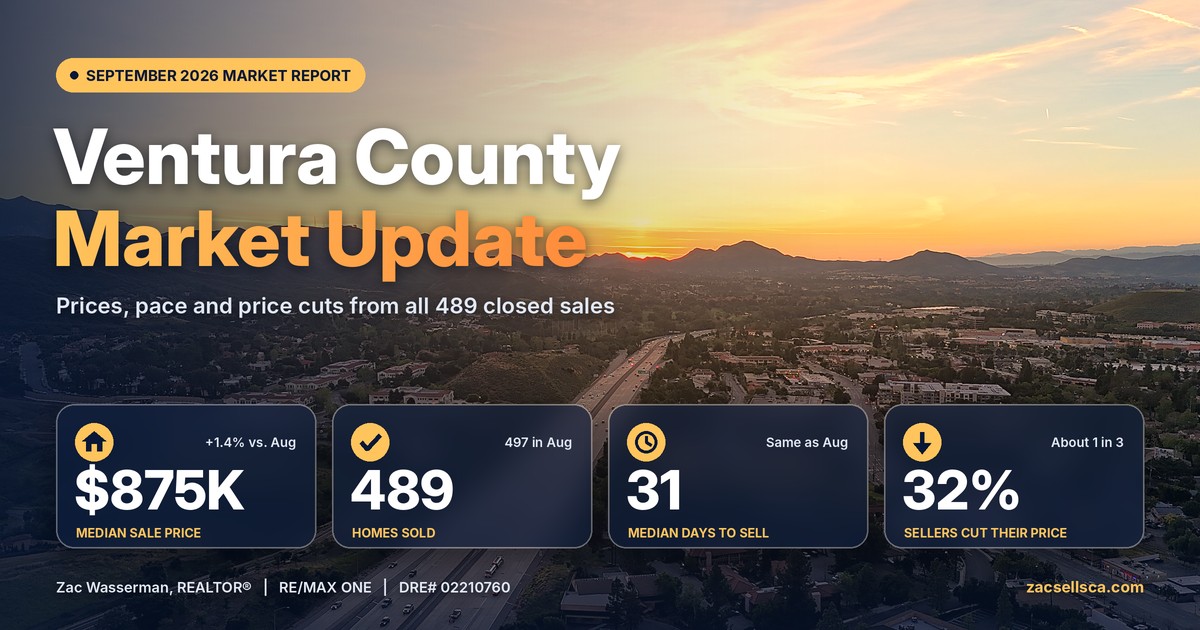
Ventura County’s September 2026 housing market: $875K median price, 489 closed sales, 31 days on market, and city-by-city data for...

State Farm filed to start writing new California home policies again, but only for homes with an IBHS Wildfire Prepared...

Encino real estate in 2026: see median home and condo prices, 494 closed sales, 91436 vs. 91316 trends, neighborhood insights,...

Sherman Oaks real estate in 2026 shows a $1.688M median for single-family homes and $655K for condos and townhomes. See...