
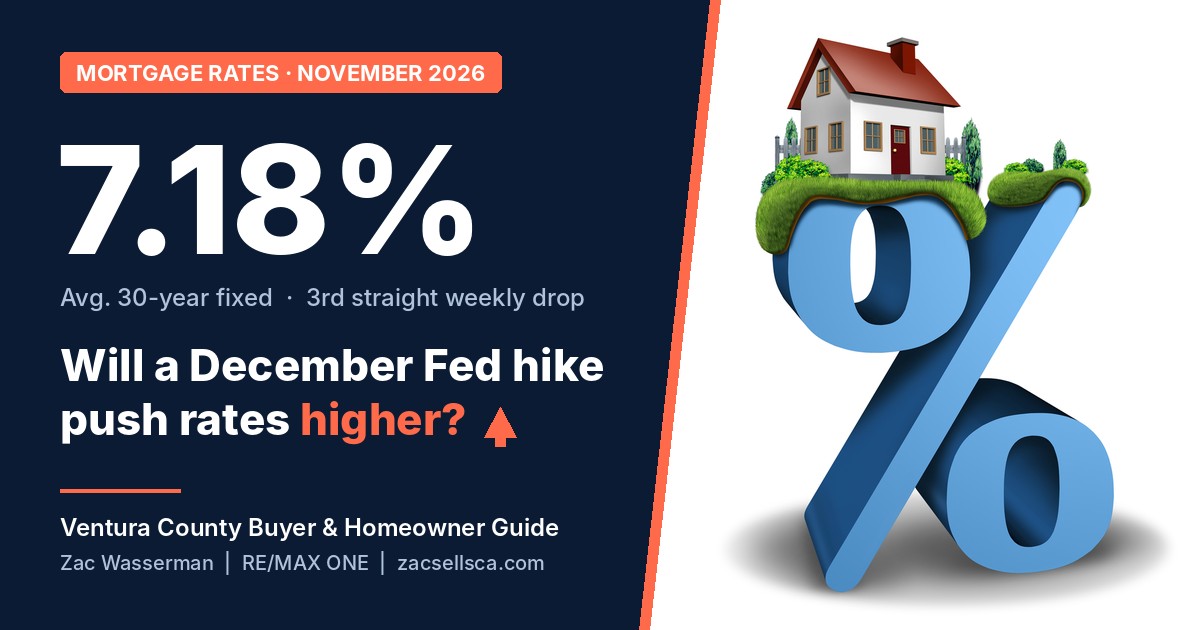
Mortgage Rates November 2026: Will a December Fed Hike Push Ventura County Rates Higher?
VENTURA COUNTY MORTGAGE RATE UPDATE | NOVEMBER 11, 2026
Mortgage rates November 2026 have given buyers a rare piece of good news. The average 30-year fixed rate has fallen for three straight weeks. However, that relief is running straight into a problem: inflation came in hot in October, and the Federal Reserve is now widely expected to raise rates again at its December 8–9 meeting.
So which wins? Do mortgage rates keep sliding, or does the Fed push them back up before the year ends? As a Ventura County REALTOR® with RE/MAX ONE, I get this question from buyers and homeowners almost every day right now. Below, I'll walk through where rates stand, what changed this week, and how I'd think about locking a rate if you're buying in Thousand Oaks, Camarillo, Simi Valley, Oxnard, or anywhere else in the county.
Mortgage Rates November 2026: Where They Stand Right Now
According to Freddie Mac's November 5 survey, the average 30-year fixed mortgage rate is 7.18%, down from 7.24% the week before. That's the third straight weekly decline. Meanwhile, the 15-year fixed averaged 6.57%. For context, the 30-year averaged 6.22% at this time last year, so borrowing is still nearly a full point more expensive than it was in late 2025.
You can track the weekly numbers yourself on the Freddie Mac Primary Mortgage Market Survey. Keep in mind that Freddie Mac reports a weekly national average rather than the rate you'll actually be quoted. Your own rate depends on your credit score, down payment, loan size, and whether you pay points.
Here's the quick snapshot:
| Measure | Latest Reading |
|---|---|
| 30-year fixed (Freddie Mac, Nov. 5) | 7.18% |
| 30-year fixed one week earlier | 7.24% |
| 30-year fixed one year ago | 6.22% |
| 15-year fixed (Freddie Mac, Nov. 5) | 6.57% |
| Fed funds target range | 3.75%–4.00% |
| Next Fed decision | December 9, 2026 |
Why Rates Fell for Three Straight Weeks
First, it helps to understand what actually moves mortgage rates. Mortgage rates don't follow the Fed's rate directly. Instead, they track the 10-year Treasury yield much more closely, because mortgage-backed securities compete with Treasuries for the same investors.
In late October, the 10-year yield eased from the mid-4.9% range to about 4.84%. As a result, lenders had room to trim rates, and the Freddie Mac average dropped from 7.40% in mid-October to 7.18% by early November. In addition, the Fed's decision on October 28 to hold rates steady, rather than hike again right away, took some pressure off the bond market.
For buyers, that slide mattered. If you read my October 2026 mortgage rate update, rates were hovering around 7.4% and sentiment was gloomy. Three weeks later, the picture had improved.
The October Inflation Report Changed the Conversation
Then came Tuesday, November 10. The Bureau of Labor Statistics reported that consumer prices rose 0.4% in October, above the 0.3% economists expected. More importantly, core inflation, which strips out food and energy, rose 0.3% for the third month in a row. You can read the full release on the BLS Consumer Price Index page.
Why does that matter so much? Because Fed Governor Christopher Waller had said that morning that a core reading around 0.3% could justify a half-point hike in December instead of a quarter point. The report hit that mark exactly.
Consequently, futures markets now fully price in at least a quarter-point increase on December 9, and the odds of a half-point move jumped from roughly zero to about 14%. Treasury yields rose and stocks fell on the news. In other words, the three-week rate rally just hit a wall.
Will a December Fed Hike Push Mortgage Rates Higher?
This is the question everyone is asking, and the honest answer is: it depends on whether the hike surprises the market.
Here's the key point most headlines miss. Because markets already expect a quarter-point hike, much of that move is already reflected in today's bond yields and mortgage rates. Therefore, a quarter-point hike on December 9 by itself may not send mortgage rates sharply higher. We saw a version of this in September: the September Fed rate hike was widely expected, so the market had largely priced it in ahead of time.
However, there are three scenarios where mortgage rates could move meaningfully higher:
- The Fed hikes by a half point. That would be a surprise, and surprises move bond yields.
- The Fed signals more hikes in 2027. The December meeting includes new economic projections, so if officials pencil in additional increases, longer-term yields could rise.
- The 10-year Treasury pushes toward or above 5%. Yields have hovered just below that line this fall. A sustained break above it would likely pull mortgage rates back toward the mid-7% range.
On the other hand, rates could hold near current levels if the Fed hikes a quarter point and signals a long pause. Several large banks, including Citi, have forecast exactly that: one more hike in December, then a hold until cuts begin around mid-2027.
My take: I wouldn't count on rates getting dramatically better before year-end. The downside risk (higher rates) currently looks larger than the upside (meaningfully lower rates).
What Mortgage Rates in November 2026 Mean for Your Monthly Payment
Numbers make this concrete. Below are principal and interest payments on a 30-year fixed loan at today's average, at mid-October's rate, and at a scenario where rates climb back toward 7.5%. Property taxes, insurance, and HOA dues are not included.
| Loan Amount | 6.22% (a year ago) | 7.18% (today) | 7.40% (mid-October) | 7.50% (if rates rise) |
|---|---|---|---|---|
| $640,000 | $3,928 | $4,336 | $4,431 | $4,475 |
| $800,000 | $4,910 | $5,419 | $5,539 | $5,594 |
| $1,000,000 | $6,138 | $6,774 | $6,924 | $6,992 |
For example, on an $800,000 loan, which is common in Thousand Oaks, Camarillo, and Simi Valley, the difference between 7.18% and 7.50% is about $175 per month, or roughly $2,100 per year. Over the first five years, that adds up to more than $10,000.
Additionally, loan size matters in our market. Many Ventura County purchases land near or above the conforming limit, so check where your loan falls against the 2026 conforming and jumbo loan limits. Jumbo pricing can behave differently from conforming pricing, especially during volatile weeks. If you're still working out your budget, my guide to how much house you can afford in Ventura County walks through the math.
Know your payment before you make an offer
Get a local strategy for financing, seller credits, and your ideal monthly payment.
Call Zac: 805.212.9147 See what your home is worthShould Ventura County Buyers Lock Now or Wait?
I'm not a lender, and I always recommend getting rate quotes from at least two or three loan officers. Still, here's how I'm advising my buyers this month.
Lock now if you're already in escrow. If you have an accepted offer and your closing date falls after December 9, there's little reason to gamble on the Fed meeting. A 30- to 45-day lock locks in today's improved rates and removes the risk of a hawkish surprise.
Ask about a float-down option. Some lenders offer a one-time float-down: if rates drop meaningfully after you lock, you can capture part of the improvement. It often costs a small fee, but in a market this volatile, it can be worth it.
Don't wait on the sidelines for a big drop. If you're shopping now, waiting for rates to fall before writing offers is a risky strategy. Even if rates dip after December, more buyers tend to return in spring, and competition can wipe out the savings. Meanwhile, the late-fall market typically has less competition, more price reductions, and sellers who are more willing to offer credits toward a rate buydown.
Use seller credits strategically. A seller credit used for a temporary or permanent rate buydown can lower your payment far more than an equivalent price reduction. This is one of the most effective tools in a high-rate market, and it's something I negotiate regularly.
For a broader look at local conditions, including prices, days on market, and inventory, read my Ventura County real estate market update for October 2026.
Buying before the December Fed meeting?
Talk through timing, negotiation strategy, and rate-lock questions before you commit.
Talk with ZacWhat Ventura County Homeowners Should Do About Refinancing
If you bought or refinanced when rates were above 7.5%, this month's dip may be worth a quick conversation with your lender. Generally, refinancing starts to make sense when you can lower your rate by roughly 0.75 to 1 point and recover your closing costs within a few years.
For most Ventura County homeowners who locked in sub-4% or sub-5% rates earlier in the decade, however, refinancing doesn't make sense right now. That "lock-in effect" is also one reason local inventory remains tight.
Thinking about selling instead? Your timing decision depends on more than rates. My guide on whether to sell now or wait until spring covers the tradeoffs, and a free home valuation will show you what your home is worth today.
Key Dates to Watch Before Year-End
Several events between now and the end of the year could move mortgage rates:
Thursday, November 12: Freddie Mac's next weekly rate survey, the first to reflect the October CPI report.
Wednesday, November 25: October PCE inflation, the Fed's preferred inflation measure.
Early December: The November jobs report.
December 8–9: The Fed's final meeting of 2026, with a rate decision, new economic projections, and a press conference on December 9. See the Federal Reserve's FOMC calendar for details.
Thursday, December 10: November CPI, released one day after the Fed decides.
Frequently Asked Questions About Mortgage Rates in November 2026
Q: What are mortgage rates in November 2026? A: According to Freddie Mac's November 5, 2026 survey, the average 30-year fixed mortgage rate is 7.18%, and the average 15-year fixed rate is 6.57%. Your actual rate will depend on your credit score, down payment, loan size, and lender.
Q: Will the Fed raise rates in December 2026? A: Markets now fully expect at least a quarter-point increase at the Fed's December 8–9 meeting after October's inflation report came in hotter than expected. Some traders also see a smaller chance of a half-point hike.
Q: Does a Fed rate hike automatically raise mortgage rates? A: No. Mortgage rates follow the 10-year Treasury yield more closely than the Fed funds rate. When a hike is already expected, much of it is priced in before the meeting. Mortgage rates tend to rise more when the Fed surprises markets or signals additional hikes.
Q: Should I lock my mortgage rate before the December Fed meeting? A: If you're in escrow and closing after December 9, locking now removes the risk of a rate jump after the meeting. Ask your lender whether a float-down option is available in case rates fall after you lock.
Q: Are Ventura County mortgage rates different from national averages? A: Rates are set by lenders nationally, so Ventura County borrowers generally see similar pricing. However, larger loan amounts are common here, and jumbo loans above the conforming limit can be priced differently from conforming loans.
Q: When will mortgage rates go down? A: No one can predict rates with certainty. Several major banks expect the Fed to hold after December and begin cutting around mid-2027, which could ease mortgage rates over time. Until inflation cools, however, a large near-term drop appears unlikely.
Get a Local Game Plan Before the Fed Meets
Mortgage rates in November 2026 opened a short window of relief, and the next few weeks will decide whether it stays open. If you're buying, the smartest move is to get pre-approved now, compare lock options, and negotiate seller credits while the late-fall market gives buyers more leverage. If you're selling, knowing your home's value and your buyer pool's financing reality will help you price correctly the first time.
Ready to make a move before year-end? Contact Zac Wasserman at RE/MAX ONE, your local Ventura County expert, at 805.212.9147 or get your free home valuation today.
Your next move starts with a local game plan
Whether you are buying, selling, or reviewing your financing options, I can help you plan the next step.
Call 805.212.9147 Get a free home valuationABOUT THE AUTHOR
Zac Wasserman, REALTOR®
CA DRE# 02210760 | RE/MAX ONE
30699 Russell Ranch Rd #100, Westlake Village, CA 91362
Phone: 805.212.9147
Rate data is from Freddie Mac's Primary Mortgage Market Survey as of November 5, 2026, and is provided for informational purposes only. This article is not financial advice; consult a licensed mortgage professional for a personalized quote.
- All Posts
- Buyer Guides
- California Home Insurance & Wildfire Risk
- Home Financing (Mortgage & Loan Guides)
- Market Updates & Forecasts
- Seller Guides
- Back
- Ventura County Real Estate Market Updates
- San Fernando Valley Real Estate Market Updates (Monthly): Prices, Inventory & Trends
Mortgage Rates November 2026: Will a December Fed Hike Push Ventura County Rates Higher? VENTURA COUNTY MORTGAGE RATE UPDATE |...

California Prop 37 and Prop 1 Passed: What They Mean for Ventura County & LA Homebuyers California voters sent a...

The San Fernando Valley housing market sent mixed signals in October 2026: the median rose to $994,500, but homes took...

The Ventura County real estate market cooled in October 2026: 478 homes closed at an $857,500 median, down 2% from...
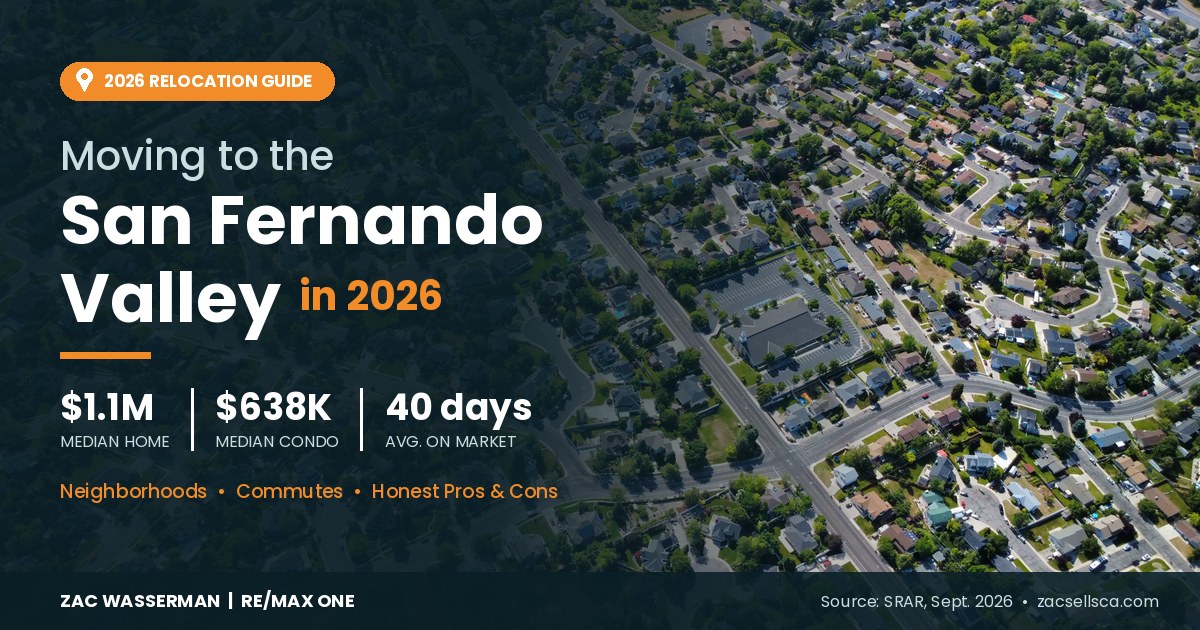
Moving to the San Fernando Valley: Your 2026 Relocation Guide Moving to the San Fernando Valley: Your 2026 Relocation Guide...
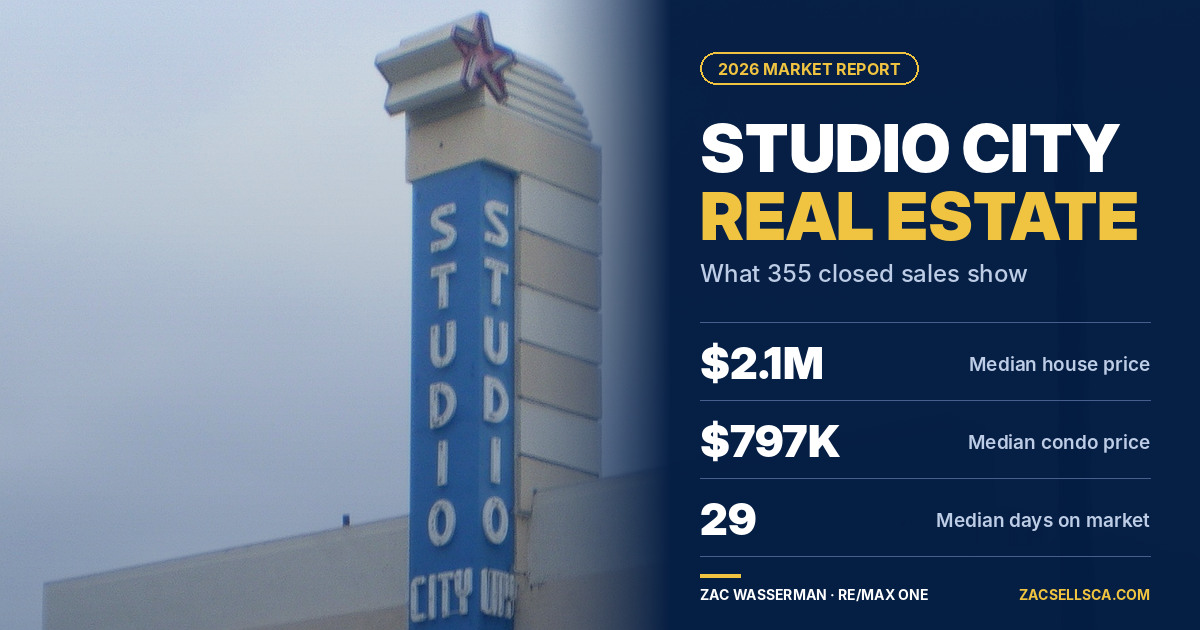
Studio City real estate by the numbers: a $2.1M median house, $797K condo, and 29 days on market, based on...