
California Prop 37 and Prop 1 Passed: What They Mean for Ventura County & LA Homebuyers
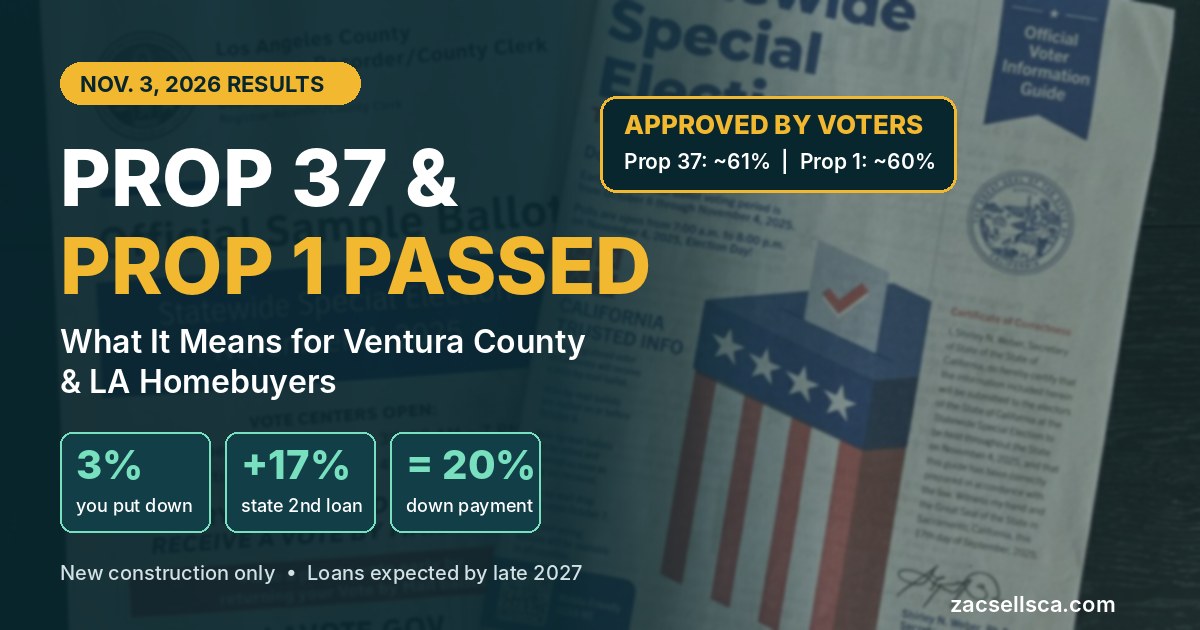
California voters sent a clear message on November 3, 2026: housing affordability matters. California Prop 37 passed with roughly 61% of the vote, creating a new state loan that can cover up to 17% of the price of a newly built home. At the same time, Prop 1, an $11.25 billion housing bond, passed with close to 60% support. Both races were called by the Associated Press on election night, although results won't be officially certified until December.
I'm Zac Wasserman, a REALTOR® with RE/MAX ONE serving Ventura County and the San Fernando Valley. Since election night, I've fielded the same question from clients over and over: "Can I use this to buy a house?" The honest answer is "maybe, but not yet." Therefore, this guide breaks down exactly what each measure does, who qualifies, what the local price and income limits look like for Ventura and Los Angeles counties, and what you should do right now while the state builds the program.
Can you use Prop 37 to buy a home today?
Not yet. The new loan program may not be available until late 2027. However, existing CalHFA assistance programs may provide options for qualified buyers right now.
California Prop 37 and Prop 1 Election Results at a Glance
Before getting into details, here's the short version of what voters approved.
| Measure | What It Does | Result |
|---|---|---|
| Prop 37 | Up to $25 billion in revenue bonds for middle-class homeownership loans of up to 17% of a qualifying new home's price | Passed, about 61% |
| Prop 1 | $11.25 billion in bonds for affordable housing, veterans and homeownership assistance | Passed, close to 60% |
- Prop 37 (Middle-Class Homeownership Loan): Passed with about 61% of the vote. It authorizes the California Housing Finance Agency (CalHFA) to sell up to $25 billion in revenue bonds. Those funds become second mortgages of up to 17% of a new home's price for buyers who put at least 3% down.
- Prop 1 (Veterans and Affordable Housing Bond Act of 2026): Passed with close to 60% of the vote. It authorizes $11.25 billion in state bonds, mostly for affordable rental housing, plus money for veterans' home loans and low- and moderate-income homebuyers.
In other words, Prop 37 is the measure that directly changes the math for middle-income buyers. Prop 1, by contrast, is mostly about building and preserving affordable housing, although it does include homeownership dollars.
What California Prop 37 Does for Homebuyers
California Prop 37 creates a brand-new "middle-class homeownership loan." Here's how it works in plain English.
First, you bring at least 3% of the purchase price as your own down payment. Next, CalHFA lends you up to another 17% as a second mortgage. As a result, you reach a full 20% down payment, which means your primary lender sees a standard 80% loan-to-value first mortgage. Additionally, analyses of the measure note that buyers reaching 20% down wouldn't need private mortgage insurance.
Here's a simple example on an $850,000 newly built townhome:
How the financing works
3% + 17% + 80%
Your down payment + Prop 37 second mortgage + conventional first mortgage
| Your down payment (3%) | $25,500 |
| Prop 37 second loan (17%) | $144,500 |
| First mortgage (80%) | $680,000 |
Illustrative financing only. Actual terms, rates, closing costs and eligibility are subject to program and lender requirements.
That's a huge difference compared to saving $170,000 in cash for a traditional 20% down payment. However, it's important to understand that the 17% is a loan, not a grant. Unlike CalHFA's existing "silent second" programs, Prop 37 loans are fixed-rate second mortgages with monthly payments. Consequently, your total monthly housing cost will include two loan payments, not one.
Some other key features written into the measure:
- Fixed rate only. CalHFA must offer fixed-rate loans, although the agency will set the actual rate later.
- No prepayment penalties. You can pay the second loan off early, for example when you refinance.
- Revenue bonds, not taxes. Borrowers' loan payments repay the bonds. Because of this, the Legislative Analyst's Office found no direct state or local cost.
- Hardship deferral. Borrowers can request a temporary deferral of monthly interest payments during a hardship.
Wondering Whether Prop 37 Could Work for You?
Let's compare your buying power with today's loan options and a potential Prop 37 financing structure.
Discuss Your Buying OptionsWho Qualifies for the California Prop 37 Loan?
Eligibility is broader than many people expect. Notably, you do not need to be a first-time buyer. To qualify, you must:
- Have lived in California for at least one year
- Earn no more than 200% of the area median income (AMI) for your household size
- Live in the home as your primary residence
- Buy a qualifying new home, meaning you are its first purchaser
Qualifying homes include newly built single-family houses, townhomes, row houses, condominiums and manufactured homes. In addition, units created by converting nonresidential buildings, such as an office building turned into condos, can qualify. Resale homes, on the other hand, do not.
Prop 37 Price Caps and Income Limits in Ventura and Los Angeles Counties
The measure caps eligible home prices at 125% of each county's federal conforming loan limit. Using 2026 figures, one published analysis calculated these local numbers:
| County | Prop 37 Price Cap | Income Ceiling — Family of 4 |
|---|---|---|
| Los Angeles | $1,561,406 | $216,200 |
| Ventura | $1,293,750 | $271,200 |
Keep in mind these are illustrations, not final program rules. CalHFA will decide which income tables to use. Furthermore, conforming loan limits reset every year, so the caps will likely move once the 2027 limits are announced. For context on how those limits work today, see my breakdown of 2026 conforming and jumbo loan limits for Ventura and LA.
For Ventura County buyers, that income ceiling is meaningful. A household of four earning up to roughly $271,000 could qualify, which covers many dual-income teachers, nurses, engineers and first responders who are priced out today.
When Will Prop 37 Loans Actually Be Available?
Important Program Timeline
Not Available Yet — Loans Expected by Late 2027
Election certification is due by December 11, 2026. CalHFA then has up to one year to implement the new program. Exact launch dates and application availability have not been announced.
This is the part most headlines skip. Prop 37 takes effect after the Secretary of State certifies the election, which is due by December 11, 2026. CalHFA then has up to one year to launch the program. Therefore, realistically, loans may not be available until late 2027.
Before launch, CalHFA must still sell the bonds, set interest rates and loan terms, and finalize price and income limits. The LAO also flags real uncertainties, including how much investor demand there will be for the bonds and whether the loans end up cheaper than other down payment options.
My advice: don't put your life on hold waiting for the new loan. If the right home comes along now, existing programs may already fit. I cover those in my guide to down payment assistance in California for 2026.
What Prop 1's $11.25 Billion Housing Bond Funds
Prop 1 is a general obligation bond, which means the state repays it from the general fund. According to the Legislative Analyst, that will cost roughly $500 million to $600 million per year for about 25 years. Here's where the money goes:
| Housing Investment | Funding |
|---|---|
| Affordable apartment buildings | $7.2 billion |
| Veterans' home loans | $1.25 billion |
| Low- and moderate-income homebuyers | $1.1 billion |
| Housing infrastructure | $500 million |
| Farmworker housing | $450 million |
| UC and CSU student housing | $350 million |
| Tribal grants | $200 million |
| Local pilot projects | $200 million |
For homebuyers, the two lines to watch are the $1.1 billion homeownership allocation and the $1.25 billion for veterans. Similarly to Prop 37, the state still has to release that funding through specific programs, so details will come over the next year.
Ventura County also has a large farmworker population in Oxnard, Santa Paula and Fillmore. As a result, the farmworker housing dollars could matter locally, even for residents who aren't buying.
Prop 37 vs. Prop 1 vs. Existing Down Payment Programs
Because several programs now overlap, here's how they compare.
| Feature | CalHFA MyHome | Dream For All | Prop 37 Loan |
|---|---|---|---|
| Help amount | Up to 3%–3.5% | Up to 20%, capped at $150,000 | Up to 17% |
| Repayment | Deferred until sale, refinance or payoff | Original amount plus a share of appreciation | Fixed-rate monthly payments |
| First-time buyer required? | Yes | Yes (or first-generation) | No |
| Home type | Most homes | Most homes | New construction only |
In short, existing programs are easier on monthly cash flow, while Prop 37 offers more money with fewer buyer restrictions. Meanwhile, Prop 1 adds funding that may expand homeownership programs in the future.
Which Homebuyer Program Makes the Most Sense?
Your income, down payment, monthly budget and preferred property type all matter. Let's compare your options before you make a decision.
Request a Buyer Strategy SessionWhat Prop 37 Means for Ventura County and San Fernando Valley Buyers and Sellers
Because Prop 37 only applies to newly built homes, its local effect depends heavily on new construction. Much of Ventura County's for-sale new construction has been townhome and condo product, which can fit comfortably under the county's price cap. Likewise, new condo and townhome projects in the San Fernando Valley could see stronger demand once the program launches.
There are trade-offs to weigh, too. New homes often carry HOA dues, Mello-Roos special taxes and, in some areas, harder-to-place insurance in wildfire zones. Additionally, a second monthly loan payment reduces how much house your income supports. As a result, run the full monthly payment, not just the down payment, before you get excited. My Ventura County mortgage rates update is a good starting point for estimating the first mortgage.
What about sellers of existing homes? Prop 37 won't help buyers purchase your resale house. However, it could pull some middle-income buyers toward new construction in 2027. Consequently, resale sellers in competing price ranges should price and prepare carefully.
The measure also includes a builder-side component. Participating builders get a modified construction-defect claims process in exchange for meeting labor standards. Supporters argue this could help restart condo construction, which has lagged for years partly due to defect liability concerns.
What Homebuyers Should Do Right Now
Even though loans aren't available yet, you can prepare today.
- Check your income against the limits. Compare your household income with the 200% AMI ceiling for your county.
- Save the 3%. Prop 37 still requires at least 3% from you, plus closing costs.
- Strengthen your credit. Better credit will mean a better first mortgage rate, regardless of how CalHFA prices the second loan.
- Get pre-approved now. A lender can show you what you qualify for today, with or without Prop 37.
- Track new-construction communities. Find out which local builders have homes priced under the cap and whether they plan to participate.
- Learn the rest of the rules for 2027. Several other changes take effect next year, which I cover in new California real estate laws for 2027.
If you're buying for the first time, my Ventura County first-time homebuyer guide walks through the whole process step by step.
California Prop 37 and Prop 1 FAQ
Did California Prop 37 pass?
Yes. Prop 37 passed on November 3, 2026, with about 61% of the vote, according to the Associated Press. Results are due to be certified by December 11, 2026.
Is the Prop 37 loan free money?
No. The Prop 37 loan is a fixed-rate second mortgage that you repay with monthly payments. It is funded by revenue bonds that are repaid by borrowers, not by taxpayers.
Can I use Prop 37 to buy a resale home?
No. Prop 37 only applies to newly built homes or units converted from nonresidential buildings, and the buyer must be the first purchaser.
Do I have to be a first-time homebuyer to use Prop 37?
No. Prop 37 does not require buyers to be first-time homebuyers. Buyers must be California residents for at least one year, earn no more than 200% of area median income and live in the home.
When can I apply for a Prop 37 loan?
Not yet. CalHFA has up to one year after the measure takes effect to launch the program, so loans may not be available until late 2027.
What does Prop 1 fund?
Prop 1 authorizes $11.25 billion in bonds, including $7.2 billion for affordable rental housing, $1.25 billion for veterans' home loans and $1.1 billion to help low- and moderate-income households buy homes.
Ready to Plan Your Next Move?
California Prop 37 could open the door to homeownership for thousands of middle-income families, but only if you're prepared when the program launches. In the meantime, there may already be a path to buying a home with the programs available today.
Ready to find out what you can afford in Ventura County or the San Fernando Valley? Contact Zac Wasserman at RE/MAX ONE for a no-pressure strategy session. I'll help you compare your options, track new-construction communities under the Prop 37 price cap and map out a plan for 2027.
Let's Build Your Homebuying Strategy
Whether you want to purchase now or prepare for 2027, I'll help you understand your options and find the right path forward in Ventura County or the San Fernando Valley.
Schedule Your Strategy SessionNo pressure. Just a conversation about your goals.
Sources: Legislative Analyst's Office, Proposition 37 analysis; California Housing Finance Agency (CalHFA).
About Zac Wasserman
Zac Wasserman, REALTOR® | RE/MAX ONE
CA DRE# 02210760
30699 Russell Ranch Rd #100
Westlake Village, CA 91362
805.212.9147
ZacSellsCA@gmail.com
- All Posts
- Buyer Guides
- California Home Insurance & Wildfire Risk
- Home Financing (Mortgage & Loan Guides)
- Market Updates & Forecasts
- Seller Guides
- Back
- Ventura County Real Estate Market Updates
- San Fernando Valley Real Estate Market Updates (Monthly): Prices, Inventory & Trends
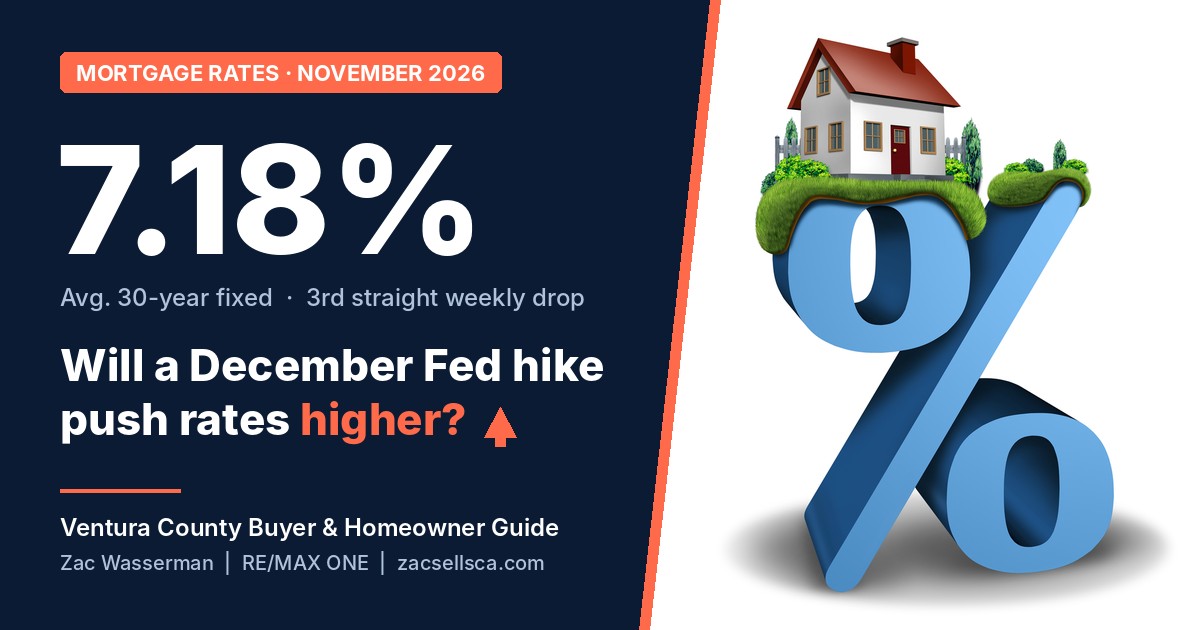
Mortgage Rates November 2026: Will a December Fed Hike Push Ventura County Rates Higher? VENTURA COUNTY MORTGAGE RATE UPDATE |...
California Prop 37 and Prop 1 Passed: What They Mean for Ventura County & LA Homebuyers California voters sent a...
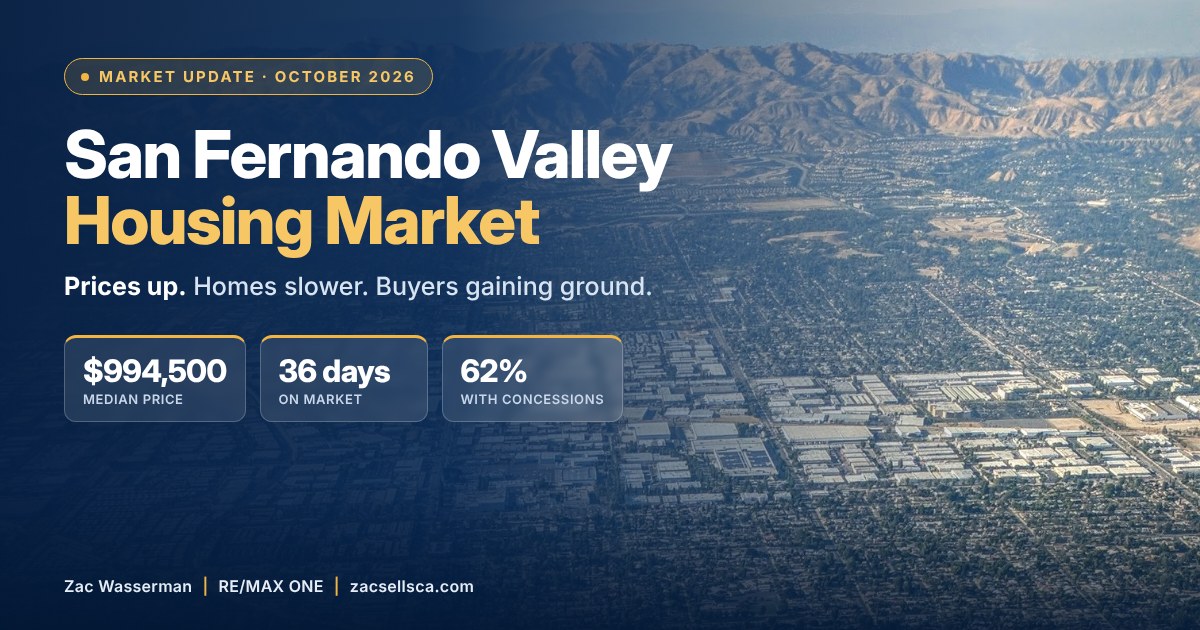
The San Fernando Valley housing market sent mixed signals in October 2026: the median rose to $994,500, but homes took...
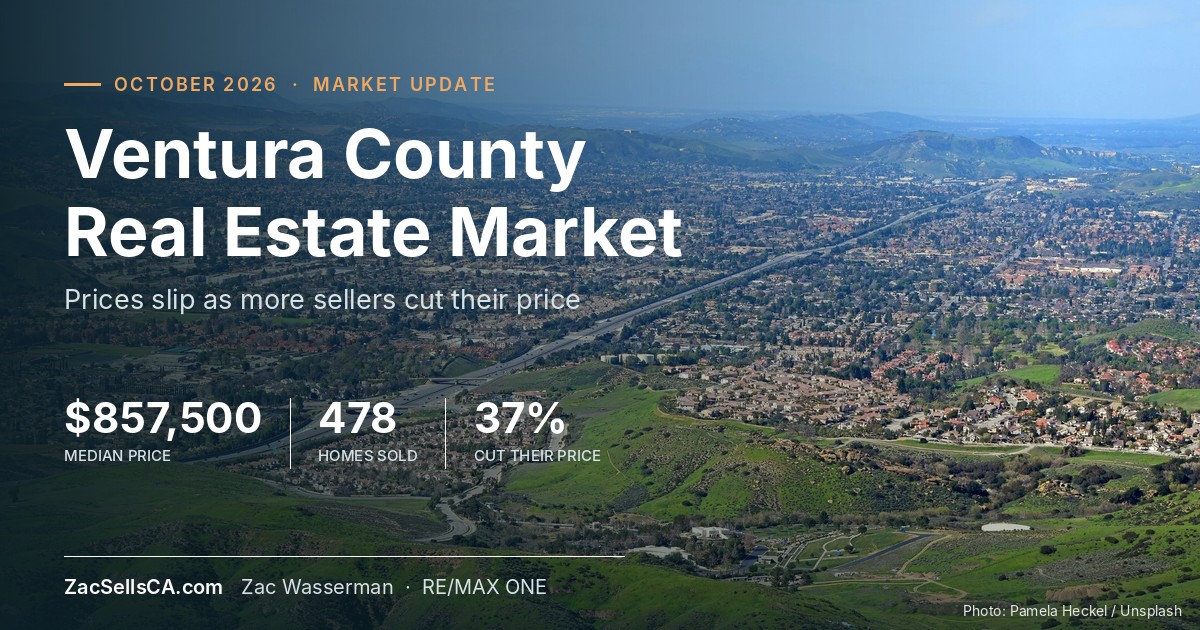
The Ventura County real estate market cooled in October 2026: 478 homes closed at an $857,500 median, down 2% from...
Moving to the San Fernando Valley: Your 2026 Relocation Guide Moving to the San Fernando Valley: Your 2026 Relocation Guide...
Studio City real estate by the numbers: a $2.1M median house, $797K condo, and 29 days on market, based on...