
How Much House Can I Afford in Ventura County in 2026?

If you are trying to answer the question, how much house can I afford in Ventura County, you are asking the right question. Ventura County is expensive, and buyers who focus only on list price usually miss the bigger picture. The better way to look at affordability is through monthly payment, debt-to-income ratio, down payment, and total cash needed to close.
Right now, Ventura County home values still put pressure on first-time buyers, move-up buyers, and even well-qualified households. A median sale price in the mid-$800,000s means many buyers need a clear framework before they start touring homes. If you want a personalized number based on your income and debts, call Zac Wasserman at 805.212.9147 — he’ll run the numbers with you for free.
Importantly, this guide is built around real-world assumptions, not wishful thinking. The payment examples below use a 30-year fixed mortgage rate of 6.00%, 10% down, estimated property taxes, and estimated insurance. In other words, this article is designed to give you a practical starting point for how much house can I afford in Ventura County, not a vague internet answer that ignores the local market.
Additionally, if you want more context on pricing, inventory, and buyer leverage, you can review the Ventura County real estate market update, the current Ventura County market conditions, and the latest read on Ventura County median home prices. Those pages help explain why payment strategy matters so much in this market.
What the Numbers Look Like in Ventura County Right Now
Ventura County continues to be a high-cost market by most buyer standards. Therefore, affordability here is different from affordability in many other parts of California. A buyer with solid income can still feel squeezed because purchase price is only one part of the equation. Taxes, insurance, rate movement, and existing debt all shape the real answer to how much house can I afford in Ventura County.
As a practical benchmark, many Ventura County buyers are shopping in a market where single-family pricing often lands in the low-to-mid $800,000s and above. That means buyers looking at entry-level detached homes, especially in more established neighborhoods, often need a stronger payment strategy than they expected. In addition, condo and townhome options may improve the monthly number, but HOA dues can offset part of that savings.
For financing structure, one of the key local numbers is the 2026 conforming limit. The Ventura County one-unit conforming loan limit is $1,035,000, which matters because it can keep qualified buyers in conforming or high-balance conforming territory rather than forcing them into jumbo rules too early. To clarify the current thresholds, review 2026 conforming loan limits for Ventura County.
Meanwhile, affordability should also include closing costs and insurance. Many buyers spend so much time asking how much house can I afford in Ventura County that they forget about cash-to-close. Before you lock a budget, it helps to understand closing costs in Ventura County and likely home insurance costs in Ventura County, especially if you are comparing neighborhoods with different fire or property-risk profiles.
How Lenders Determine What You Can Afford (DTI Explained)
When lenders evaluate how much house can I afford in Ventura County, they are not starting with the home you want. They are starting with your ratios. Specifically, they look at your gross monthly income, your existing monthly debts, your estimated housing payment, your credit profile, and your available assets.
The first ratio is usually called the front-end debt-to-income ratio. In plain language, that means the percentage of your gross monthly income that would go toward housing only. Housing usually includes principal, interest, property taxes, homeowners insurance, and sometimes HOA dues. As a general rule, many buyers feel best when that housing-only number lands around 28% to 31% of gross monthly income. That is not a hard law, but it is a useful target.
The second ratio is the back-end debt-to-income ratio, or total DTI. That number includes your full housing payment plus recurring debts such as car loans, student loans, minimum credit card payments, and personal loans. Conventional financing often targets something around 43% to 45% on the back end, although approvals depend on the whole file. FHA financing can sometimes stretch more with compensating factors, but higher ratios usually mean less margin for error.
In other words, the question is not simply how much house can I afford in Ventura County. The more accurate question is: how much monthly payment can I support while still fitting underwriting rules and staying comfortable in real life? That distinction matters. A lender may approve a payment that feels tight to you personally, so smart buyers should always compare maximum approval to practical affordability.
Furthermore, DTI is why two buyers with the same income can have very different buying power. One buyer may have no car payment and low recurring obligations. Another buyer may have a student loan, a truck payment, and revolving debt. As a result, their answers to how much house can I afford in Ventura County can be dramatically different even before credit score and down payment are considered.
Ventura County Mortgage Payment Examples by Price Range
Below are realistic payment examples using a 6.00% 30-year fixed rate with 10% down. Additionally, these examples use estimated property taxes at roughly 1.10% annually and estimated homeowners insurance at roughly 0.30% annually. HOA dues are not included, and actual taxes, insurance, and loan-level pricing will vary by property and borrower profile.
For example, a buyer looking at $800,000 may feel fine about the down payment but still be surprised by the total monthly number. Therefore, when buyers ask how much house can I afford in Ventura County, they should build the conversation around total payment, not only around qualifying loan amount. A home that is technically approved can still feel too aggressive once taxes, insurance, utilities, and savings goals are considered.
That said, these examples are useful because they make the market more concrete. A $500,000 purchase and a $1,000,000 purchase are not just separated by list price. They represent very different monthly obligations and, therefore, very different lifestyle tradeoffs. Additionally, if you are comparing Ventura County to nearby alternatives, you may also want to read how much house can I afford in Los Angeles and the broader 2026 Southern California housing market forecast.
How Much Income Do You Need to Buy in Ventura County?
The next step after payment is income. Specifically, if we assume a 43% back-end DTI limit and $500 per month in existing recurring debt, the table below shows the gross annual income needed for each price point above. Again, these are examples, but they provide a practical answer to how much house can I afford in Ventura County under common underwriting assumptions.
As a result, many Ventura County buyers realize that the income needed is higher than expected, especially once taxes and insurance are added. A household making roughly $160,000 may be able to support an $800,000 example under these assumptions. However, a slightly lower rate, lower taxes, or less existing debt can improve that number. On the other hand, HOA dues, larger monthly debts, or a tougher insurance quote can pull affordability down quickly.
Importantly, this is why the question how much house can I afford in Ventura County should always be paired with “what monthly payment do I want to live with?” Approval and comfort are not always the same thing. Some buyers intentionally stay below the top of their range so they can keep cash reserves, invest elsewhere, or avoid becoming house-rich and cash-poor.
Down Payment Options for Ventura County Buyers in 2026
Down payment is one of the biggest variables in affordability. Therefore, buyers who feel boxed out should not assume they need 20% down to compete. Conventional financing can work with far less, and FHA financing can allow as little as 3.5% down for qualified buyers. Additionally, buyers who compare down payment options early often discover more flexibility than they expected once seller credits, reserves, and closing costs are factored into the full picture. In addition, some buyers may qualify for down payment help through CalHFA-style programs or other assistance options.
That matters because the answer to how much house can I afford in Ventura County changes when your cash-to-close strategy changes. A buyer with enough money for 10% down on an $800,000 home may feel strong. However, another buyer may choose a lower down payment structure, preserve reserves, and keep more flexibility after closing. There is no universal best answer. The right approach depends on payment comfort, rate pricing, reserves, and how competitive the property is.
For instance, buyers who want to compare program rules should review FHA loan limits in Ventura County. They should also weigh the full cost picture, because lower down payment can mean mortgage insurance or higher monthly cost even if it helps you get into the market sooner. That said, if your long-term goal is ownership in Ventura County, getting the financing structure right matters more than chasing a single generic down payment rule.
How Loan Type Affects What You Can Afford (FHA vs. Conventional)
Loan type has a major effect on payment, approval flexibility, and cash needed at closing. Conventional financing often works well for buyers with stronger credit, cleaner debt profiles, and a desire to avoid long-term FHA mortgage insurance. FHA financing, on the other hand, can help buyers who need more flexibility on credit or down payment. Importantly, loan choice can change both your approval ceiling and your monthly comfort level even when the purchase price stays the same. Therefore, loan type directly changes the real answer to how much house can I afford in Ventura County.
Conventional loans can be attractive because they may offer competitive pricing and greater flexibility for borrowers who fit standard guidelines. In addition, once you understand the Ventura County conforming thresholds, you can plan whether your target purchase falls within conforming or high-balance conforming territory. That matters because pricing and documentation can shift as loan size rises.
Meanwhile, FHA loans can be a smart bridge for buyers who can handle the monthly payment but need a lower cash entry point. However, buyers still need to compare the total payment, including mortgage insurance. For that reason, affordability should always be measured against actual monthly cost, not just against whichever loan program makes the minimum down payment look easiest.
Ultimately, the best buyers do not ask only how much house can I afford in Ventura County. They also ask which financing structure gets them into the market with the strongest overall position. Sometimes that means lower down and more flexibility. Other times, it means more money down, lower monthly payment, and cleaner long-term economics.
Ventura County Affordability by City: Where Does Your Budget Go Further?
City selection can change your affordability more than buyers expect. In contrast to broad county averages, neighborhood-level reality matters. A budget that feels stretched in one city may go much further in another. Therefore, anyone seriously asking how much house can I afford in Ventura County should compare cities, not just properties.
Camarillo often appeals to buyers who want a balance of suburban feel, access, and relative value compared with some higher-priced pockets nearby. If that area is on your list, review Camarillo real estate for a more targeted look. Thousand Oaks and Westlake Village, meanwhile, tend to command stronger pricing in many segments because of location, product type, and buyer demand. As a result, the same monthly budget may buy less square footage or require tradeoffs on lot, condition, or location.
Oxnard can sometimes present more approachable opportunities depending on neighborhood and property type, although insurance, condition, and proximity factors still matter. Ventura often attracts buyers who value coastal lifestyle, but that lifestyle premium can show up in pricing and monthly ownership costs. Simi Valley may offer different value dynamics and can be attractive for buyers prioritizing house-to-payment ratio over coastal proximity.
Moorpark can sit in an interesting middle zone for many buyers. Specifically, it may offer more value than the highest-priced neighboring pockets while still drawing buyers who want a strong community feel and commuter access. Westlake Village, by contrast, usually pushes higher on the pricing spectrum, so buyers looking there often need either more income, more down payment, or more flexibility on housing preferences.
The point is simple: how much house can I afford in Ventura County is partly a city question. A buyer with a fixed payment cap may need to decide between detached versus attached, remodeled versus cosmetic, or premium city versus more flexible city. Not sure which city fits your budget? Zac Wasserman helps buyers find the right fit in Ventura County every day — call 805.212.9147 or email zacsellsca@gmail.com.
What Today's Rates Mean for Your Buying Power
Rate movement matters because even a small change can meaningfully shift your monthly payment. For this article, the payment examples use 6.00%. However, buyers should understand how sensitive affordability is to even a half-point swing. That is one more reason the question how much house can I afford in Ventura County should be revisited whenever rates move.
On an $800,000 purchase with 10% down, the loan amount is $720,000. At 6.00%, estimated principal and interest is about $4,317 per month. If that rate drops to 5.50%, estimated principal and interest falls to about $4,088. That is roughly $229 less per month before taxes and insurance. On the other hand, if the rate rises to 6.50%, estimated principal and interest jumps to about $4,551. That is roughly $234 more per month than the 6.00% example.
In fact, that small half-point shift can be the difference between feeling comfortable and feeling stretched. Therefore, buyers who are serious about how much house can I afford in Ventura County should watch rates, not obsess over them. Waiting forever for a perfect rate usually does not work. Instead, the better move is to understand your payment range, structure the loan correctly, and stay ready when the right property appears.
Tips to Stretch Your Budget in Ventura County's Market
There are practical ways to improve buying power without forcing the numbers. First, reduce recurring monthly debt where possible. A lower car payment or lower revolving debt can immediately improve DTI. Second, compare multiple financing structures instead of locking yourself into one assumption. Third, widen your city or property-type search just enough to create better options.
Additionally, buyers who want to stretch their budget should think in terms of total ownership strategy. For example, a slightly smaller home in a more favorable payment position can create flexibility for future moves, renovations, or savings. Meanwhile, a home with a lower HOA or lower insurance burden may outperform a superficially cheaper property with hidden monthly drag. Buyers who stay current on the Ventura County housing market outlook are better positioned to move when the right property appears.
Another smart move is to get clear on timing and preparation. Buyers who already understand how much house can I afford in Ventura County before they start touring are able to move faster and negotiate from a calmer position. They are not guessing. They know the payment they want, the cash they have, and the loan structure that makes sense.
Furthermore, if you are already a homeowner, part of the affordability conversation may involve your existing equity. In that case, it can help to get your free home valuation so you can measure your next-step buying power more accurately. That is especially useful for move-up buyers who want to trade into a better location, larger home, or stronger long-term fit.
Finally, if you want a more personal breakdown of how much house can I afford in Ventura County, the fastest next step is not more scrolling. It is a real numbers conversation based on your income, debts, cash, and goals. You can also contact Zac Wasserman directly to start that process.
Frequently Asked Questions: Affordability in Ventura County 2026
How much house can I afford in Ventura County in 2026?
The answer depends on your income, debts, down payment, credit profile, taxes, insurance, and mortgage rate. Therefore, the best way to answer how much house can I afford in Ventura County is to start with total monthly payment, not just target price. Using the examples in this article, a buyer with modest existing debt and strong income may find that $650,000, $800,000, and $1,000,000 each create very different affordability profiles.
What is the income needed to buy a house in Ventura County?
That depends on the purchase price and the rest of your file. For instance, under the assumptions used here, a $500,000 example lands around $105,525 in annual gross income needed, while an $800,000 example lands around $160,468. However, real-world results vary based on taxes, insurance, HOA dues, rate pricing, and other debts.
What is the debt-to-income ratio for buying a home in California?
Many buyers aim for a front-end ratio around 28% to 31% for housing only and a back-end ratio around 43% to 45% for total monthly debt. That said, exact limits depend on loan type, lender overlays, reserves, and the strength of the overall file. Therefore, DTI is one of the biggest drivers behind how much house can I afford in Ventura County.
Are there down payment assistance programs for Ventura County buyers?
Yes. Some buyers may qualify for state or local assistance options, including programs associated with CalHFA. In addition, FHA financing can help buyers who need a lower down payment entry point. However, assistance eligibility and loan structure should always be reviewed together, because the right program is not only about getting in — it is also about sustaining the payment comfortably.
What is the conforming loan limit for Ventura County in 2026?
The 2026 one-unit conforming loan limit for Ventura County is $1,035,000. That number matters because it shapes whether your target financing stays within conforming or high-balance conforming guidelines. For broader affordability context, you can also review National Association of Realtors affordability data, the California Association of Realtors housing report, the CFPB mortgage guide for homebuyers, and U.S. Census Bureau income data.
If you’ve been asking yourself how much house can I afford in Ventura County, the next step is a 15-minute conversation. Zac Wasserman is a licensed REALTOR® with RE/MAX ONE serving buyers across Ventura and LA County. Call or text 805.212.9147, email zacsellsca@gmail.com, or visit zacsellsca.com to get started today. There’s no obligation — just clarity on your numbers.
- All Posts
- Buyer Guides
- California Home Insurance & Wildfire Risk
- Home Financing (Mortgage & Loan Guides)
- Market Updates & Forecasts
- Seller Guides
- Back
- Ventura County Real Estate Market Updates
- San Fernando Valley Real Estate Market Updates (Monthly): Prices, Inventory & Trends
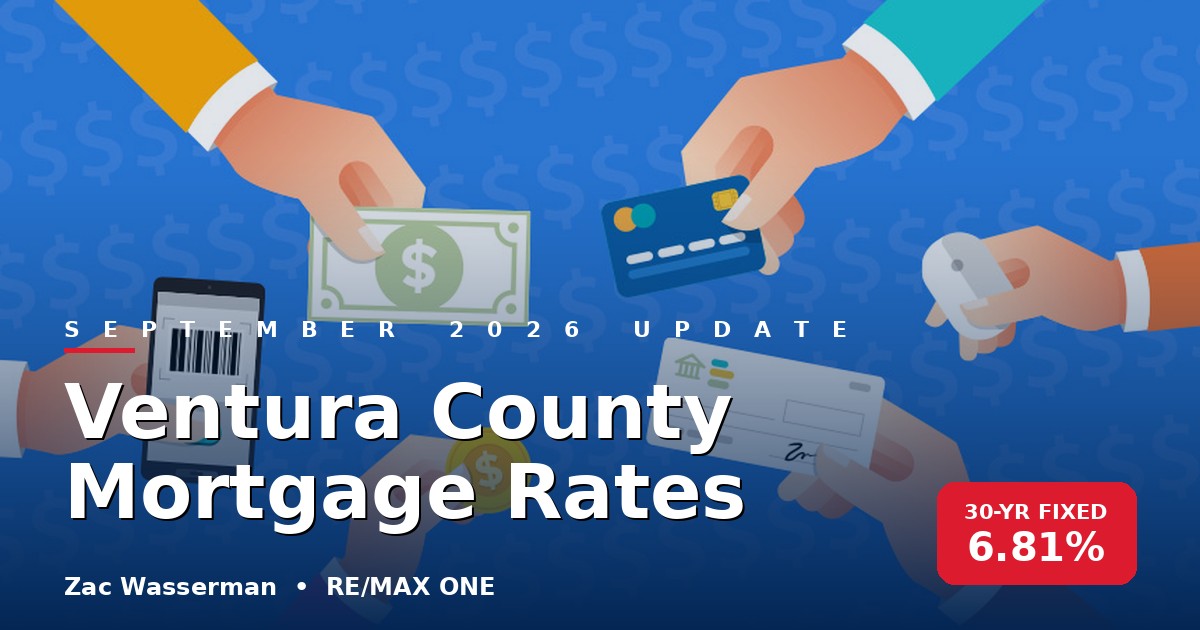
Ventura County Mortgage Rates: September 2026 Update September 2026 Mortgage Update Ventura County Mortgage Rates: September 2026 Update Rates have...

Can You Sell an ADU Separately in California? Your 2026 AB 1033 Guide for LA & Ventura County Sell an...
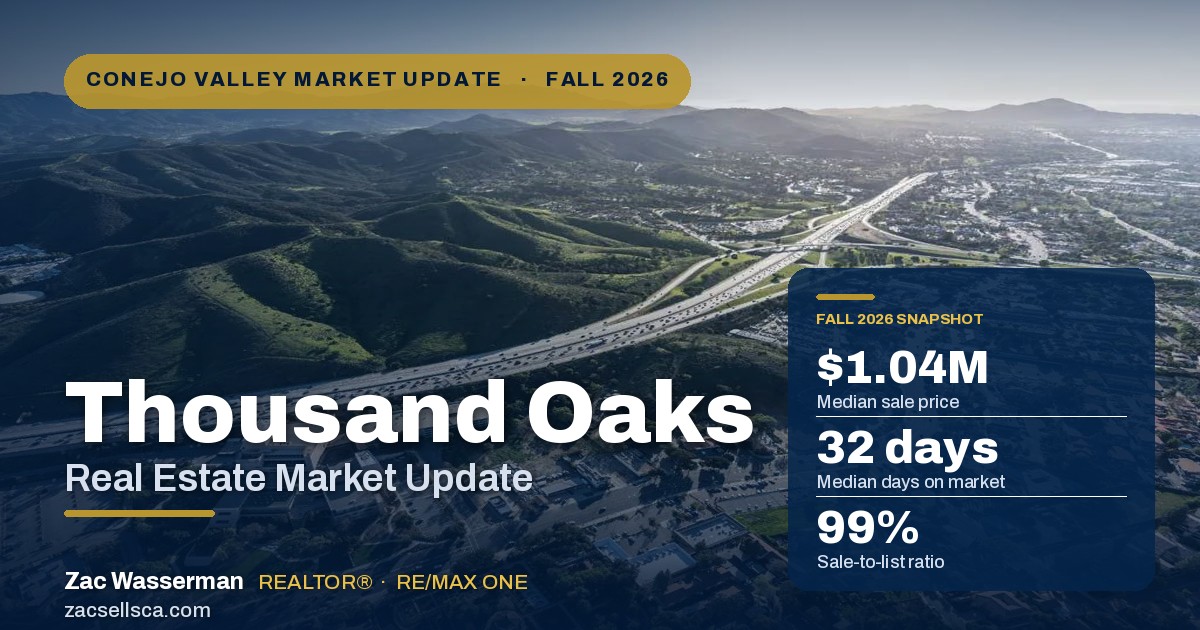
Conejo Valley Market Update · Fall 2026 Thousand Oaks Real Estate Market Update: Fall 2026 Prices remain firm, inventory is...
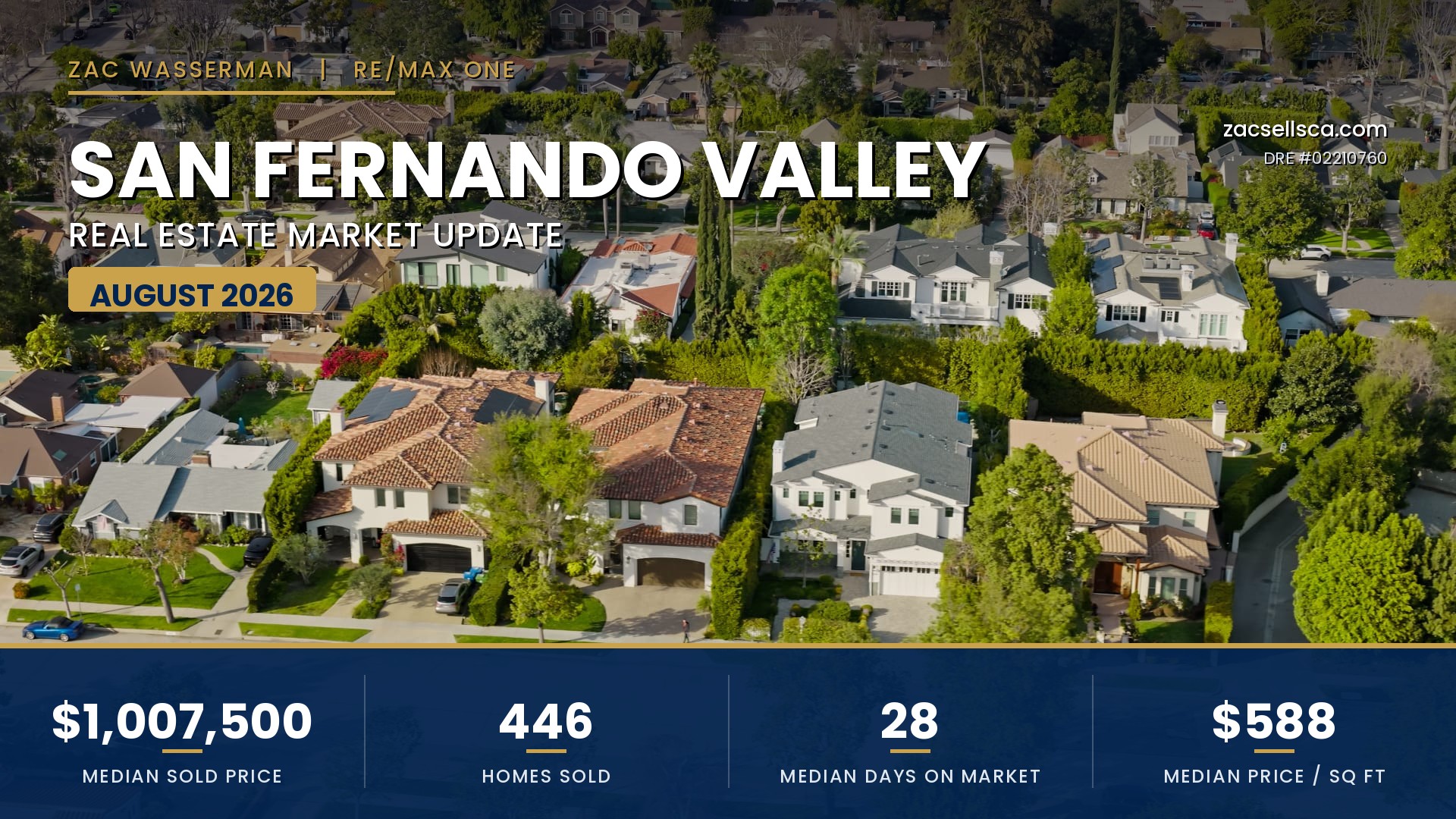
August 2026 • Local Market Report San Fernando Valley Housing Market Update: August 2026 Prices, Trends & City-by-City Data By...
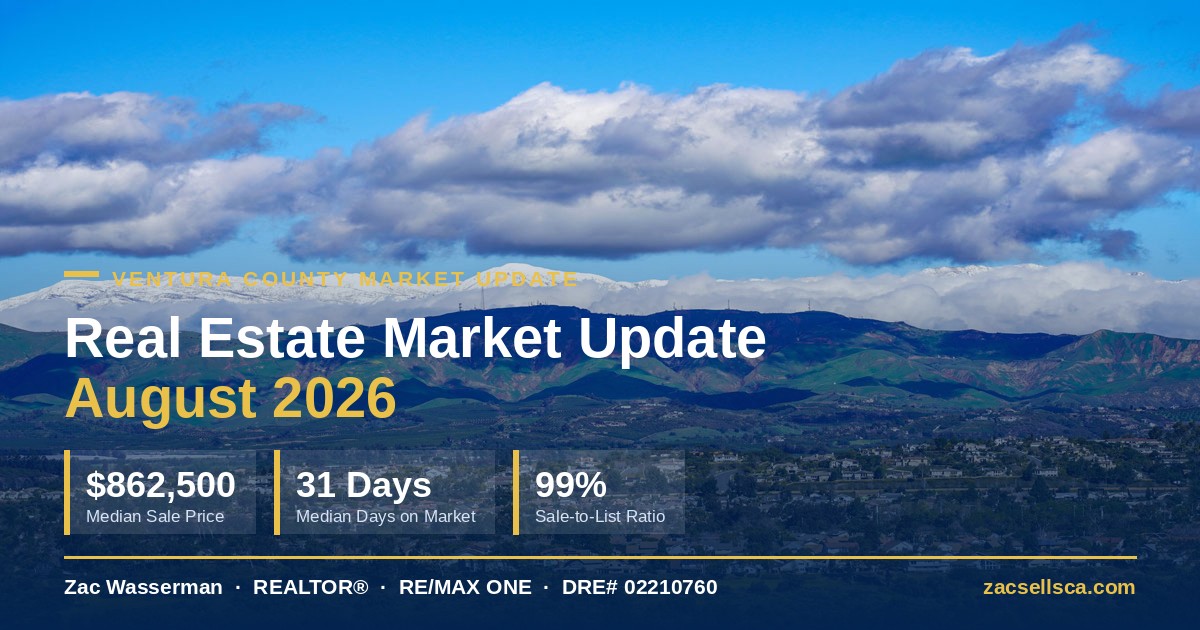
Ventura County Real Estate Market Update: August 2026 Ventura County Market Update — August 2026 Ventura County Real Estate Market...
Ventura County Real Estate Guide • 2026 Ventura County Foreclosures in 2026: How to Buy Smart or Sell Fast A...